New Smartphone Players are Capitalizing on India’s Affordable Price Segment
India’s smartphone market is becoming increasingly difficult to navigate, particularly at the lower end of the price spectrum, due to rising memory and component costs. The sub-INR 15,000 segment is already under pressure as margins are thin and consumers remain highly price-sensitive. However, the same challenges are also creating an opportunity for a new set of brands to enter the market.
Traditional smartphone brands have built their portfolios around certain minimum specifications and feature expectations. Moving too far below these standards risks affecting their brand positioning and consumer perception. As component costs rise, this leaves them with limited flexibility to reduce specifications or lower device costs. New brands have fewer such constraints. They can use older-generation or more cost-effective components across chipsets, memory, camera sensors and displays to build devices targeted specifically at price-sensitive consumers. While this may not allow them to compete directly with established brands on specifications, it can help them reach price points that are becoming increasingly difficult for larger OEMs to address profitably.
However, the opportunity is largely concentrated at the affordable and mid-end price segment of the market. New brands are unlikely to make a significant push into the premium segment in the near term, where purchase decisions are more closely tied to brand trust, product reliability, ecosystem integration and perceived brand value. These are areas where established players have a significant advantage and where newer brands will need time to build credibility.
The revival of Indian smartphone brands had already started in 2025, with new players entering the market across price segments. AI+ entered the entry-level segment around mid-year, while Wobble entered the mid-range segment toward the end of the year. However, their early performance has been mixed. Wobble has so far had limited impact on the broader Indian smartphone market, while AI+ has gained decent traction and recently emerged as a leading player in its price segment.
Before the arrival of these new entrants, Lava was the only major Indian smartphone brand with a substantial presence in the market. Despite the increased competition, Lava has managed to hold its ground, highlighting the importance of established brands, distribution network and consumer trust in a market where price competition is intense.
New Entrant Smartphone Launches: Pricing Timeline
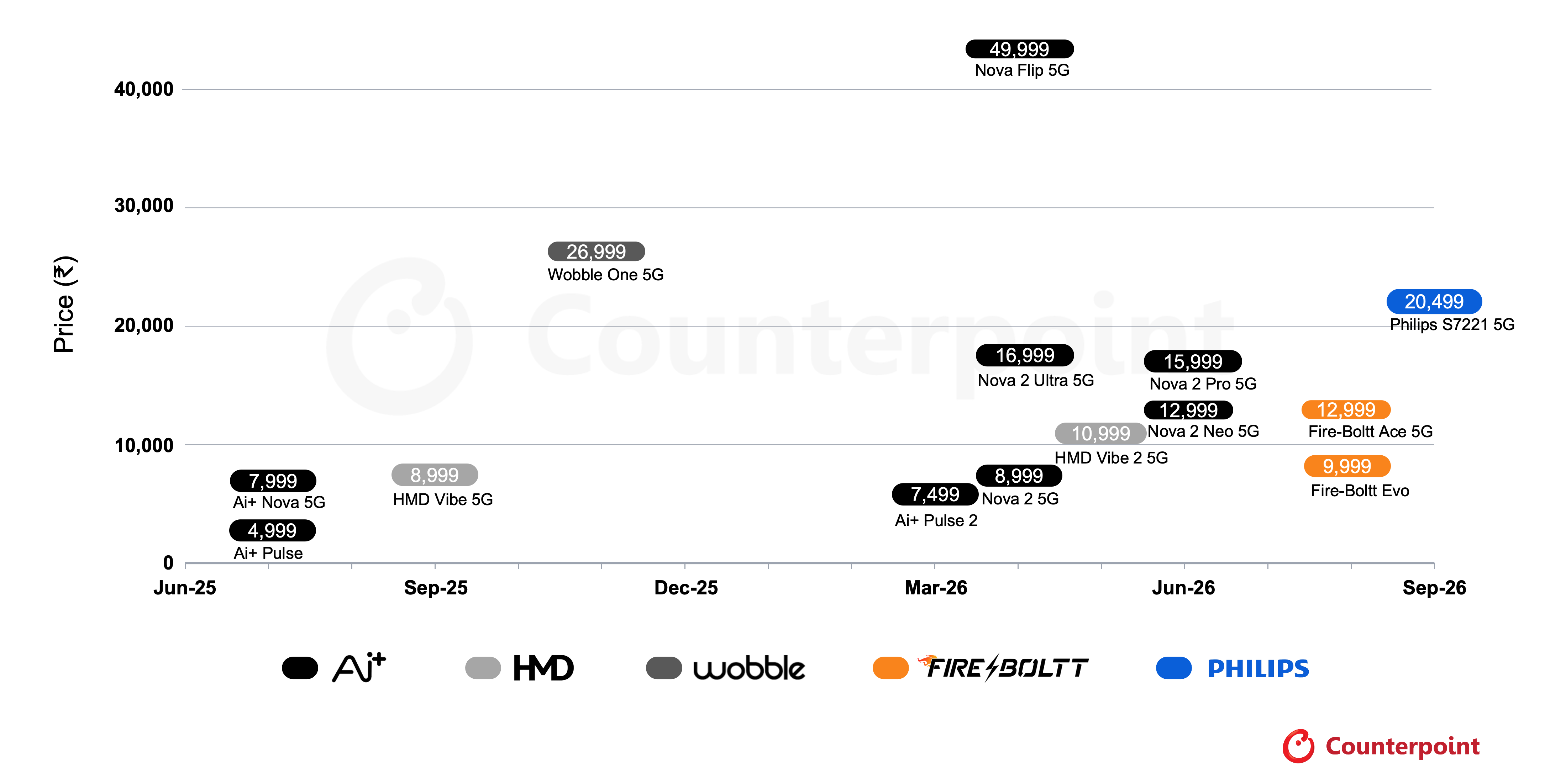
New upcoming smartphone brands like Boltt and Mivi have already established themselves in other consumer electronics categories. They are now considering smartphones as the next avenue for growth. Their existing presence in products such as smartwatches, TWS and other connected devices gives them a starting point that many new smartphone entrants would not otherwise have. They can leverage existing brand awareness, consumer relationships and marketing networks to introduce smartphones without building a consumer base from scratch. This has been showcased by the recent launch of Boltt smartphones on Flipkart which sold out on day one on the back of strong consumer demand. The opportunity exists because demand for affordable and value for money smartphones has not disappeared even as the economics of serving the segment have become more challenging. The challenge is increasingly on the supply side, as higher memory and component costs make it harder for established brands to maintain attractive price points. This creates an interesting distinction between established OEMs and new entrants.
Other established brands such as Philips and HMD, along with expected model launches from Karbonn are also making a push into the Indian smartphone market. These brands are looking to capitalize on the opportunities created by the evolving market landscape. Their existing brand recognition, particularly among older consumers and in smaller cities, gives them an advantage over relatively unknown new entrants. Additionally, their established feature-phone presence and distribution networks can provide a strong foundation for expanding their smartphone businesses, particularly through the offline channel.
The route to market is another advantage. Most of these new brands are relying on online channels, allowing them to reach consumers without the cost and complexity associated with building a large offline distribution network. A primarily online strategy also provides greater flexibility to test products, manage inventory and adjust pricing based on consumer response.
India has successfully built a large-scale smartphone manufacturing ecosystem, but historically the value captured by Indian-owned brands and smaller domestic companies has been limited. The new INR 62,500 crore Mobile Phone Manufacturing Scheme (MPMS), launched in 2026, is explicitly trying to address this by supporting not just manufacturing but also Indian brands, domestic sourcing, design and R&D. The ecosystem of contract manufacturers, component suppliers and established distribution networks is lowering entry barriers for smaller Indian brands.
The emergence of these new brands does not necessarily signal an immediate threat to the leading smartphone OEMs. Rather, it points to a new competitive layer forming at the bottom of the market. If memory costs remain elevated and established brands continue to prioritize higher-value segments, the affordable smartphone market could increasingly become a ground for smaller Indian and consumer electronics brands looking to build a presence in smartphones. The past experiences of brands such as Micromax and Karbonn in India’s smartphone market also offer an important lesson for the new players. Their earlier success demonstrated that aggressive pricing could help brands gain initial traction, but price-led growth alone is difficult to sustain over the long term. For the new Indian brands to build a lasting presence, they will need to go beyond affordability and offer a combination of competitive pricing, clean software, reliable products, strong after-sales service and a differentiated consumer proposition, with a strong focus on R&D and designing products in India. The ability to build consumer trust and a sustainable distribution and service ecosystem will ultimately determine whether these new entrants can establish themselves as long-term players in India's smartphone market.
Category
Industry
Smartphone
Service
Standard
Report Type
Report
Time Period
Other
Receive our insightful weekly newsletter and stay ahead of the competition.
Author
Shubham Nimkar


Shubham Nimkar closely tracks the Indian Smartphone market. With a background in social media marketing and degrees in Electronics & Telecommunication and MBA Marketing from BIMTECH, Greater Noida, he operates from Navi Mumbai. He has more than 2 years of experience working on India and Vietnam Smartphone market.