- Global smartphone SoC shipments declined 15% YoY in H1 2026, driven by soaring memory prices.
- MediaTek and Qualcomm’s shipments fell more than 25% YoY, while Apple, Samsung, Google and UNISOC gained market share, though for different reasons each.
- Smartphone memory prices surged 300% YoY in Q2 2026, meaning memory costs surpassed SoC costs in all smartphone segments.
- Despite rising costs, GenAI smartphone SoC shipments grew 24% YoY, fueled by consumer demand for AI features and the sustained premiumization trend.
- Global smartphone SoC shipments are expected to decline by 14% YoY in 2026, with entry-level shipments set to fall more than 30% YoY. The ongoing memory supply shortage is expected to persist until H2 2027.
Beijing, Berlin, Buenos Aires, Fort Collins, Hong Kong, London, New Delhi, Seoul, Taipei, Tokyo –July 29, 2026
Global smartphone SoC shipments declined by 15% YoY in H1 2026, hurt by rising memory costs, cautious inventory management by smartphone OEMs and a longer replacement cycle, according to Counterpoint Research’s latest Global Smartphone SoC Shipments Preliminary View report.
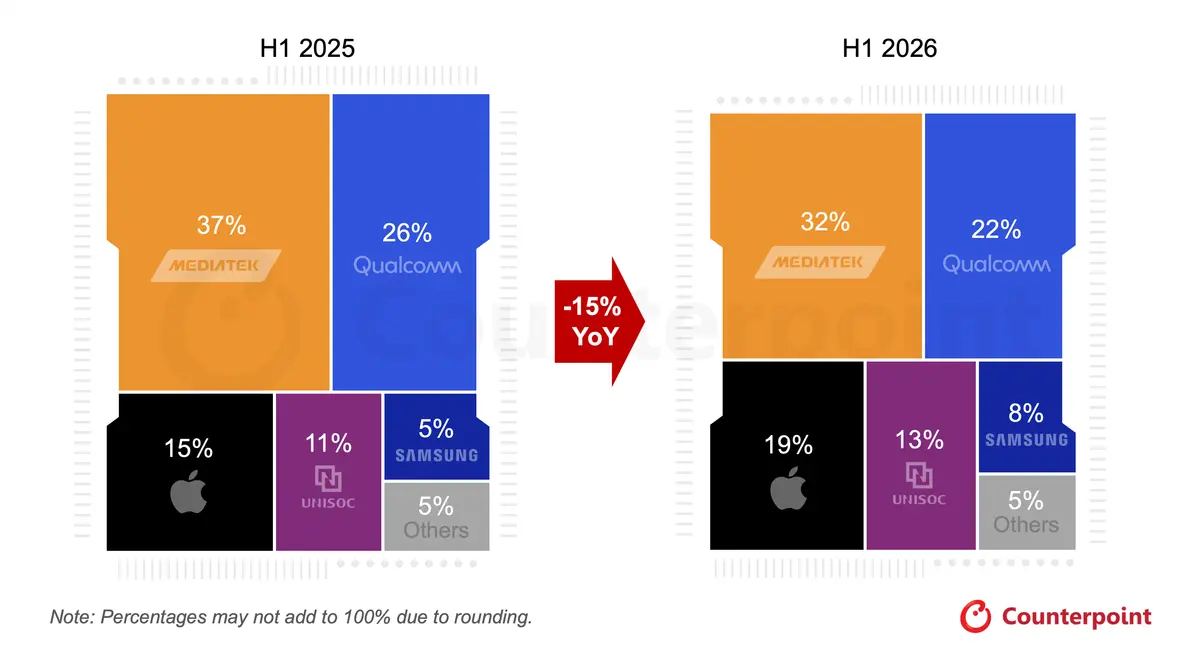
MediaTek and Qualcomm’s shipments declined by more than 25% YoY in H1 2026. Meanwhile, Apple, Samsung, Google and UNISOC posted sturdy shipment growth during the period, each for distinct reasons detailed below.
Commenting on the smartphone SoC player dynamics, Senior Analyst Shivani Parashar said, “Apple’s market share increased by 4% in H1 2026 from H1 2025, driven by the impressive performance of the iPhone 17 series. Qualcomm and MediaTek, on the other hand, lost share, although for different reasons. Qualcomm’s premium segment saw limited growth, as the Samsung Galaxy S26 series adopted both the Snapdragon 8 Elite Gen 5 and Samsung’s own Exynos 2600 – unlike its predecessor, which ran entirely on Qualcomm silicon. Softer sales of the Xiaomi 17 series added further pressure on Qualcomm’s premium shipments. Meanwhile, MediaTek took a hit in its low-end and entry-level 5G chipsets from the ongoing memory crisis, although its premium 9500 series is performing well on the back of design wins with vivo, OPPO, Pocophone and Redmi.”
Parashar added, “Many entry-level smartphone models are migrating to UNISOC’s 4G platforms in efforts to reduce BoM costs, helping UNISOC achieve growth in H1 2026. Additionally, UNISOC is making significant progress in 5G adoption through partnerships with Pocophone and Redmi.”
Global Smartphone SoC Shipments Share by Vendor, H1 2025 vs H1 2026
Smartphone memory prices skyrocketed more than 300% YoY in Q2 2026, prompting OEMs to aggressively secure long-term supply contracts – either to navigate the shortage or to capitalize on it and gain share. Consequently, rising device costs are being driven primarily by memory pricing rather than hardware specification upgrades. Yet even against this cost pressure, GenAI smartphone SoC shipments grew by 24% YoY in H1 2026, as premiumization trends and rising consumer demand for AI features continued to lift shipments in the mid-high, premium and flagship price tiers.
Commenting on the smartphone SoC market outlook, Principal Analyst Soumen Mandal said, “Global smartphone SoC shipments are expected to decline by 14% YoY in 2026. The entry-level market is set to be the most severely affected with shipments likely to fall by more than 30% YoY this year. In H1 2026, smartphone memory costs surpassed SoC costs across all price segments and we do not expect the memory supply to normalize before H2 2027, which means the smartphone industry could experience another difficult year in 2027.”
About Counterpoint Research
Counterpoint Research is a global market research firm specializing in products across the technology ecosystem. We advise a diverse range of clients – from smartphone OEMs to chipmakers and channel players to Big Tech – through our offices located in the world's major innovation hubs, manufacturing clusters and commercial centers. Our analyst team, led by seasoned experts, engages with stakeholders across the enterprise – from the C-suite to professionals in strategy, analyst relations (AR), market intelligence (MI), business intelligence (BI), product and marketing – to deliver services spanning market data, industry thought leadership and consulting. Our core areas of coverage include AI, Automotive, Consumer Electronics, Displays, eSIM, IoT, Location Platforms, Macroeconomics, Manufacturing, Networks and Infrastructure, Semiconductors, Smartphones and Wearables. Visit our Insights page to explore our publicly available market data, insights and thought leadership, and to understand our focus, meet our analysts and start a conversation.


