Advancing Silicon Photonics: How Polariton Brings Marvell into the Plasmonic Era
- Marvell's acquisition of Polariton integrates Plasmonics into its Silicon Photonics portfolio addressing the bandwidth/speed limits of conventional silicon photonics.
- Technology promises major performance gains, enabling bandwidths beyond 3.2T at much lower power-per-bit while remaining manufacturable directly on existing SiPho platforms.
- Marvell is positioning this as a vertically integrated stack (Polariton's plasmonics + Marvell's DSPs and SiPho) to power scale-x architectures for a 6.4T AI connectivity era.
Marvell Technology acquired Polariton Technologies Ltd. to further innovate on its optical connectivity portfolio by integrating plasmonics into its Silicon Photonics (SiPho) light engines. This is going to be quite impactful as the Plasmonics era beckons.
Based on our understanding and deep dive into Silicon Photonics research for Interconnect and Networking at Counterpoint Research, we can outline the following benefits that Plasmonics promises for the industry and Marvell.
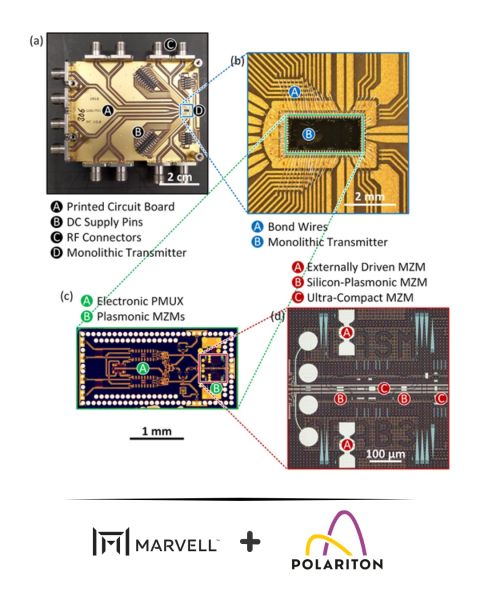
Exponential Performance
SiPho modulators, while highly scalable and cost-efficient, are fundamentally constrained by the physical properties of light modulation in silicon, limiting their ability to scale efficiently to higher bandwidths.
Plasmonic waveguides address these challenges by compressing light below the diffraction limit at a metal-dielectric interface.
Here the metal-dielectric channel is filled with an active Pockels material (LiNbO₃,BBO, BTO, DKDP, KTP, etc) integrated into SiPho devices or other photonic material system. Thus these waveguides can respond much faster to electrical signals, enabling much higher modulation rates than conventional photonic modulators.
Greater Bandwidth & Scaling
Also, Plasmonic modulators measure around 10 microns and can operate at up to 1 THz, delivering a 300x to 500x reduction in size and a 10x improvement in speed over conventional silicon photonics enabling higher bandwidths beyond 3.2T
Ultra-Low Power Efficiencies
These engines while support connectivity for 3.2T and beyond but they also operate at a fraction of the power-per-bit required by conventional optical modules. Making it super efficient at higher bandwidths.
Seamless Manufacturing
These structures are integrated directly onto the silicon photonics platform, enabling the industry to build on the extensive foundation already established with SiPho while incorporating the performance advantages of plasmonics.
Vision & Outlook
By combining Polariton's plasmonic modulation technology with its own existing DSPs and SiPho stack, Marvell is engineering vertically integrated optical engines. This ecosystem will power next-generation coherent ZR/ZR+ links, DCI and scale-across architectures accelerating the industry into 6.4T AI connectivity era. Marvell has built a strong portfolio to compete and co-exist with likes of NVIDIA, Broadcom and startups such as Credo.
Having said that, technology is still in the early days of development for commercialization and will require a good amount of work for high-scale manufacturing, testing and adoption.
Our Annual Silicon Photonics(SiPh) and Co-Packaged Optics(CPO) Report is set to be released this year:
The Annual Silicon Photonics and Co-Packaged Optics Report highlights how the rapid advancement of AI is driving explosive growth in demand for high speed, high capacity data transmission, outpacing the capabilities of traditional optical modules. Co-Packaged Optics (CPO) has emerged as a key solution, offering reduced loss, lower power consumption and high integration by shortening the distance between the switching chip and optical engine. Silicon Photonics (SiPh), the ideal technology for enabling CPO, is central to reshaping data center and networking infrastructure to meet growing bandwidth and energy efficiency needs. As a result, global optical communication transceiver revenue is projected to grow at a CAGR of 18.6% from 2025 to 2033.
Another relevant report is Scaling-Out AI Factories - Key Vendors and Technologies:
This research provides an overview of the main components of an AI data center’s scale-out network and highlights the key players - both big tech and start-ups - that the provide the crucial connectivity chips to enable high-performance rack-scale based AI computing across hundreds or thousands of racks.
Contact us to learn more about Counterpoint's Cloud AI Server Analysis Service, which tracks, forecasts, and analyzes key components of AI datacenter value chain from foundry, memory, compute, networking, interconnect, cooling, servers, racks, models to AI applications:
- Foundry and Node Tracker - maps out which chips built on advanced nodes (e.g., TSMC's 3nm/5nm) and tracks packaging constraints like CoWoS (Chip-on-Wafer-on-Substrate).
- CPU Tracker – deep dives into evolving role of CPU in the Agentic AI era from capabilities, competition to collaborations. From x86, Arm-based to RISC-V-based CPU shipments, revenues, penetration, vendor stratgegies and outlook.
- GPU Tracker – Tracking the proliferation, success metrics of GPGPUs from NVIDIA, AMD to rising China-based accelerator ecosystem. From the growing rack-scale deployments to
- XPU Accelerators Tracker – tracks the shift away from standard merchant GPUs (like Nvidia's) towards custom cloud chips. Includes shipments of Google’s TPUs, Amazon’s Trainium/Inferentia, Meta’s MTIA and Microsoft’s Maia chips. The expanding role of turnkey design houses such as Broadcom, Marvell, GUC, Alchip to new players such as MediaTek, Qualcomm. Tracking the new breed of accelerators from Groq to Cerebras or Rebellions to Qualcomm-based NPU deployments.
- High Bandwidth Memory (HBM) & DRAM Consumption & Outlook - tracks memory density, memory pricing, capacity, supply and generational transitions, such as the shift to HBM3E and beyond and the rising LPDDR content.
- Networking Components – provides qualitative and quantitative information, including forecasts, of key networking components such as switches, pluggable transceivers, CPO, NPO LPO, etc. and other data center networking components.
- Hyperscaler & ODM Dynamics - market share by CSPs such as AWS, Microsoft, Google, Meta and ODMs such as Foxconn, Quanta and Wistron building direct-to-cloud servers.
- Demand-Drivers: Important to track the key demand drivers from LLM to LBM/LAMs and how the demand is shifting from Generative to Agentic to Physical AI applications. The growth of AI models (OpenAI, Anthropic, Google, DeepSeek, etc), usage, proliferation across enterprises and consumers. The rise of on-Device AI.
Receive our insightful weekly newsletter and stay ahead of the competition.
Author
Neil Shah


Neil is a sought-after frequently-quoted Industry Analyst with a wide spectrum of rich multifunctional experience. He is a knowledgeable, adept, and accomplished strategist. In the last 18 years he has offered expert strategic advice that has been highly regarded across different industries especially in telecom. Prior to Counterpoint, Neil worked at Strategy Analytics as a Senior Analyst (Telecom). Neil also had an opportunity to work with Philips Electronics in multiple roles. He is also an IEEE Certified Wireless Professional with a Master of Science (Telecommunications & Business) from the University of Maryland, College Park, USA.