Q2 2026 Global Smartphone Shipments Slump to Lowest Q2 Level in 13 Years as Memory Crisis Deepens
- Global smartphone shipments fell 11% YoY in Q2 2026 reaching the lowest second-quarter levels since 2013 as the DRAM and NAND shortage intensified.
- Samsung reclaimed the global leadership position with a 24% market share, recording the strongest YoY growth among the top five brands, as pricing and competitive dynamics in certain regions worked in its favor.
- Apple's shipments grew 3% YoY in Q2 2026, with its Q2 shipment share reaching 20% for the first time, supported by strong demand for its premium iPhone lineup.
- Xiaomi, OPPO and vivo recorded the steepest declines among the top five OEMs as their wider exposure to memory-sensitive entry and mid-tier price bands weighed on volumes.
- The outlook for the rest of 2026 remains challenging.
Seoul, Beijing, Berlin, Buenos Aires, Fort Collins, Hong Kong, London, New Delhi, Taipei, Tokyo – July 13, 2026
Global smartphone shipments tumbled 11% YoY in Q2 2026, reaching the lowest second-quarter levels since 2013, according to preliminary estimates from Counterpoint Research's Market Monitor, as the memory shortage deepened and emerged as the dominant drag on the industry. DRAM and NAND prices continued to balloon through the quarter as memory suppliers kept prioritizing AI data center demand over consumer electronics, forcing OEMs to pass rising Bill of Materials (BOM) costs onto consumers via repeated price hikes, particularly on entry and mid-tier devices.
Commenting on the market dynamics, Senior Analyst Shilpi Jain said, "The global memory crisis has now overtaken every other factor as the single biggest drag on the smartphone industry. What started as a components issue last year is now a full-blown demand issue. The entry and mid-tier devices, which account for a majority of the world’s smartphone volumes and are the most exposed to BOM economics, become structurally unfeasible at previous price points. We see OEMs responded in different ways, some are increasing prices and accepting margin pressure, while others are extending the lifecycle of older-generation models and using promotions to retain budget-conscious buyers, and a few are simply pulling back on launches and production. Alongside the memory shortage, geopolitical tensions in the Middle East bumped up oil and shipping costs, further inflating smartphone prices. This coincided with a broader macro squeeze, slower global growth, higher inflation, and record-low consumer sentiment which hit price-sensitive buyers the hardest."
Top 5 Smartphone Brands Global Sell-in Shipment Share (Preliminary Data)
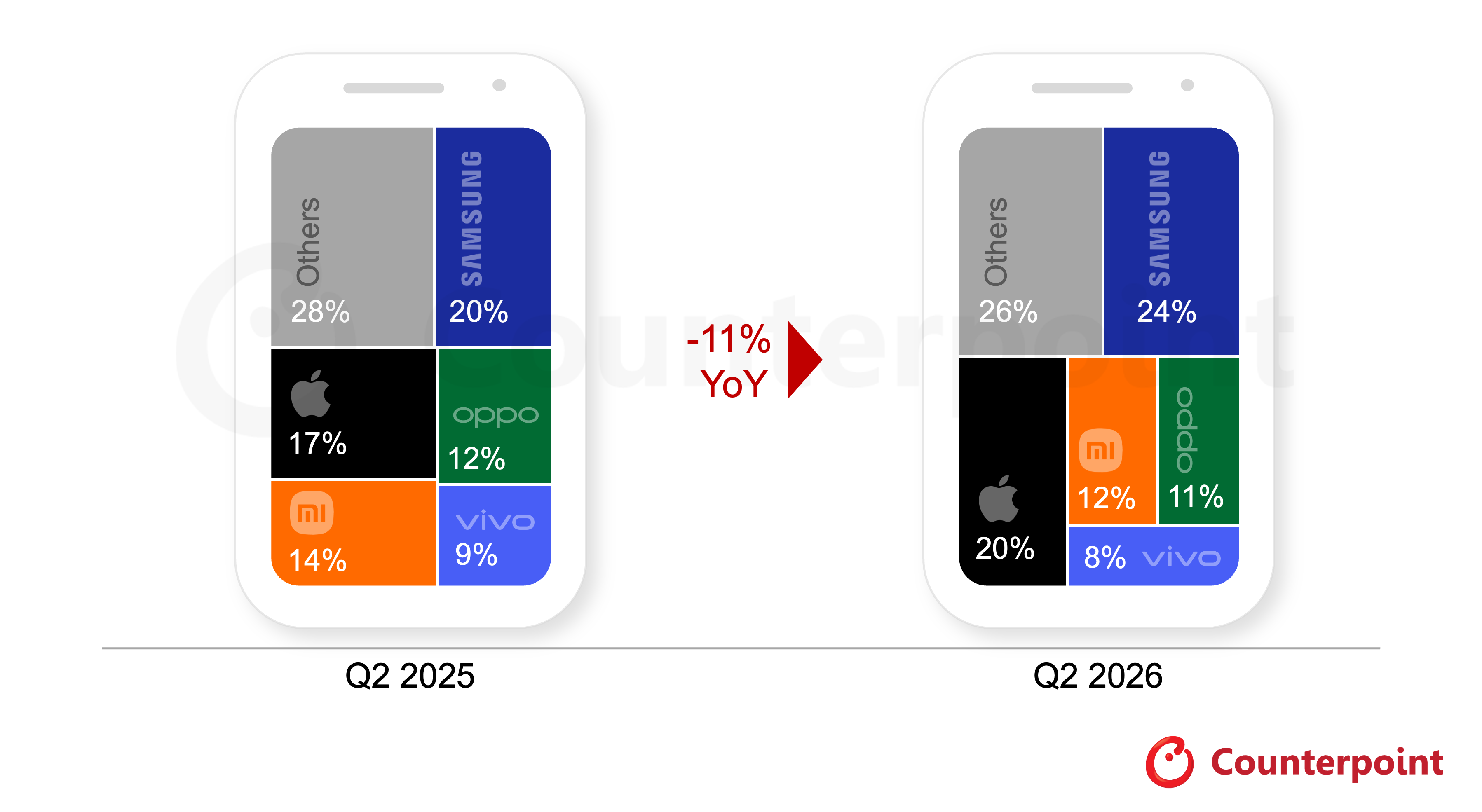
Notes: OPPO includes OnePlus and realme. Percentage totals may not add up to 100% due to rounding.
Samsung reclaimed its global No.1 position with a 24% share in Q2 2026 and recorded the strongest growth among top five brands. Samsung held up relatively well in India and the Middle East, supported by better product availability, fewer price hikes and aggressive summer promotions that complemented flagship momentum. Samsung’s Galaxy S26 series ramp-up drove overall shipment growth, with the Ultra variant emerging as the standout performer, driven by strong demand for its privacy display and AI features. Meanwhile, Samsung’s vertical integration, expanded AI portfolio, and refreshed product lineup helped sustain growth despite weaker demand in the entry and mid-range segments.
Apple’s shipments grew 3% YoY during the quarter, while its market share climbed to a record 20%. It was also the only major OEM to avoid smartphone price hikes during the quarter. This marks an extended streak of YoY growth for the brand, driven by the continued strength of the iPhone 17 series which remained the top-shipped global model, alongside resilient demand in several key markets. China remained a relative soft spot, with Apple's shipments declining YoY despite an early promotional campaign ahead of the 618-shopping festival, as this year's discounts were less aggressive than the promotions offered during the same period in 2025. Legacy iPhone models also faced softer demand, as component allocation prioritized current-generation devices amid memory-related supply constraints.
Xiaomi, OPPO and vivo each recorded double-digit percentage YoY shipment declines in Q2 2026 due to increased market volatility stemming from rising memory costs, which weighed on demand in the price-sensitive entry and mid-range segments. Considering their greater exposure to these tiers, all three brands were disproportionately affected as consumers delayed purchases, traded down to older-generation devices, or extended replacement cycles.
However, Xiaomi streamlined its portfolio and eased retailer financing terms to protect volumes, which helped it capture a 12% market share. At the same time, Xiaomi also witnessed some traction in the premium segment, led by the Redmi Note 15 series, Redmi K90 and Xiaomi 17 series. OPPO and vivo ranked fourth and fifth in the market in Q2 2026, capturing an 11% and 8% shipment share, respectively. vivo faced supply challenges and the recent price hikes pushed several of its key models out of their crucial price bands, weighing further on the brand’s shipments. OPPO faced softness across most of its key markets as demand remained weak. However, decent traction from its A-series and Reno lineups helped cushion the overall volume decline, though the brand continued to face pressure from the same entry-tier cost dynamics affecting the broader industry.
Meanwhile, beyond the top five brands, Google and Huawei witnessed significant shipments growth in Q2 2026, rising 16% and 6% YoY, respectively. Google's strong performance was driven by the Pixel 10 and 10a in key mature markets, while Huawei's growth was supported by the Mate 80 series, Nova 15, and the newly launched Enjoy 90 series.
The outlook for the rest of 2026 remains challenging. Counterpoint continues to expect global smartphone shipments to decline substantially, with the global memory shortage expected to persist in 2027. OEMs are likely to keep prioritizing value over volume, trimming low-margin models, pushing configuration and storage-tier adjustments, and leaning further into refurbished and previous-generation devices to retain budget-conscious buyers. Premiumization is expected to hold up relatively well throughout the remainder of the year, supported by financing, ecosystem loyalty and AI-led retail experiences. However, overall demand recovery is unlikely until memory supply conditions improve substantially.
About Counterpoint Research
Counterpoint Research is a global market research firm specializing in products across the technology ecosystem. We advise a diverse range of clients – from smartphone OEMs to chipmakers and channel players to Big Tech – through our offices located in the world's major innovation hubs, manufacturing clusters and commercial centers. Our analyst team, led by seasoned experts, engages with stakeholders across the enterprise – from the C-suite to professionals in strategy, analyst relations (AR), market intelligence (MI), business intelligence (BI), product and marketing – to deliver services spanning market data, industry thought leadership and consulting. Our core areas of coverage include AI, Automotive, Consumer Electronics, Displays, eSIM, IoT, Location Platforms, Macroeconomics, Manufacturing, Networks and Infrastructure, Semiconductors, Smartphones and Wearables. Visit our Insights page to explore our publicly available market data, insights and thought leadership, and to understand our focus, meet our analysts and start a conversation.
Follow Counterpoint Research
Receive our insightful weekly newsletter and stay ahead of the competition.
Author
Shilpi Jain

Shilpi is a Senior Analyst with Counterpoint Research, based out of Gurgaon. She has more than 9 years of work experience in consulting and market research field. She closely tracks mobile devices and ecosystem at Counterpoint and led various research and consulting projects. She holds a Master's in Business Administration from Fore School of Management, specializing in Finance, and a Bachelor's degree in Economics from Daulat Ram College, Delhi University.