

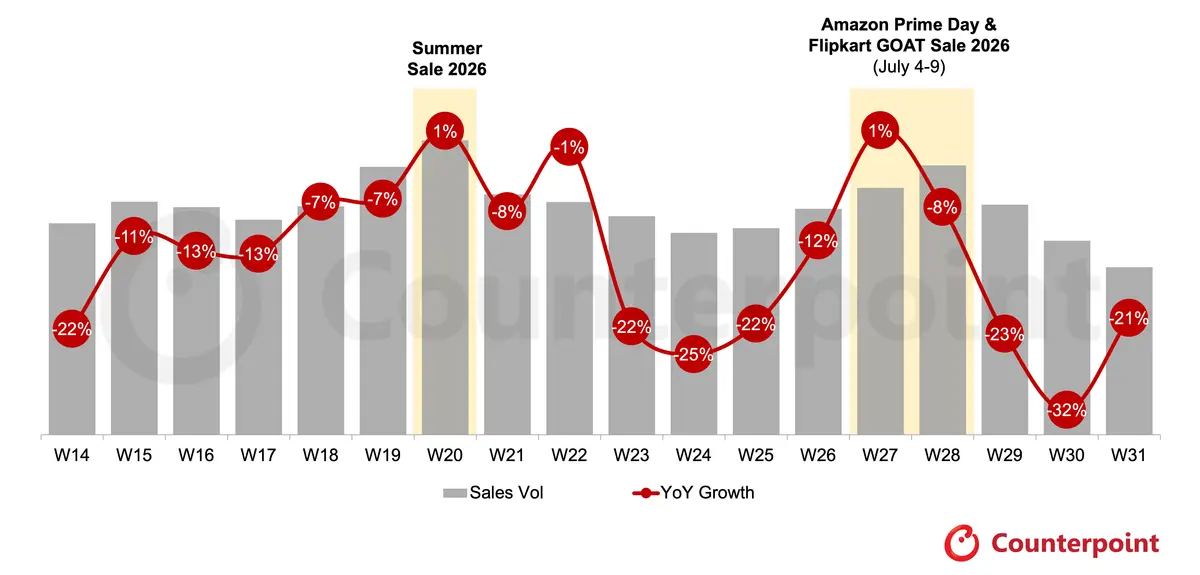
- Smartphone sales in India remained under pressure in April-July 2026, declining for three consecutive weeks following the July online sales events, highlighting the short-lived impact of major promotional events on demand.
- Only two weeks during W14-W31 recorded positive YoY growth, providing a temporary demand boost and highlighting consumer dependence on discounts and affordability schemes.
- At 15% YoY, Apple recorded the strongest growth during W14-W31, while OPPO and Samsung each grew 4% YoY, supported by portfolio performance, channel expansion and promotional offers.
- India’s smartphone market is expected to decline around 13% YoY in 2026, although the upcoming festive season, new launches and increased promotional activities around the festive period could support a better performance in H2 compared to H1.
Seoul, Beijing, Buenos Aires, Hong Kong, London, New Delhi, San Diego, Taipei, Tokyo – Aug 19, 2026
India’s smartphone market remained under pressure during April-July 2026, as continued price hikes and cautious consumer spending weighed on demand. According to Counterpoint Research’s India Weekly Smartphone Sellout Tracker, weekly sales during the period remained largely below year-ago levels, with major promotional events providing only temporary boosts to demand. Following Amazon Prime Day and Flipkart GOAT Sale in July, smartphone sales declined for three consecutive weeks as demand softened quickly after the promotional period ended, highlighting continued affordability pressure and consumers’ growing tendency to wait for attractive offers before making purchases.
Commenting on the market dynamics, Senior Analyst Prachir Singh said, “The India smartphone market continues to face demand pressure as rising device prices are making consumers increasingly value-conscious and more dependent on promotional offers. This trend has become more visible over the past few months, with sales seeing temporary spikes during major promotional events, followed by a sharp normalization once these offers end. Only two weeks, W20 and W27, recorded positive YoY growth during the period, supported by major sale events. The three-week decline following the July sales further indicates that these promotional events are largely pulling forward demand rather than creating sustained market momentum. Continued price hikes, particularly in the mass-market segments, with prices of affected models increasing by an average of around INR 3,200 during Apr-Jul’26, are also extending replacement cycles as consumers delay purchases or wait for better deals, making affordability a key factor shaping smartphone demand in 2026.”
India Smartphone Weekly Sales Trend, Week 14 – Week 31, 2026 vs 2025
Note: 2025 Week 14: Mar 30 - Apr 05; Week 31: Jul 27 - Aug 01
2026 Week 14: Mar 29 - Apr 04; Week 31: Jul 26 - Aug 01
Apple recorded the strongest sales growth during the period, increasing 15% YoY, driven by sustained demand for the iPhone 17 series and continued affordability offers. OPPO grew 4% YoY, supported by healthy demand for its budget A and K series devices. Samsung also grew 4% YoY, benefiting from its increased focus on the mainline channel and aggressive offers across its A and S series, which helped the brand gain sales momentum during the period.
Commenting on the market outlook, Research Director Tarun Pathak said, “We expect demand to improve gradually in the coming months as brands increase promotional activity ahead of the festive season. The festive period will remain critical for the market, with discounts, financing schemes and new launches expected to support replacement demand. However, continued price increases and affordability pressures, particularly in the mass-market segment, will remain key headwinds. Overall, we expect the Indian smartphone market to decline by around 13% YoY in 2026, with the second half likely to perform better than the first half as festive demand provides some support.”
The comprehensive and in-depth India Weekly Smartphone Sellout Tracker’ is available for subscribing clients.
Feel free to contact us at [email protected] for questions regarding our latest research and insights.
About Counterpoint Research
Counterpoint Research is a global market research firm specializing in products across the technology ecosystem. We advise a diverse range of clients – from smartphone OEMs to chipmakers and channel players to Big Tech – through our offices located in the world's major innovation hubs, manufacturing clusters and commercial centers. Our analyst team, led by seasoned experts, engages with stakeholders across the enterprise – from the C-suite to professionals in strategy, analyst relations (AR), market intelligence (MI), business intelligence (BI), product and marketing – to deliver services spanning market data, industry thought leadership and consulting. Our core areas of coverage include AI, Automotive, Consumer Electronics, Displays, eSIM, IoT, Location Platforms, Macroeconomics, Manufacturing, Networks and Infrastructure, Semiconductors, Smartphones and Wearables. Visit our Insights page to explore our publicly available market data, insights and thought leadership, and to understand our focus, meet our analysts and start a conversation.

