- Nordic Semiconductor simplifies Edge AI for billions of IoT devices
- Ambarella launches powerful Edge AI 8K Vision SoC with industry-leading AI and multi-sensor perception performance
- Synaptics showcases Edge AI innovations with Synaptics Astra, Veros and multimodal sensing
- NXP advances Edge AI leadership with new eIQ agentic AI framework
- Syntiant delivers full-stack, embodied AI to real-world users
- Ambiq unveils world’s first ultra-low-power NPU SoC built on SPOT
- TDK launches sensing solutions with edge intelligence for wearables and hearables
- Telit Cinterion showcases AI-powered Edge intelligence
- Qualcomm’s IE‑IoT expansion complete: Edge AI unleashed for developers, enterprises, OEMs
- Quectel debuts innovative SRG091X and SRG093X NXP i.MX based series modules with Wi-Fi 6, redefining entry-level processing for next-generation IoT applications
CES 2026 was dominated by Edge AI demonstrations and announcements. It is becoming increasingly critical as intelligence moves closer to devices, enabling real-time, low-latency, privacy-preserving decision-making while reducing dependence on the cloud, power consumption and operating costs across large-scale IoT deployments.
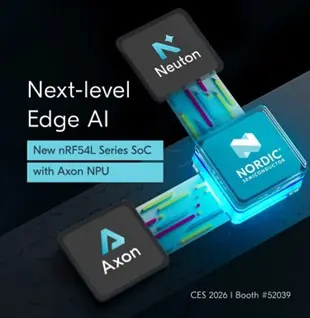
Nordic Semiconductor introduced the nRF54L Series (nRF54LM20B) with an integrated Axon NPU, enabling millisecond-level decisions on tiny IoT devices without cloud dependency. Support for Bluetooth LE and Matter over Thread, combined with strong TinyML tooling via the Nordic Edge AI Lab and Neuton models, highlights Nordic’s focus on scalable, developer-friendly edge AI.
Neuton edge AI models are ultra-tiny, CPU-run edge AI models designed for resource-constrained devices. They are typically under 5 KB in size, making them up to 10 times smaller, faster and more efficient than comparable CPU-based models. Nordic Edge AI Lab is a developer tool that assists in creating custom Neuton models. With these integrated edge AI launches, Nordic is redefining the ultra-low-power edge AI boundaries.
Ambarella introduced its highly integrated CV7 edge AI vision system-on-chip (SoC) with multiple functional blocks. It is a highly optimized chip that combines top-tier AI and video-processing capabilities with significant power reduction, specifically tailored for advanced edge vision products. Ambarella has shipped more than 39 million edge AI SoCs so far. More information here.
Synaptics showcased a broad edge AI portfolio spanning Astra AI-native SoCs, Veros connectivity and multimodal sensing. Use cases ranged from smart home and living, and personal devices, to robotics and industrial automation.
Astra AI-native SoCs are power- and size-optimised, multimodal compute solutions designed to deliver scalable AI performance at the edge while managing cost effectively.
Veros connectivity portfolio is Synaptics’ seamless intelligent connectivity solution, consisting of SoCs for a wide range of wireless protocols. It covers Wi-Fi, Bluetooth, Zigbee, Thread, Matter and GPS.
The company also announced a strategic collaboration with Edgecore Networks around an AIoT Edge Hub using Wi-Fi HaLow signals, growing interest in scalable, infrastructure-grade edge intelligence.
NXP Semiconductors introduced its eIQ agentic AI framework, designed to enable autonomous, real-time AI decision-making directly on edge devices. This empowers both expert and novice device developers to simplify and accelerate agentic AI development, orchestration and deployment. Combined with NXP’s secure edge hardware platforms, it positions edge AI as a system-level capability rather than just silicon. Healthcare collaborations further underline the move toward mission-critical edge intelligence.
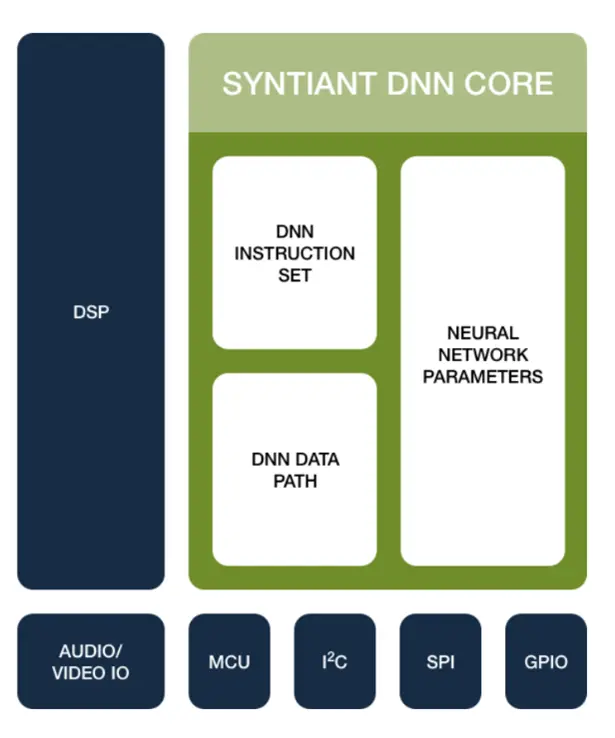
Syntiant demonstrated its ultra-low-power Neural Decision Processors and sensor-plus-ML models for always-on voice, audio, vision inference, and vibration sensing. The demos covered AI-enabled headphones for clear calls and adaptive noise control, low-power voice-controlled smart frames, vehicle security, automotive listening mode, and vision and voice control for conference room equipment. Syntiant aims to redefine everyday devices, making them seamless, instantly responsive, and securely private extensions of human interaction.
Ambiq unveiled Atomiq, the world’s first ultra-low-power NPU SoC built on the SPOT platform, targeting always-on edge intelligence. With an Arm Ethos-U85-based neural accelerator delivering over 200 GOPS, Ambiq is pushing the envelope on battery-constrained edge AI across vision, audio, speech, wearables and industrial endpoints. For more details, click here.
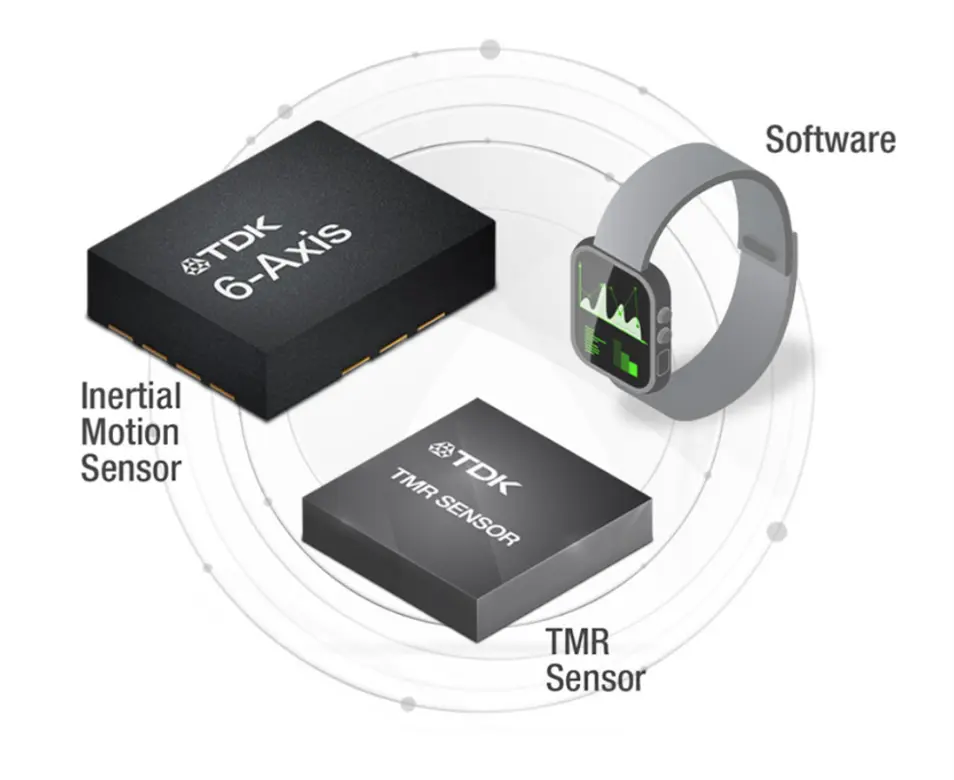
TDK announced InvenSense SmartMotion custom motion sensors with on-chip sensor fusion and machine learning capabilities. These solutions enable edge intelligence for AI glasses, TWS earbuds, smartwatches, fitness bands and other IoT devices. The new TDK IMUs feature on-board motion processing, allowing them to offload computation from the main system chip (SoC/MCU) for better power efficiency and faster responsiveness.
Telit Cinterion launched and showcased the Nokia Black Box, an intelligent edge device designed for heavy industry, integrating multi-network connectivity, and essential computing power. It enables real-time edge intelligence, allowing systems to sense, decide and act locally. The device integrates an NVIDIA GPU for AI processing and multiple Telit Cinterion advanced modules for connectivity.
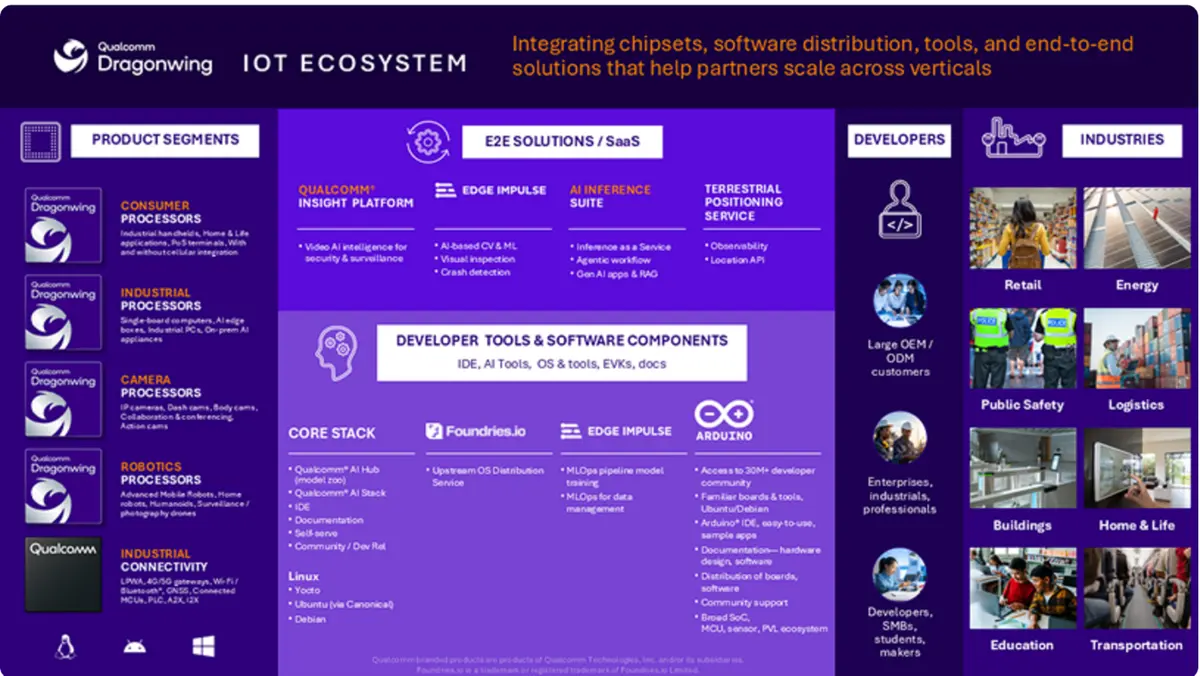
Qualcomm introduced a new range of high-performance edge AI processors for its Industrial and Embedded IoT Portfolio.
The Dragonwing Q‑8750’s AI engine achieves 77 TOPS (INT4/8/16 & FP16). It supports on-device LLMs up to 11 billion parameters, eliminating cloud dependence for critical tasks, and up to 12 cameras with 48MP. It is ideal for drones, multi-angle vision systems and advanced media hubs.
The Dragonwing Q‑7790 is built with 24 TOPS of on-device AI performance. It supports dual 4K60 displays, 4K120 video coding and AV1 decoding. It enables advanced inferences for applications like smart cameras, AI TVs and collaboration systems.
Qualcomm also highlighted some of its key acquisitions to build its end-to-end IE-IoT platform – Augentix (advanced multimedia signal processing), Arduino (simplifying developer access), Edge Impulse (TinyML and MLOps tools), Focus.AI, and Foundries.io (security-focused deployment and management).
Quectel launched its SRG091X and SRG093X Wi-Fi 6 modules at CES 2026, built around NXP’s i.MX 9 series application processors integrate CPU, memory, and multi-protocol wireless connectivity within a single module. They feature the i.X 91, and i.MX 93, respectively, application processors from NXP Semiconductors. These modules are energy-efficient edge processors fitted for applications in industrial, enterprise IoT, and automotive. They integrate Arm Cortex-A55 CPUs with an Ethos-U65 microNPU to enable secure, low-power edge AI and on-device machine learning, supported by EdgeLock security and Energy Flex architecture. The platform supports Linux-based edge applications, multiple qualification grades, and long-term product availability.