- AMD focuses on increasing AI compute globally and strengthening position against NVIDIA
- Inference arriving faster than expected: Vera Rubin shows NVIDIA’s ambition
- Intel: A manufacturing-led AI PC reset
- Qualcomm introduces Snapdragon X2 Plus to strengthen its AI PC portfolio
- Lenovo highlights ‘Smarter AI for all’ vision
- Ambiq unveils world’s first ultra-low-power NPU SoC
- NVIDIA pushes desktop AI forward: GIGABYTE unveils DGX Station-class W775-V10 powered by Grace Blackwell
The first couple of days at CES 2026 have made it clear that AI hype cycle is now moving into the execution phase. As AI training matures and capex reaches peak, the next phase of growth will be driven by edge, i.e. AI inferencing. The silicon push continues from likes of NVIDIA’s inference-shattering Vera Rubin platform and AMD’s ecosystem-validated Helios architecture to Intel and Qualcomm’s aggressive AI PC push. The industry is focusing on solving critical bottlenecks like networking, memory bandwidth and power efficiency. Below are our key highlights from our coverage of everything semiconductor at CES.
AMD focuses on increasing AI compute globally and strengthening position against NVIDIA
AMD’s CES 2026 keynote marked a strategic inflection point, not because of consumer products, but because of ecosystem validation and platform credibility, led by OpenAI. AMD is no longer merely aspiring to be a major AI player; it is now being treated as one. The remaining debate is not about relevance, but about execution, supply and whether results can outrun elevated expectations.
Key highlights:
- AMD framed AI compute demand as growing 10,000x and ultimately reaching ~10 yotta FLOPS over the next decade.
- The MI450 “Helios” rack-scale platform, co-developed with Meta, was positioned as the world’s most powerful AI rack, designed to meet extreme power, cooling and density requirements.
- MI450 GPUs deliver ~10× performance uplift versus MI355X, reinforcing AMD’s multi-generation AI roadmap.
- Ryzen AI Max/Halo, positioned as the world’s smallest AI development platform, will be launched in Q2 2026. It offers dramatically lower cost for developers than NVIDIA’s DGX.
- Ecosystem validation: The caliber and diversity of partners on stage, ranging from OpenAI to Blue Origin and more, reinforced AMD’s relevance across distinct AI-driven industries. This partner validation materially enhanced AMD’s credibility versus prior cycles.

Inference arriving faster than expected: Vera Rubin shows NVIDIA’s ambition
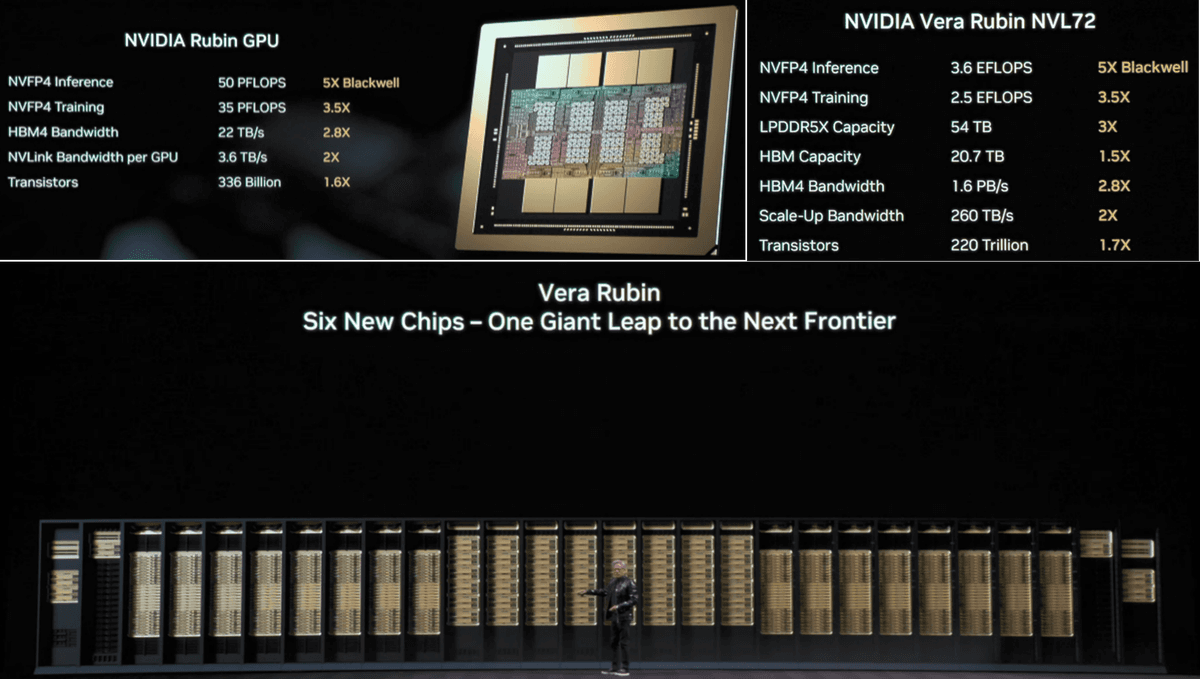
This year’s introduction of Vera Rubin makes one thing clear – the inference era is arriving faster than expected. Compared with earlier expectations, the platform shows deliberate architectural changes aimed squarely at real-world inference workloads.
What stands out most is how NVIDIA is responding to the rapid growth of inference demand. Inference is far more networking-intensive than training, and the new system reflects that shift. On the scale-out side, NVIDIA strengthens distributed performance with #ConnectX 9 SuperNICs and BlueField_4 DPUs. At the same time, scale-up systems begin adopting optics through Spectrum_X Ethernet with co-packaged optics (CPO), signaling parallel evolution of both paths.
Vera Rubin also introduces a new Inference Context Memory Storage platform, designed to break the context bandwidth wall. By creating a new memory tier dedicated to large-scale KV cache handling, NVIDIA improves time-to-first-token by up to 20×.
This is more than a spec upgrade. Vera Rubin reflects NVIDIA’s view that future AI systems will be defined by networking, memory hierarchy, and responsiveness, not just raw compute.
Key highlights:
- Platform overview: NVIDIA unveiled the Vera Rubin platform, a system-level breakthrough featuring six distinct, co-designed chips – Vera CPU, Rubin GPU, NVLink 6 Switch, Spectrum-X Ethernet, ConnectX-9 SuperNIC and BlueField-4 DPU – engineered to address exponential growth in AI model size and inference complexity.
- Vera CPU: A custom-designed processor with 88 physical cores (176 threads via spatial multi-threading), delivering 2x the performance-per-watt of leading CPUs. It is optimized for high-speed, coherent data sharing directly with the Rubin GPU.
- Rubin GPU: Delivers 5x the AI performance of the Blackwell generation with only a 1.6x increase in transistor count. This efficiency is driven by the new MVF-FP4 Tensor Core, which adaptively adjusts precision to maximize throughput.
- NVLink 6 Switch: Utilizes 400 Gbps SerDes technology to enable 240 TB/s of all-to-all bandwidth across the rack backplane, effectively double the total bandwidth of the global internet.
- Spectrum-X Ethernet (Photonics): The world's first Ethernet switch featuring co-packaged silicon photonics, offering 512 lanes at 200 Gbps for massive, energy-efficient scale-out capability.
- ConnectX-9 SuperNIC: Provides 1.6 Tbps of scale-out bandwidth per GPU. Co-designed with the Vera CPU, it minimizes latency for high-performance AI clusters.
- BlueField-4 DPU: Offloads critical storage, security and networking tasks from compute nodes. It serves as the engine for the Dynamo KV Cache, managing massive context memory workloads within the rack.
- Rubin Pod architecture: A standardized deployment unit integrating 16 NVL72 racks to aggregate 1,152 Rubin GPUs into a single, massive coherent engine for training and inference.
- Dynamo KV cache: Addressing the “context memory” bottleneck in reasoning models, this in-rack storage solution (managed by BlueField-4) provides an additional 16 TB of memory per GPU (150 TB backing store per node), significantly reducing network traffic.
- 100% liquid cooling: The system utilizes a warm-water cooling loop (45°C input), eliminating the need for energy-intensive data center chillers and reducing global data center power consumption by approximately 6%.
Intel: A manufacturing-led AI PC reset
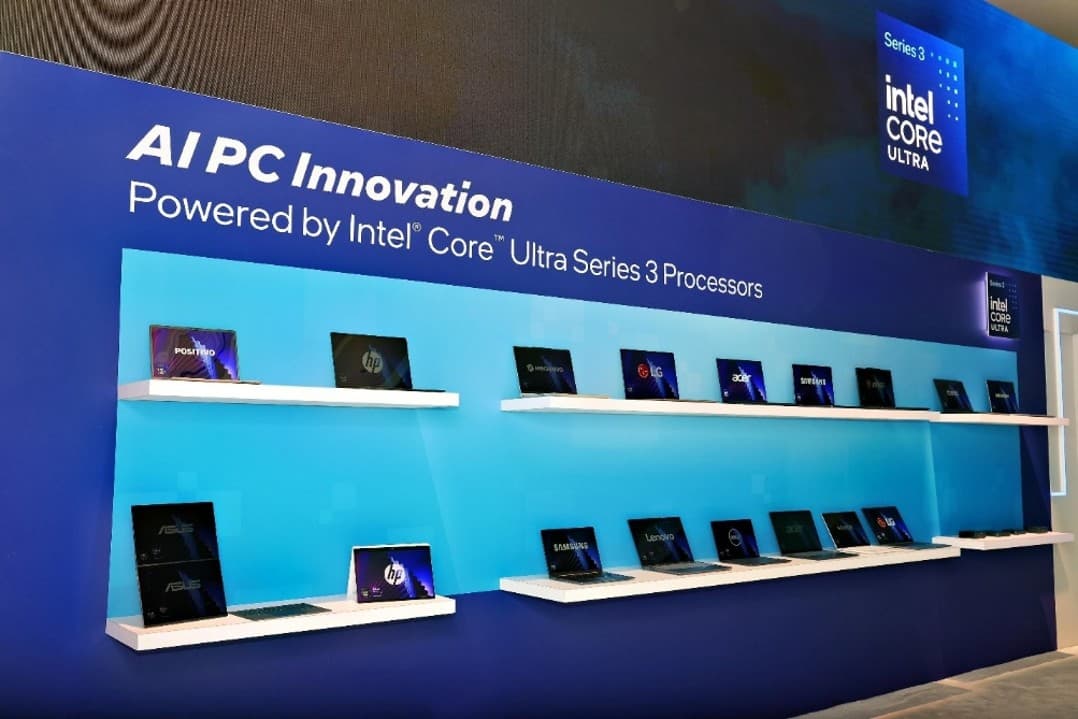
Intel launched its Core Ultra Series 3 (Panther Lake), which relies on its 18A process, key to producing chips in-house in the US. Intel’s bet is that AI PCs, along with leading-edge manufacturing, can bring it back to manufacturing leadership. The 18A process is important here as it includes RibbonFET and PowerVia technologies. Winning external foundry business and clients will be a solid business prospect for Intel to get back into the foundry business.
Key highlights:
- Panther Lake is built with Intel’s chiplet and packaging technology, with a separate compute and graphic chiplet. Integrated ARC-based graphics offer a strong gaming performance in thin and light laptops. ARC B390 offers 50% more graphics cores and 120 GPU TOPS for AI.
- The series offers 60% performance gains compared to the Lunar Lake series and efficiency gains for thin-and-light PCs. The chip features new P-cores, E-cores and a redesigned Low Power Island with dedicated E-cores to handle hundreds of background tasks, significantly extending battery life.
- Core Ultra Series 3 chips have stronger on-device AI capabilities (NPU + CPU + GPU working together), a big push towards the AI PC market with 50 TOPS.
- Broad OEM adoption across consumer and commercial laptops is expected in 2026 with Asus, MSI and Lenovo product announcements.
Qualcomm introduces Snapdragon X2 Plus to strengthen its AI PC portfolio
Qualcomm officially unveiled the Snapdragon X2 Plus platform at CES 2026. The launch expands the Snapdragon X series with a more mainstream laptop chip designed for Windows 11 and Copilot PCs. Qualcomm is positioning the X2 Plus as a bridge between high-end AI-focused processors and everyday productivity devices. This approach allows OEMs to ship Windows 11 Copilot+ PCs with robust on-device AI capabilities but without the cost premiums of flagship silicon, which could accelerate ARM adoption in Windows ecosystems while challenging incumbent x86 vendors on efficiency and AI performance.
Key highlights:
- Qualcomm has expanded its Snapdragon X series with a more mainstream laptop chip designed for Windows 11 and Copilot PCs. Devices equipped with the Snapdragon X2 Plus are expected to be made available by leading OEMs in H1 2026.
- Built on a new 3nm process, the Snapdragon X2 Plus succeeds the Snapdragon X Plus, featuring the third-generation Qualcomm Oryon CPU and an integrated Qualcomm Hexagon NPU delivering 80 TOPS of AI performance.
- The Snapdragon X2 Plus is available in two variants – a 10-core version (X2P-64-100) combining six Prime and four Performance cores, and a 6-core version (X2P-42-100) with 6 Prime cores. Both variants are based on third-generation Oryon CPU architecture and integrate an Adreno X2-45 GPU.

- In terms of performance and efficiency, the Snapdragon X2 Plus CPU delivers up to 35% faster single-core performance versus the previous generation while using 43% less power. The 6-core variant offers up to 10% higher multi-core performance, while the 10-core variant delivers up to 17% better multi-core performance. The integrated Adreno GPU delivers up to 29% higher performance over the prior generation.
- For connectivity and platform features, the Snapdragon X2 Plus supports Wi-Fi 7, optional 5G connectivity and Snapdragon Guardian security, enabling secure, always-connected and on-the-go productivity experiences.
- Lenovo has committed to using the Snapdragon X2 Plus in multiple upcoming Copilot+ PCs, highlighting a closer integration between Qualcomm’s silicon and Lenovo’s laptop lineup for 2026.
Lenovo highlights ‘Smarter AI for all’ vision
Lenovo is focusing on AI coordination by connecting personal “super agents” like Qira on consumer devices to massive, enterprise-grade infrastructure like the AI Giga Factory.
Key highlights:
- Lenovo introduced its first personal AI super-agent, Qira, which uses intelligent model orchestration for picking up the most efficient AI model.
- Partnered with Intel, Lenovo launched a new portfolio of Aura Edition AI PCs. These devices feature "Smart Modes" and "Aura Engine" capabilities.
- Lenovo detailed its strategy of combining public/private cloud, on-prem data centers, and edge computing to enable real-time AI inferencing.
- Lenovo AI Giga Factory, leveraging NVIDIA's Reuben platform, will help cloud providers scale to hundreds of thousands of GPUs for massive AI models.
- Lenovo launched new servers – ThinkSystem SR675i (for high-throughput inferencing), SR650i and SE455i (for edge environments).
- With ThinkSystem SR675i, powered by AMD’s EPYC processors, Lenovo will be among the first to adopt the AMD Helios Rackscale AI architecture.

Ambiq unveils world’s first ultra-low-power NPU SoC
Ambiq Micro unveiled the world’s first ultra-low-power SoC with an NPU, advancing its edge AI roadmap by enabling sophisticated AI without draining battery life. The chip supports use cases from always-on smart cameras and wearables to industrial sensors and robotics, all while running independently of the cloud. With a comprehensive software stack, a 12nm SPOT roadmap and partnerships with Ronds and Bravechip, Ambiq is solidifying its position as a leader in the ultra-low-power edge AI market.

Key highlights:
- The Atomiq SoC, built on Ambiq’s proprietary SPOT (Sub-threshold Power Optimized Technology) platform, integrates the Arm Ethos-U85 NPU, delivering >200 GOPS for on-device AI performance. It supports always-on, real-time AI features such as advanced audio processing, computer vision and reasoning in power-constrained environments, and can handle larger AI models at the edge with industry-leading energy efficiency ideal for wearables, smart cameras, hearables and IoT devices.
- This platform includes ready-to-use software tools like Helia AI, ADK and neuralSPOT SDK, which helps developers run AI efficiently on small devices while using less memory and building apps faster.
- At the event, the company also highlighted a next-gen 12nm SPOT platform for even greater efficiency and support for more complex AI applications across healthcare monitoring, consumer electronics and smart buildings.
- On partnerships and ecosystem, Ambiq is working with Ronds to deploy over 400,000 smart sensors in heavy industries, using Ambiq’s Apollo chips for always-on AI monitoring. It is also collaborating with Bravechip on advanced smart rings, and at CES, Ambiq showed real-world examples of edge AI in consumer devices like wearables, smart glasses and hearing aids, as well as industrial applications like sensors and medical devices.
NVIDIA pushes desktop AI forward: GIGABYTE unveils DGX Station-class W775-V10 powered by Grace Blackwell
Following the successful launch of its DGX Spark, NVIDIA has expanded its desktop AI strategy by working with partners to introduce DGX Station-class desktop AI computers.
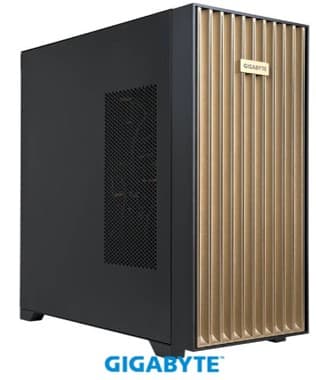
As a leader in AI hardware and advanced thermal solutions, GIGABYTE has unveiled the W775-V10, a new desktop AI supercomputer built on DGX Station-level technology. Designed to enable advanced AI development directly at the desk, the system allows developers to build, fine-tune and run AI workloads locally with data-center-class capability.
The GIGABYTE W775-V10 is powered by the NVIDIA GB300 Grace Blackwell Ultra desktop superchip, delivering up to 775 GB of coherent system memory, significantly accelerating large-scale AI training and inference on-premise. The system made its public debut at CES 2026, alongside GIGABYTE’s broader portfolio spanning mini PCs, servers and rack-scale AI infrastructure.
Featuring a fully liquid-cooled design and pre-integrated NVIDIA AI software stack, the W775-V10 enables AI developers, researchers and data scientists to rapidly prototype, fine-tune and deploy models locally, with seamless scalability to data centers or cloud environments. Positioned as a premium desktop AI platform, the W775-V10 underscores NVIDIA and GIGABYTE’s push to bring data-center-class AI performance directly to the desktop.