

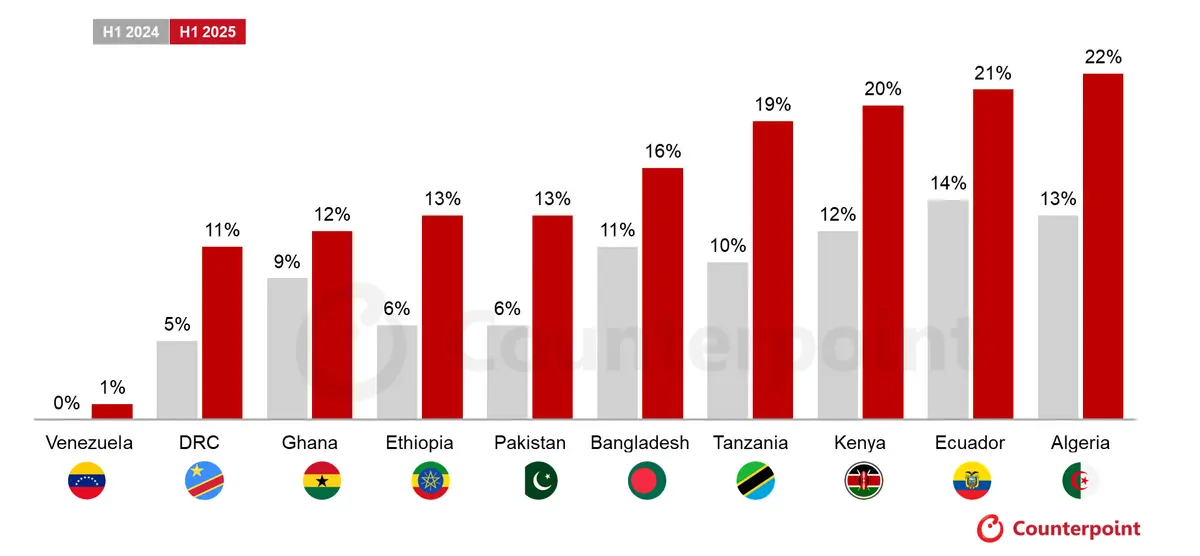
- While 5G smartphones made up more than 71% of overall global smartphone shipments in H1 2025, the bottom 10 countries saw an average 5G contribution of only 15% in their smartphone shipments.
- Venezuela ranked the lowest, with 5G smartphones forming just 1% of its total shipments.
- Africa had 6 of these bottom 10 countries, with Algeria recording the highest share among them at 22%.
- Despite their sizable smartphone markets, Pakistan and Bangladesh recorded the lowest 5G shares in Asia.
5G smartphones have become mainstream, accounting for 71% of overall global smartphone shipments in H1 2025, according to Counterpoint Research’s Market Monitor Service. Their penetration has increased rapidly across both developed and emerging markets, driven mainly by rising consumer demand, affordable devices and faster 5G network rollouts. However, some countries continue to see very sluggish growth in the 5G share of their smartphone shipments, lagging behind the global average by a significant margin. In H1 2025, the average 5G share for the bottom 10 countries was only 15%. A digital divide persists in these countries due to weak infrastructure, low investment, and affordability barriers.
Bottom 10 Countries for 5G Share in Smartphone Shipments, H1 2025 vs H1 2024
Latin America: Uneven growth
While Latin America’s overall 5G shipment share reached over 41% in H1 2025, two countries lagged far behind – Venezuela and Ecuador. In fact, Venezuela ranks the lowest globally with just 1% 5G shipment share in H1 2025. The country has been facing hyperinflation, unemployment and US sanctions, crippling its telecom sector. Low per capita GDP keeps most Venezuelans on 3G and 4G devices. The country got its first 5G Fixed Wireless Access (FWA) service in June 2025, but the coverage is limited to cities like Barinas and Nueva Esparta. Similarly, Ecuador’s progress is stalled by delayed spectrum auctions, limited telecom infrastructure investments, political uncertainty and expensive 5G smartphones. As a result, despite a growing middle class, Ecuador’s 5G shipment share was 21% in H1 2025.
Africa: Infrastructure gaps
Six of the bottom ten countries with the lowest 5G smartphone shipment shares are from Africa, showing a significant lag in 5G adoption in these markets. In the Democratic Republic of Congo (DRC), 5G coverage is limited as operators are currently focusing on strengthening 4G while preparing for 5G infrastructure.
Ghana has launched 5G mainly through a public-private partnership company, Next Gen Infraco (NGIC), which has partnered with telecom operators. While operators are leveraging NGIC infrastructure, the 5G ecosystem remains nascent and heavily dependent on network and infrastructure wholesalers.
Ethiopia launched its first commercial 5G service in 2022 through its state-owned operator Ethio Telecom. However, even after three years, 5G share is still lagging at only 13% of overall smartphone shipments. Digital literacy is among the key challenges faced by the country, with only 25% of Ethiopians using the internet. Limited infrastructure, slow spectrum allocation, currency volatility and unclear pricing policies have further impacted 5G adoption.
Tanzania’s 5G shipment share reached 19% in H1 2025, with 5G coverage being limited to cities. Most users in the country rely on 4G due to its affordability.
Kenya’s first commercial 5G rollout was in late 2022, but the coverage remains limited. 5G device and data costs are also high, and since core services like mobile payment run perfectly on 4G, consumers don’t see an urgent need to upgrade.
Algeria has a comparatively stronger economy than the other five African countries on the list, resulting in a better 5G shipment share. Regulatory delays have impacted faster 5G growth in the country. While import duties on smartphones were removed in 2022 to promote ease of business, the high cost of 5G devices and limited coverage have kept 5G share at just 22% in H1 2025.
Asia: Some exceptions
Asia is the largest 5G smartphone market globally, with strong shipments across most countries. However, Pakistan and Bangladesh, despite their sizable smartphone volumes, stand out as exceptions and figure among the countries with the lowest 5G adoption.
Pakistan was the seventh biggest market in terms of Asia’s smartphone shipments in H1 2025, but it is yet to roll out 5G services. The government has been delaying spectrum auctions since 2021 over complaints of high spectrum cost, even as insufficient infrastructure and fiscal challenges keep 5G devices out of reach.
Bangladesh’s smartphone market is dominated by sub-$150 devices, but most 5G phones cost above $250 in the country, slowing 5G growth. Low average revenue per user (ARPU), limited coverage, and consumer focus on other smartphone features like battery life, storage and camera quality are further holding back 5G adoption.
Conclusion
Although 5G is growing steadily, 4G is expected to remain the backbone mobile network in these lagging countries until at least 2030. The adoption of 5G will accelerate only when devices become more affordable through local manufacturing or subsidies, network coverage is expanded, and brands actively push 5G devices. Economic conditions, regulatory policies and consumer preferences will also play a crucial role. Increased investments in telecom infrastructure by companies could considerably shorten the timeline for 5G adoption in these countries.
Note: Shipments here exclude grey-market and transshipment movements.

