Brazil Smartphone Shipments Decline 11% YoY in H1 2026, Signaling Potential Double Digit Contraction for Full Year
- LATAM’s largest smartphone market, Brazil, saw shipments decline by 11% YoY in H1 2026, driven by shrinking domestic production and more cautious consumer spending.
- Samsung and Motorola, the two largest brands in Brazil, together captured 73% of the smartphone market and led the rankings for the top five best-selling smartphones.
- Chinese brands are disrupting the Brazilian market with extended warranties and steep price markdowns, supported by local manufacturing partners to reduce taxation costs.
- In the first half of the year, 5G coverage had already surpassed the target set for 2027.
Brazil’s smartphone shipments declined 11% YoY in H1 2026, according to Counterpoint Research’s Market Monitor. This was a significant contraction for the largest smartphone market in Latin America (LATAM) and it is expected to deteriorate further during H2 2026. Rising memory prices and the resulting decline in domestic smartphone production, along with slowing sales, are creating conditions for a potential double-digit contraction in 2026.
Brazil’s OEM landscape in H1 2026
Samsung led the Brazilian market with a 42% share, followed by Motorola in a solid second place at 31%. Although both gained share in the first half of the year, Samsung’s volume declined 6% YoY, and Motorola’s 2%, reflecting the broader market contraction. The arrival of Chinese players such as Jovi (vivo in Brazil), HONOR, OPPO and realme has heightened competitive intensity, while their collective market share declined from 26% in H1 2025 to 20% in H1 2026.
Brazil Smartphone Market Shipment Shares by OEM, H1 2026 vs H1 2025
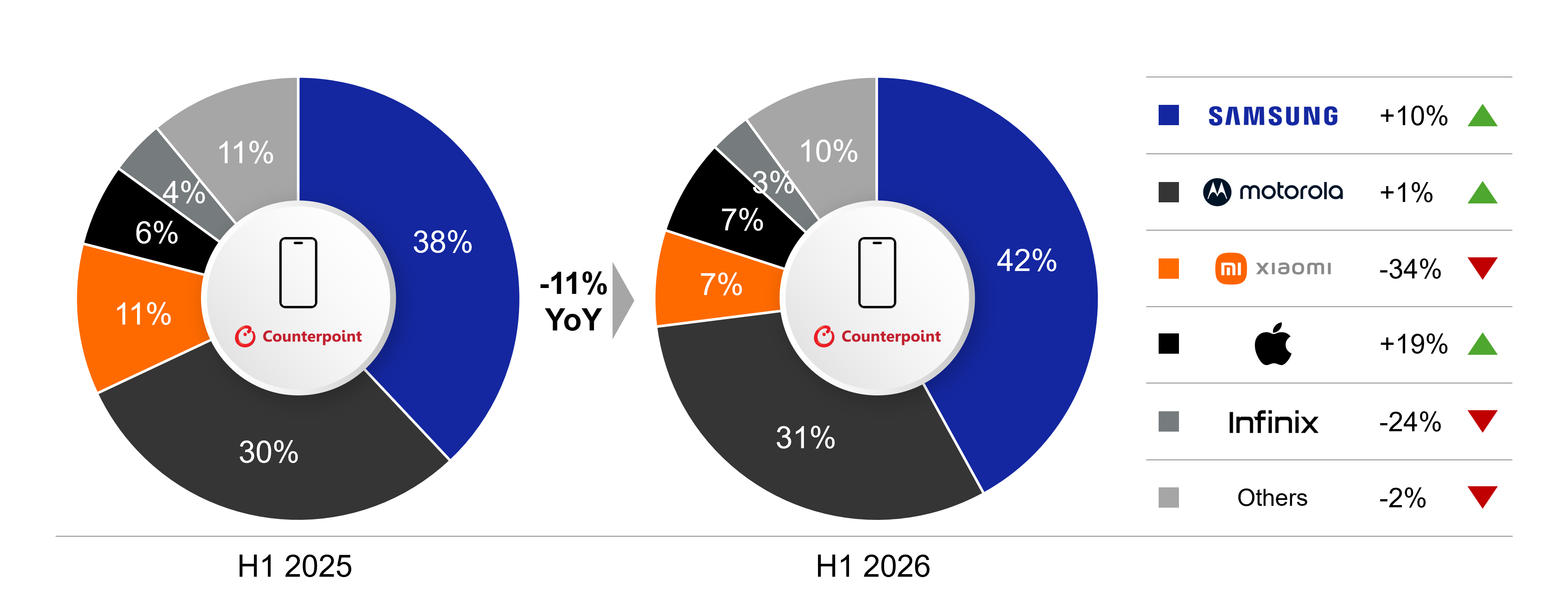
Despite the overall market contraction, Samsung delivered solid results, increasing by 10% YoY in H1 2026. The outcome was supported by well‑stocked distribution channels and aggressive price markdowns, which accelerated the transition from legacy A‑series models to the refreshed lineup, alongside the expected launch of the S26 series in Q1 2026, which gained traction in the second quarter. All this underscored the brand’s enduring market presence, well-developed infrastructure, and broad consumer recognition.
In terms of volume, Brazil is Motorola’s most important market in LATAM. The brand grew 1% YoY in the country in H1 2026, driven by increased visibility across physical stores and online channels, leveraging its FIFA World Cup partnership. Motorola launched special editions and applied targeted price discounts during the period. To maintain strong consumer engagement, it also refreshed several models across the G series, Edge lineup and Razr family during H1. The company also introduced a new premium flagship model, the Motorola Signature.
Xiaomi, which has no local manufacturing operations, remained Brazil’s third‑largest brand despite a 34% YoY decline in H1 2026. The result was driven by rising consumer preference for locally manufactured devices, a drop in global shipments into the market and intensified competition from new Chinese entrants. Xiaomi in Brazil is largely supported by gray-market volume originating in Paraguay. Given Brazil’s manufacturing requirements and import taxes that can reach 105%, the country has become a key destination for smuggled smartphones. Gray-market devices are typically offered at discounts of up to 50% compared to their equivalent models sold through official channels. For some consumers, the cost savings from purchasing a gray-market device outweigh potential warranty or after-sales care limitations.
Apple, the most valuable smartphone brand in Brazil, emerged as one of the strongest performers in H1 2026, increasing domestic production by 7% YoY and market share by 19% YoY. Apple’s performance was driven by continued momentum for the iPhone 17 series and resilient sales of the iPhone 16 and 16e. The brand’s sales were further boosted by discounts for legacy models. Apple faces limited competition in the >$600 segment, holding 63% of the market in H1, while Samsung took 34%.
With a shorter history in the country’s market, Transsion’s Infinix completed the top-five list. The brand’s share dropped 24% YoY in H1 2026 due to increasing pressure from new Chinese brands competing in the same price segments. Infinix has faced ongoing challenges in sustaining domestic production levels, driven by memory shortages and associated price increases.
Chinese smartphone brands are reshaping the Brazilian market in partnership with local manufacturers and distribution channels. For instance, vivo‑owned JOVI, starting from zero, initiated local manufacturing in January 2025 in collaboration with GBR Componentes and launched commercially in May through TIM, Claro and selected retail partners. During H1 2026, the brand expanded its distribution to vivo, Brazil’s largest telecom operator, and strengthened its footprint in the open market. In just one year, the brand secured approximately 0.5% of the total market, positioning itself in direct competition with long-established brands such as Positivo and Multilaser.
Emerging brands are targeting the market through major investments, like opening branded stores and implementing extensive marketing campaigns, aggressive price markdowns, bundles, in-store dedicated brand sales reps and longer payment plans. Some brands are adding an extra year of warranty, extending protection for two years instead of the standard one.
Samsung and Motorola dominate Top 5 list of best-selling smartphones
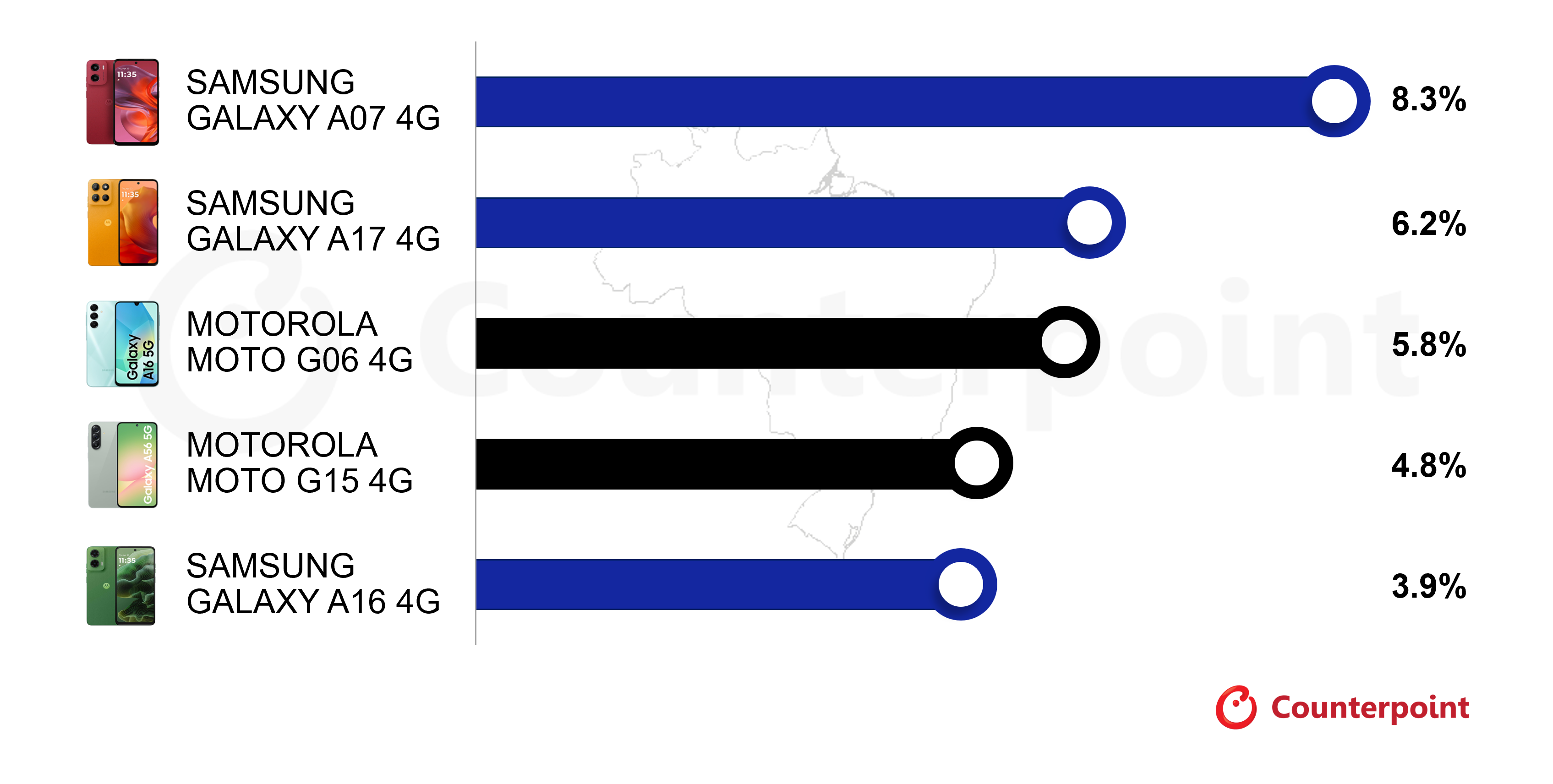
The top-five best‑selling smartphone models accounted for 29% of the overall Brazilian market in H1 2026. The Samsung Galaxy A07 4G, which has remained in the top position since December 2025, supported by strong supply and competitive price, accounted for 8.3% of the overall market. The Samsung Galaxy A17 4G took second place and the Motorola Moto G06 4G took third. Both models alternated between second and third places throughout the period. The Motorola Moto G15 4G reached fourth place in the ranking, driven by broad distribution and a competitive price. Samsung’s Galaxy A16 4G, positioned fifth, declined as the brand moved towards its updated model.
Brazil’s Top 5 Best-selling Smartphones, H1 2026
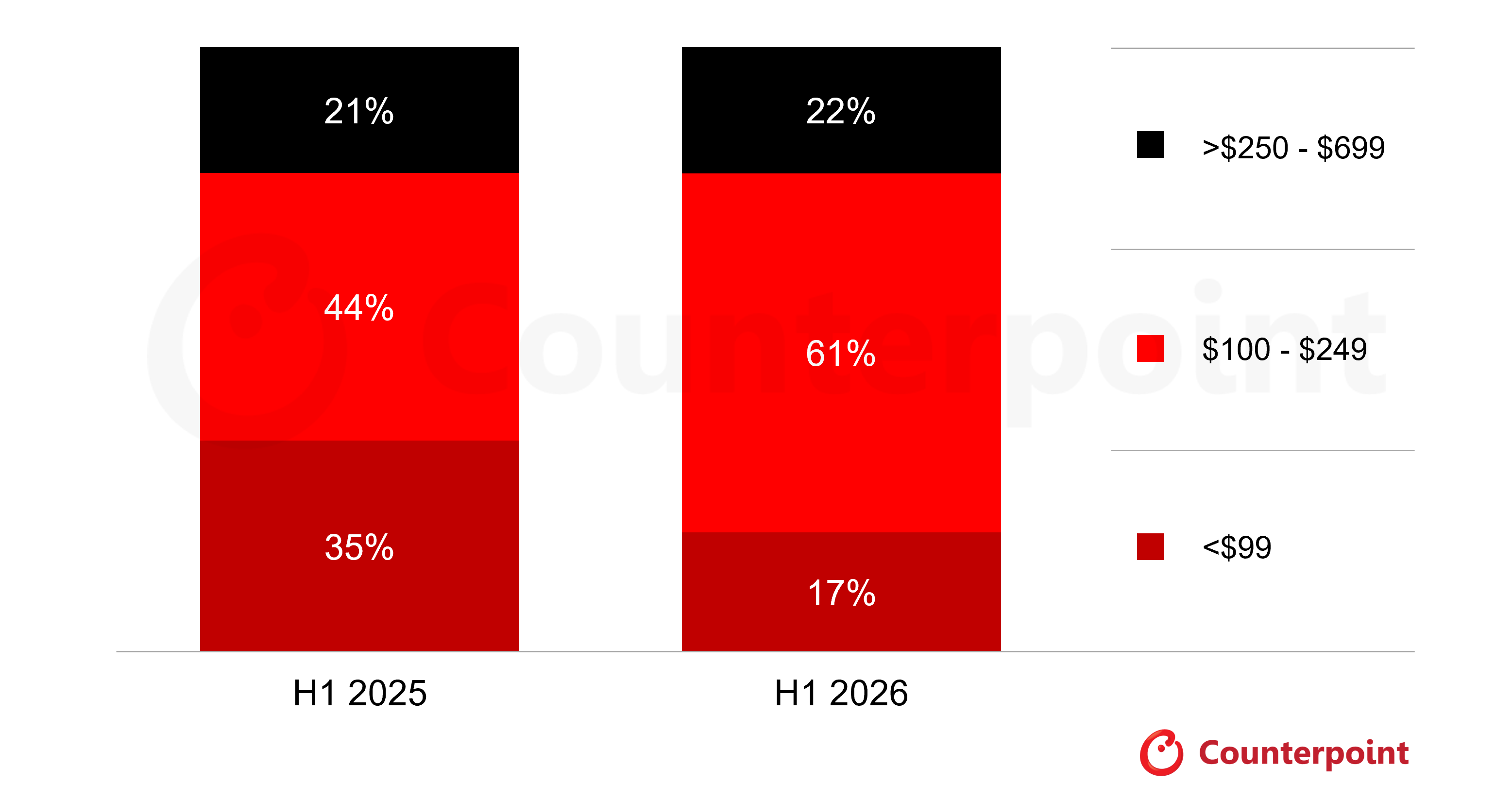
Devices priced $100-$249 surge 37% YoY, reaching 61% of Brazil market
Devices priced below $249 accounted for 78% of the overall Brazilian market in H1 2026. Within this range, the $100-$249 segment grew 37% YoY, reaching 61% of the overall market, driven partly by a sharp 50% decline in the <$99 price band in H1 2026 and the effect of price hikes. In other words, six out of every ten devices sold in Brazil cost between $100 and $249. Brazil’s reliance on the sub-$250 segment outpaces the rest of the region, where 75% fall into this segment.
This segment’s expansion reflects three underlying drivers. First, consumer spending patterns shifted, with buyers showing a greater willingness to invest in better hardware specifications. Second, the arrival of new Chinese brands broadened model availability within this price band. Third, the initial effects of memory‑related price hikes began to emerge, with further escalation expected in H2 2026.
Samsung and Motorola lead the sub-$249 price band, followed by Xiaomi and Infinix. The mix of long-established players and emerging brands has expanded model availability in this segment. The broader and more diverse portfolio has heightened competitive pressure in the entry‑level and mid‑range tiers, forcing brands to address the market with more aggressive offerings.
Brazil Smartphone Shipment Distribution by Price Band
According to Counterpoint, the global memory shortage will persist in 2027. Entry-level and mid-range devices, which represent the bulk of smartphone volumes in the world as well as in LATAM, are most exposed to BoM price impacts, resulting in price hikes. Additional price actions are expected to continue throughout 2026.
5G adoption is progressing faster than expected
Brazil is accelerating 5G rollout, positioning itself as the regional leader in connected subscribers and network deployment. According to the National Telecommunications Agency (Anatel) and the Ministry of Communications, 5G coverage reached approximately 63% of the national territory as of April 2026, surpassing the 57.6% target originally set for 2027. This progress was primarily driven by the release of the 3.5 GHz band, which enabled faster rollout and modernization of carrier networks. Additional momentum came from the Universal Telecommunications Services Fund (FUST), which provided credit lines to support new infrastructure investments.
According to the ministry, around 66 million people had access to 5G as of May 2026. Brazil’s mobile networks operate at a smartphone saturation level of 124%, with 216.5 million people and 268 million active lines. 5G adoption reached 26% in H1 2026, among the highest in LATAM.
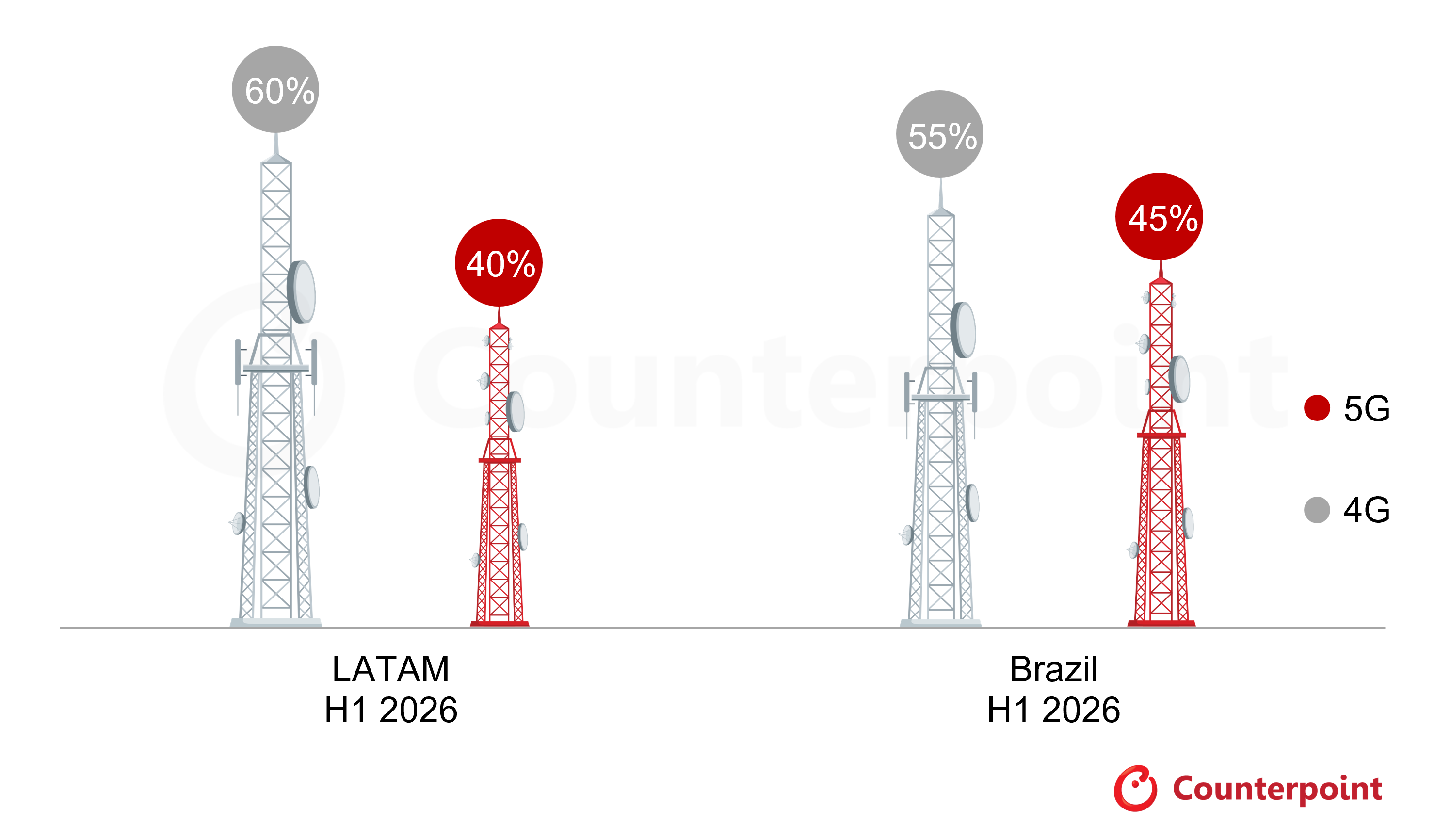
5G device shipments grew 39% YoY, reaching 45% of the total market. This result stands well above the regional average of 40% and highlights the accelerated adoption of next-generation connectivity, positioning the country as the regional 5G leader.
4G and 5G Smartphone Shipment Shares in LATAM and Brazil, H1 2026
Growth was driven by contributions from multiple sectors across the industry, including regulatory advances and government facilitation, carrier investments to expand network coverage and improve quality, rising enterprise connectivity demand, OEMs broadening their 5G portfolios, carriers and open market retailers incentivizing sales through longer payment terms with highly competitive promotional offers, and a marked increase in overall smartphone consumer spending.
Other dynamics surrounding Brazil’s smartphone industry, H1 2026
Since 2020, Brazil’s economy has been decelerating. From 2020 to 2024, annual GDP growth was above 3%, then declined to 2.3% in 2025, and is projected to reach 1.9% to 2.3% in 2026. Besides, the global smartphone industry is facing price increases due to memory shortages, which are impacting domestic smartphone production and supply.
The government is struggling to stimulate economic activity through initiatives such as income‑tax exemptions, dual VAT reform, energy subsidies, and support for the agri-business sector. However, oil exports to Asia, driven by the Middle East conflict, and exchange rate volatility have also caused domestic inflation, affected consumers' wallets, and reduced purchasing power. In addition, the presidential elections scheduled for October this year are keeping both consumers and investors in a cautious mood. The mix of all these factors is driving the smartphone industry slowdown.
Outlook for H2 2026
Price increases, which are likely to become more pronounced in H2 2026, will further constrain supply, leading the smartphone market toward a potential overall double‑digit decline in 2026. Brands like Infinix, TCL and realme, and local OEMs will struggle to maintain domestic production volumes, reducing the overall smartphone portfolio depth and market availability. As a result, the market will move toward consolidation, with some OEMs exiting the market and others strategically reducing the breadth of their model portfolios.
Amid the current economic environment, Brazil’s smartphone industry will face challenging times due to headwinds like memory shortages and associated price increases, economic deceleration, and high inflation. At the same time, the combination of these factors will create new opportunities for some companies such as Samsung and Apple, while pushing others into survival mode. The smartphone industry will face intensified competition in the coming months, especially considering the market concentration around two dominant brands in Brazil.
Category
Industry
Smartphone, Telecom
Service
Premium
Report Type
Report
Time Period
Other
Receive our insightful weekly newsletter and stay ahead of the competition.
Author
Benjamin Corona

Benjamín has leveraged over two decades of experience in project management and business development across Latin America. Throughout his career, he managed cross-functional and multi-regional teams to launch numerous smartphones, tablets, and consumer electronics. Before joining Counterpoint Research, Benjamin worked as Business Development Director in Latin America for SixUnited and KaiOS. Benjamín holds a PhD in strategic direction and innovation management, as well as SMC and PMP certifications. Apart from his career in the world of electronics, he is an accomplished musician, having collaborated on several recording projects.