- Global PC shipments rose 8.1% YoY in Q3 2025, driven by approaching Windows 10 sunset, and strategic inventory adjustments related to certain US import tariff policies.
- Lenovo, Apple, and Asus saw over 10% YoY growth in shipments, further consolidating their worldwide market dominance among the major brands.
- Significant growth in the AI PC market is expected from 2026, following the launch of new AI chipsets by key manufacturers.
Beijing, Berlin, Buenos Aires, Fort Collins, Hong Kong, London, New Delhi, Seoul, Taipei, Tokyo – October 22, 2025
Global PC shipments grew 8.1% YoY in Q3 2025, according to Counterpoint Research’s preliminary data. The growth was primarily driven by the approaching end-of-support for Microsoft Windows 10 in October 2025 and strategic inventory adjustments linked to evolving US import tariff policies.
The Windows 10 sunset has effectively acted as an industry-wide refresh timer, prompting both enterprises and consumers to replace aging systems ahead of the October deadline. With nearly 40% of the current PC installed base still on Windows 10, this replacement cycle is poised to be a major catalyst for PC market growth over the next few years.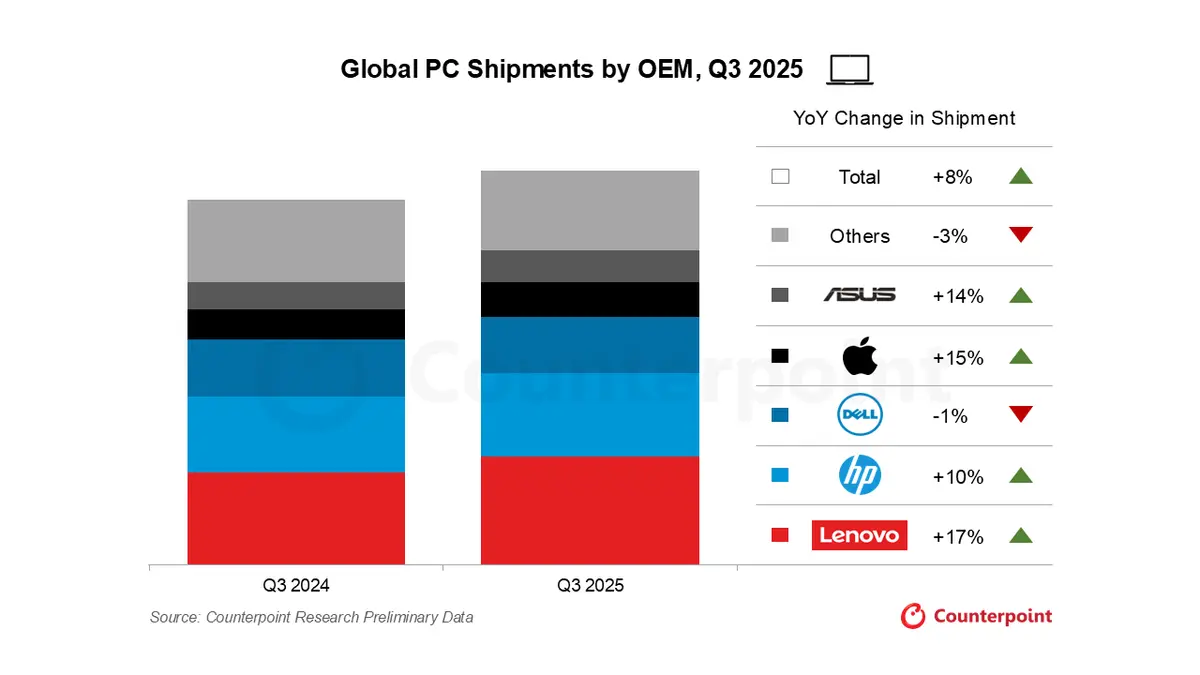
The competitive landscape saw major players capitalizing on the refresh cycle, with several companies posting double-digit YoY percentage growth:
- Lenovo maintained its market leadership, with shipments rising 17.4% YoY in Q3 2025, the highest annual growth among the top six vendors.
- HP solidified its second position with a 10.3% YoY rise in shipments to underscore strong commercial sector penetration.
- Dell remains resilient but saw a slight dip in annual performance. Its shipments saw a marginal 0.9% YoY decline, despite a 2.7% QoQ gain, reflecting more cautious enterprise buying in its core segments.
- Apple’s shipments jumped 14.9% YoY in Q3 2025 thanks to popular new MacBook models and enterprise adoption.
- Asus recorded the most explosive QoQ growth, surging by an impressive 22.5% while also achieving 14.1% YoY growth driven by solid consumer notebook demand.
Together, these top five vendors captured nearly three-quarters of the global PC market, underscoring continued consolidation at the high end. Smaller OEMs, by contrast, saw flat or declining volumes.
Senior Analyst Minsoo Kang noted, “While the current growth is primarily driven by OS migration, the industry is poised for an even more profound transformation with the rise of the AI PC. However, this next wave of growth has not yet fully materialized in the Q3 2025 numbers.”
The significant ramp-up in AI PC shipments is anticipated to commence after 2026. This shift will be powered by the commercialization of next-generation processors specifically designed for on-device AI, including Qualcomm's new Elite X2 Chip, Intel's Panther Lake architecture, and future chips developed through collaborations with NVIDIA.
The successful transition driven by the Windows 10 end-of-support is setting the financial and hardware foundation necessary for the industry to smoothly pivot towards these cutting-edge AI-enabled devices in the coming years.
Associate Director David Naranjo said, “The PC market’s rebound in 2025 is not just about replacing outdated systems, it is about preparing for what is next. Many enterprises are choosing AI-capable PCs to future-proof their fleets, even if they do not yet need those capabilities immediately. The next refresh cycle will be defined by intelligence at the edge, not just performance improvements.”
Looking ahead, the industry’s attention is turning toward the next big catalyst – the rise of the AI PC. In 2025, PC makers began touting new models with on-device AI acceleration, for instance, laptops capable of running generative AI assistants and large language models locally rather than relying on the cloud. However, so far these AI-oriented features have not converted into a major sales driver for the overall PC market. Buyers are still prioritizing fundamental upgrades (like OS compatibility, performance and battery life) over bleeding-edge AI capabilities in their purchase decisions. AI PCs are a little bit about futureproofing right now and many enterprises are starting to include AI features as a hedge for the future. Companies are looking to refresh their installed base with AI PCs because they do not want to be outdated in a year or two. In other words, some businesses are beginning to deploy AI-capable models – not due to immediate need, but to future-proof their fleets for emerging use cases.
The significant ramp-up in AI-PC shipments is expected to truly accelerate after 2026, once a new generation of chips and platforms hits the market. Semiconductor leaders are gearing up to fuel this phase: Qualcomm recently unveiled its Snapdragon X2 Elite PC processor, and Intel is preparing its next-gen “Panther Lake” Core Ultra chips – both of which integrate powerful neural processing units and on-chip AI engines aimed at enhancing PC-based AI performance. Likewise, NVIDIA is collaborating with PC chip partners (like MediaTek) on Arm-based CPU designs with built-in GPU AI acceleration. We project that significant mass shipments of these AI-centric chips will only arrive in late 2026, with broader availability in 2027. This timeline suggests that the real AI PC boom – when AI-optimized PCs become a mainstream segment – will come to fruition post-2026, likely lifting the PC market to new heights in the latter part of the decade. We expect events like CES 2026 to be filled with on-device AI demos and new AI PC product lines, as vendors position this upgrade cycle as the dawn of a more intelligent computing era.
About Counterpoint Research
Counterpoint Research is a global market research firm specializing in products across the technology ecosystem. We advise a diverse range of clients – from smartphone OEMs to chipmakers and channel players to Big Tech – through our offices located in the world's major innovation hubs, manufacturing clusters and commercial centers. Our analyst team, led by seasoned experts, engages with stakeholders across the enterprise – from the C-suite to professionals in strategy, analyst relations (AR), market intelligence (MI), business intelligence (BI), product and marketing – to deliver services spanning market data, industry thought leadership and consulting. Our core areas of coverage include AI, Automotive, Consumer Electronics, Displays, eSIM, IoT, Location Platforms, Macroeconomics, Manufacturing, Networks and Infrastructure, Semiconductors, Smartphones and Wearables. Visit our Insights page to explore our publicly available market data, insights and thought leadership, and to understand our focus, meet our analysts and start a conversation.
