How Will Display Industry Respond to Naphtha Supply Shock?
- The display industry is facing a severe shortage of naphtha because of the conflict in the Middle East.
- Many optical components related to displays are made in Japan, where suppliers are being hit hard.
- Flexible OLED panels will be particularly exposed since they use specialty polymers for the substrate and encapsulation.
The effects of the ongoing conflict in the Middle East and the closure of the Strait of Hormuz continue to ripple across the technology hardware supply chain. While semiconductor manufacturing has already been impacted by a helium supply shock, the flat panel display (FPD) industry is also facing a severe shortage of naphtha. South Korea, Japan and Taiwan are currently the most exposed, due to short reserves and limited options for alternative supply sources.
Naphtha is one of the petrochemical feedstocks produced by oil refineries. Further processing, known as naphta cracking, yields base chemicals like ethylene, propylene and aromatic compounds. These chemicals are the building blocks for plastics and synthetic fibers, as well as specialized organic materials used in semiconductor and display manufacturing. According to BloombergNEF, around 37% of global seaborne naphtha volumes transit through the Strait of Hormuz.
Naphtha Price (USD/T)
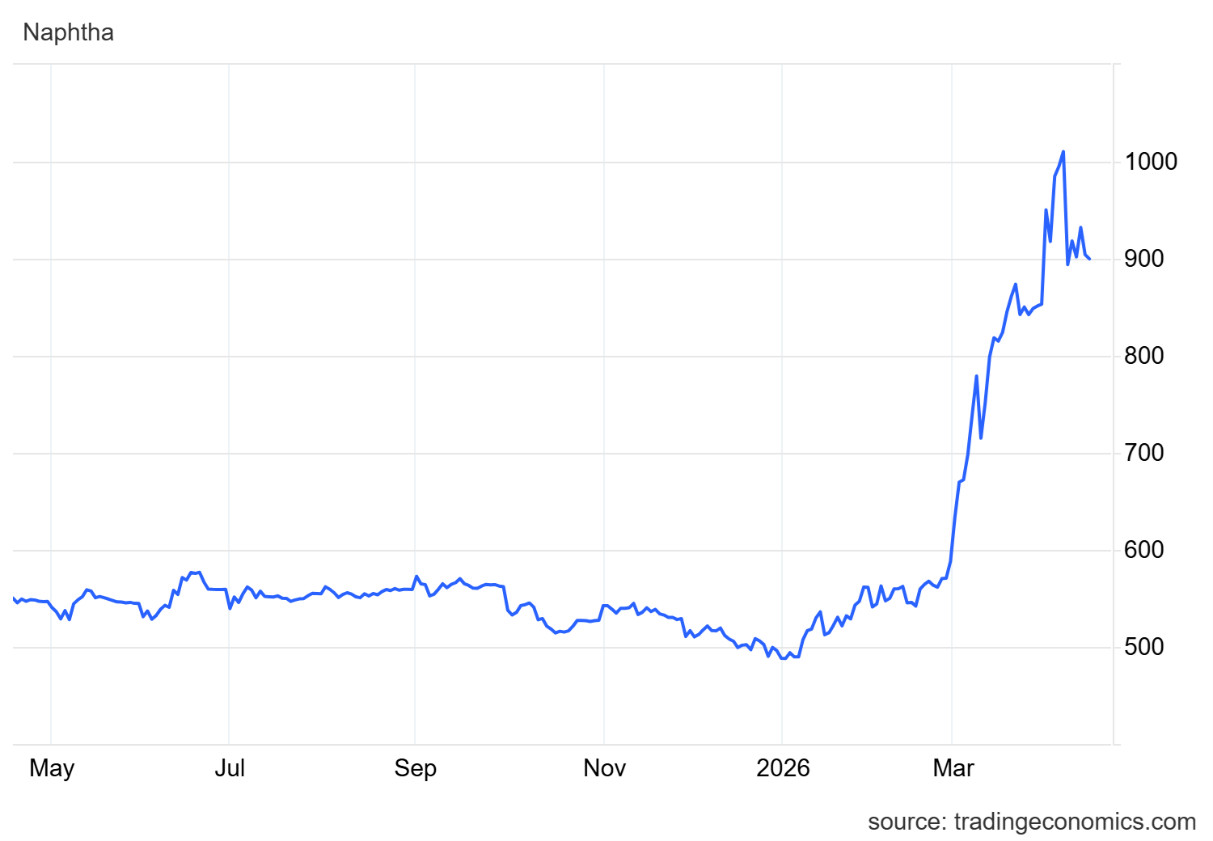
While LCD capacity is currently dominated by China, many components are still manufactured in Japan. These include polarizers, optical films and specialty adhesives such as Optically Clear Adhesives (OCA). Photoresist materials, which are used during panel manufacturing, will also be affected. Japanese suppliers like Nitto Denko, Sumitomo Chemical and Mitsui Chemicals are likely to be hit hard by the naphtha shortage and forced to increase prices. For instance, Kaneka has already announced a 20% price increase for polyimide films and a 30% increase for optical-grade acrylic resin (PMMA). There have also been reports that polarizer manufacturers are planning a 10% price hike during this quarter.
In Taiwan, LCD panel makers have not yet reported production cuts. However, InnoLux has decided to increase the prices of industrial displays, directly passing on the extra cost to its customers.
In South Korea, both Samsung Display and LG Display extensively rely on a network of local suppliers for the production of OLED panels. Flexible OLED panels will be the most affected since they require polyimide substrates and advanced polymers for thin-film encapsulation (TFE). Moreover, most of the layers in the OLED display stack are based on organic materials. Several of these materials are currently produced by South Korean suppliers, including LG Chem, Samsung SDI and Duk San Neolux.
According to Counterpoint Research’s AMOLED Materials Report, OLED panels made in China are increasingly based on materials from Chinese suppliers. However, South Korean (LG Chem, Samsung SDI) and Japanese (Idemitsu Kosan) materials companies are still present in the stack.
Conclusions
The naphtha supply shock highlights the importance of polymer-heavy components in flat panel displays. The impact has been cost-driven rather than volume-driven so far. Price increases from Japanese suppliers could drive Chinese LCD panel makers to switch to local suppliers, thereby accelerating a supply chain consolidation in China.
Meanwhile, South Korean panel makers will likely have to hike prices of OLED displays too, widening the gap with Chinese competitors. While the color filter on encapsulation (CoE) technology enables some OLED panels to be completely polarizer-free, Samsung Display has limited CoE capacity and allocates most of it to foldable panels. Therefore, most OLED phones and OLED laptops will be impacted by an increase in polarizer prices.
Category
Industry
Display
Service
Standard
Report Type
Report
Time Period
Other
Receive our insightful weekly newsletter and stay ahead of the competition.
Author
Guillaume Chansin

Dr. Guillaume Chansin is a display analyst covering advanced and emerging display technologies. He has authored the display reports on XR and MicroLED displays. He is also a regular contributor to the Display Weekly Review Report. Guillaume has a Master’s degree in Applied Physics from INSA Toulouse and a PhD from Imperial College London.