- Shipments of smartphones designed by ODM and IDH companies recorded a sharp YoY decline of 10% in H2 2025, ending two consecutive years of growth.
- Given that OEMs’ low-to-mid-end smartphone shipments rely heavily on ODMs and IDHs, this cost-driven downturn has inevitably spilled over into the ODM-IDH space.
- Despite the market downturn, Huaqin maintained its market leadership, followed by Longcheer and TINNO.
Seoul, Beijing, Buenos Aires, Fort Collins, Hong Kong, London, New Delhi, San Diego, Taipei, Tokyo – April 16, 2026
Soaring memory prices that emerged in H2 2025 have placed significant cost pressure on the global smartphone industry, particularly hitting the low-end segment, with sales of smartphones priced under $150 falling 11% YoY in H2 2025. Given that OEMs’ low-to-mid-end smartphone shipments rely heavily on Original Design Manufacturers (ODMs) and Independent Design Houses (IDHs), this cost-driven downturn has inevitably spilled over into the ODM-IDH space. According to Counterpoint Research’s Smartphone ODM Tracker, shipments of smartphones designed by ODM and IDH companies recorded a sharp YoY decline of 10% in H2 2025, ending two consecutive years of growth.
Global Smartphone ODM & IDH Shipment Share by Company, H2 2025
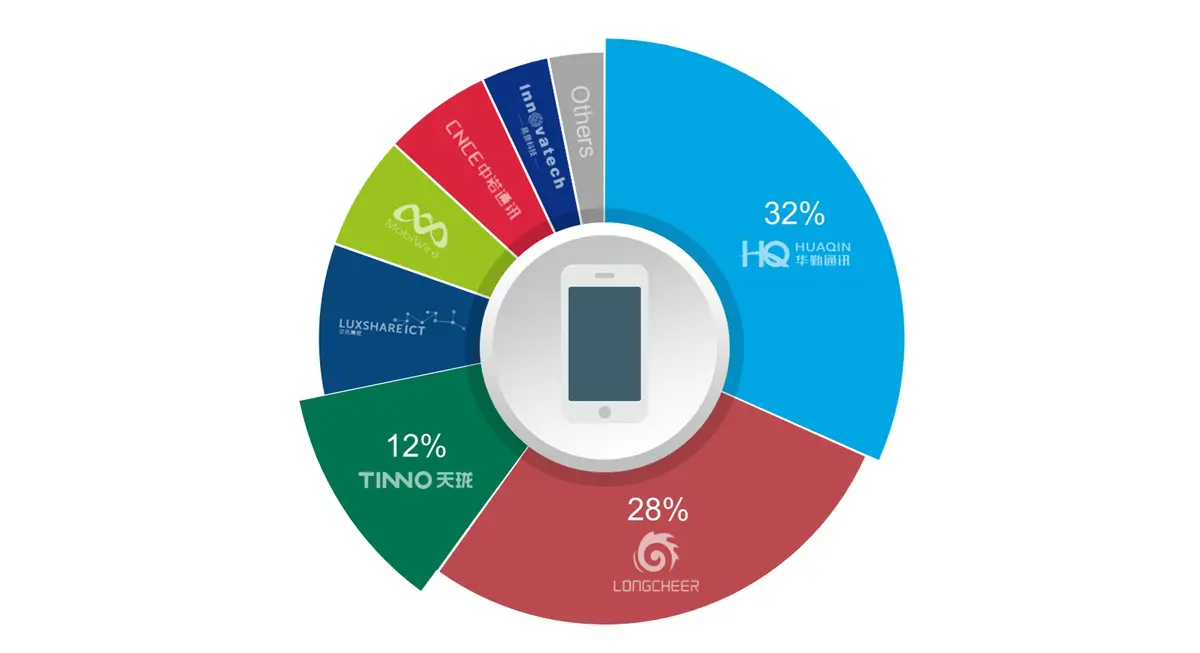
Source: Counterpoint’s Smartphone ODM Tracker
Note: *Starting from 2025, Wingtech's ODM business becomes part of Luxshare.
Despite the market downturn, Huaqin maintained its market leadership, followed by Longcheer. Senior Analyst Ivan Lam said, “While both companies were largely able to secure supplies, often through OEM-backed price increases, this led to higher costs and ultimately raised end-product prices. Given the scale of shipments, such pressure is difficult to absorb, especially in the entry-level segment where margins are minimal and pricing is highly competitive.”
TINNO managed to achieve YoY growth amid the challenging conditions, thanks to increased orders from Lenovo Group. Notably, all of the top-10 best-selling smartphone models from ODM and IDH companies were produced by these three players.
In response to soaring costs, smartphone OEMs have already begun either reducing SKUs, especially in the low-end segment, or passing at least part of the cost increase to consumers through higher prices. Either approach is expected to dampen market demand. This ripple effect is projected to lower ODM and IDH shipments in 2026.
Caught between reduced orders and competitive pressure, ODMs and IDHs find themselves in a difficult position – they cannot afford to exit the low-end segment for fear of losing customers to rivals. The traditional procurement model of lining up orders before sourcing components has given way to a more cautious approach, where inventory availability now dictates which orders to accept. To survive, many are diversifying into new revenue streams, such as AI servers and robotics.
However, the impact on ODMs and IDHs is uneven. Leading companies can leverage their financial strength, economies of scale and product mix flexibility to weather the market downturn. In contrast, small companies face more severe challenges due to their limited flexibility. As a result, we expect ODM and IDH shipments to drop more sharply than the global smartphone market in 2026, putting a pause on the sector’s years of growth and rising importance. The next two years will truly test the resilience of ODMs and IDHs.
About Counterpoint Research
Counterpoint Research is a global market research firm specializing in products across the technology ecosystem. We advise a diverse range of clients – from smartphone OEMs to chipmakers and channel players to Big Tech – through our offices located in the world's major innovation hubs, manufacturing clusters and commercial centers. Our analyst team, led by seasoned experts, engages with stakeholders across the enterprise – from the C-suite to professionals in strategy, analyst relations (AR), market intelligence (MI), business intelligence (BI), product and marketing – to deliver services spanning market data, industry thought leadership and consulting. Our core areas of coverage include AI, Automotive, Consumer Electronics, Displays, eSIM, IoT, Location Platforms, Macroeconomics, Manufacturing, Networks and Infrastructure, Semiconductors, Smartphones and Wearables. Visit our Insights page to explore our publicly available market data, insights and thought leadership, and to understand our focus, meet our analysts and start a conversation.

