

As AI workloads push the boundaries of data center infrastructure, cooling has emerged as one of the most critical challenges. High-density racks, filled with power-hungry GPUs, generate far more heat than traditional computing racks and air cooling is no longer sufficient. Today, most high-performance AI servers and racks use cold plates as part of a Direct Liquid Cooling (DLC) system. However, traditional cold plate-based single-phase cooling systems cannot accommodate the escalating power densities of next-generation accelerators. For example, NVIDIA’s Rubin Ultra GPU is estimated to have a Thermal Design Power (TDP) of 3.6 kW, while the next-generation Vera Rubin VR200 superchip’s TDP is expected to be a staggering 5 kW!
To address these challenges, the industry is turning to advanced cooling technologies such as two-phase cooling, immersion cooling and even microfluidics, in which cooling channels are etched onto the processors themselves.
Single Phase vs Two-Phase Cooling
While single-phase liquid cooling is superior to air cooling, it is insufficient for next-generation rackscale systems. As GPU TDPs exceed 3.5 kW and rack densities increase beyond 150 kW, the industry is hitting a “flow rate” wall. Removing heat from a 150kW rack requires pumping a high volume of fluid. This must be done without significantly increasing the fluid’s temperature, or the GPUs will throttle back. This results in very high fluid flow rates flowing through the narrow, dense microchannels of high-performance cold plates.
To keep fluid velocities manageable, the pipes must become thicker. Even so, the coolant can physically scrub the copper walls of the cold plates and piping at high velocities, leading to pinhole leaks over time. In addition, pumps and high-velocity fluid flow create mechanical vibrations that can affect the sensitive alignment of optical interconnects used in compute and networking fabrics such as NVLink/UALink and Infiniband. By leveraging a fluid’s latent heat of vaporisation, however, two-phase systems can remove the same amount of heat as single-phase systems using only about 10% of the flow rate. Not only does this provide more efficient cooling, it also eliminates the need for complex plumbing and pumping infrastructure.
Table 1 compares the characteristics of single-phase cold plate, two-phase Direct-to-Chip and two-phase immersion cooling systems.
| Feature | Single-PhaseCold Plate | Two-phaseDirect-to-Chip | Two-PhaseImmersion |
| Coolant | Water/glycol | DielectricRefrigerant | DielectricRefrigerant |
| Flow Rate | High (220 LPM[1]) | Low (45 LPM) | None |
| MaximumGPU TDP | 2000W | 3500W+ | 3500W+ |
| Maintenance | High | Moderate | Complex(Tank based) |
| Coherency | Balanced by manifold | Inherently stable | Perfectly uniform, |
[1] Litres Per Minute
Source: Counterpoint Research
Table 1: Comparison of Single-Phase versus Two-Phase Cooling for a 150kW Rack
ZutaCore’s Solution
ZutaCore®’s HyperCool® technology is a waterless, two-phase, direct-to-chip (D2C) cooling system. The cold plate sits directly on top of the processor (CPU/GPU), bringing the cooling mechanism right to the heat source rather than relying on air or remote heat sinks. Unlike traditional liquid cooling using water or glycol, ZutaCore uses a non-conductive, non-corrosive dielectric fluid which leverages the physics of "pool boiling" to manage heat.
As the liquid coolant enters the cold plate, it absorbs heat and boils at a controlled, low temperature within the microchannels. The phase change from liquid to vapour absorbs a large amount of thermal energy due to the latent heat of vaporization. This is much more effective than single-phase liquid or air cooling. The vapour then travels naturally to the Cooling Distribution Unit (CDU) within a closed-loop system, where it is condensed back into liquid form. The cooled liquid is then circulated back to the cold plates.
Key Advantages of ZutaCore’s design
- High Cooling Capacity – can accommodate very high wattage chips without throttling. For example, ZutaCore claims that its cold plates can today cool processors with a TDP of 3,500W and above, making them suitable for NVIDIA’s current and future chips.
- Eliminates thermal gradients – in a single-phase system, the outlet side of a two-die GPU is always hotter than the inlet side. As the fluid boils at a constant temperature, two-phase cooling eliminates the thermal gradient, keeping the entire GPU surface at a constant temperature. This enables higher boost clocks and more stable AI performance.
- Energy Efficiency and Sustainability - enables heat reuse and lower Power Usage Effectiveness (PUE), a key metric that defines the energy efficiency of a data center.
- Flow Rate Efficiency – due to the phase change’s efficiency, ZutaCore requires about 80% less pumping power and a much lower flow rate (approximately 0.3L/min per kW) than water-based systems. This means that the cooling pipes are much thinner, making the rack less crowded and easier to service.
- Waterless, Non-Conductive Fluid - uses a non-conductive, non-corrosive next-generation dielectric fluid. In the event of a leak, there is zero risk of short circuits or hardware damage as the fluid does not conduct electricity and will simply evaporate.
- Self-Regulating - ZutaCore’s system uses a reservoir that automatically maintains a constant liquid level to prevent dry-out and a patented fin/wick arrangement inside the cold plate to ensure uniform boiling across the chip without hot spots being formed. The more heat a chip produces, the faster the fluid boils, meaning the cooling scales instantly with the workload without needing complex pump speed adjustments.
- Scalability & Retrofit Benefits - can be deployed in new or existing rack systems with minimal infrastructure changes.
- 1U Form factor – the system is compact enough to fit into standard 1U server chassis, replacing bulky heat sinks and fans while maintaining high server density. ZutaCore offers a number of unique form factors that allow for liquid cooling without the plumbing.
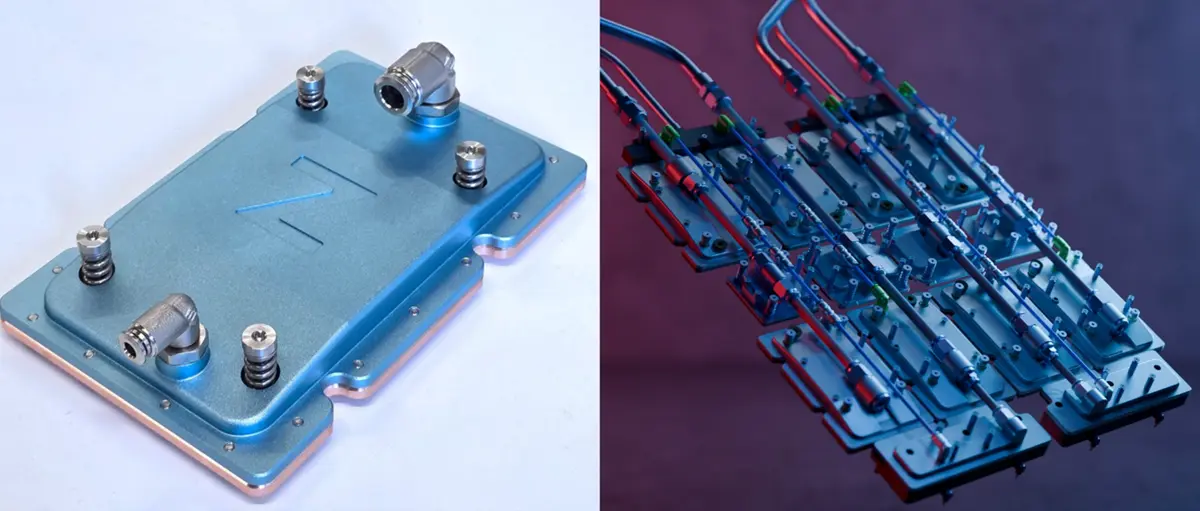
©ZutaCore
Figure 1: ZutaCore’s NVIDIA HGX B300 server loop
Partnerships And Server Availability (2025-2026)
ZutaCore’s strategy is to sell its HyperCool® solution through a global ecosystem of partners spanning System Integrators, OxMs and data center infrastructure partners. This includes factory-warranted waterless liquid-cooling solutions for the NVIDIA HGX B300 server with ASRock Rack and the AMD Instinct MI355x platform with Compal.
Analyst Viewpoint
ZutaCore is a pioneer in low-pressure, two-phase cooling and was the first vendor to launch a monolithic dielectric cold plate capable of cooling NVIDIA’s HGX B300 server. Today, it is the most prominent commercial player in two-phase liquid cooling.
Traditionally, the biggest challenge facing two-phase cooling systems has been the environmental impact of certain dielectric fluorinated fluids. ZutaCore’s design, which uses Honeywell’s R1233ZD next-gen fluid, has already been validated by major server OEMs such as ASRock and Compal, who are now integrating ZutaCore’s cooling solution into their high-end AI servers. Validation also means ensuring that all cooling components (cold plates, manifolds, pipes, O-Ring seals, etc.) will not degrade when in contact with the fluid over their expected lifespans.
As a result, Counterpoint Research believes that ZutaCore is in pole position to benefit from the imminent transition from single-phase to two-phase liquid cooling. As its solution is waterless, not only is the company well placed to capture market share in new data center installations, it is also well positioned to capture a sizeable share of the 80% of data centers that are air-cooled and who want to eliminate the risk of water damage to their $40,000+ GPUs!

