Siemens Eigen: The Industrial Engineering Agent
Analyst Take
Siemens’ AI agent Eigen is the most consequential industrial AI launch we have tracked this cycle. The German engineering company has wrapped a frontier model in two decades of PLC, HMI, and drive context and shipped it inside the toolchain engineers already use. We see three near-term consequences:
- Siemens widens its lead in the software-defined factory and converts TIA Portal from a design tool into a recurring-revenue platform;
- ABB, Rockwell, and Schneider now face a 12-18-month catch-up window on agentic capability, not just copilot parity; and
- The bottleneck for industrial AI shifts from model quality to integration depth, which favours incumbents with installed hardware bases over pure-software entrants.
Hannover Messe 2026 has marked the transition of Industrial AI from 'conversational assistance' to 'agentic execution.' Siemens' launch of the Eigen Engineering Agent represents the cornerstone of this shift. This report analyses the Eigen Agent's architecture, commercial model, adoption trajectory, and competitive implications, positioning Siemens as the primary orchestrator of the software-defined factory.
The Eigen Engineering Agent: A Paradigm Shift
For the past two years, the industrial sector has experimented with LLM-based 'copilots' that offer code suggestions or manual summaries. At Hannover Messe 2026, Siemens effectively ended the copilot era by introducing Eigen which is the first true autonomous engineering agent integrated directly into the industrial toolchain.
The Eigen Engineering Agent is a purpose-built industrial AI system designed to autonomously execute engineering tasks. Unlike traditional AI copilots that assist engineers through suggestions or code generation, Eigen is designed to plan, execute and validate tasks within real engineering environments.
The system is tightly integrated into Siemens’ engineering ecosystem, particularly environments such as TIA Portal, allowing it to operate directly on live projects rather than in isolated development environments. Eigen is positioned as a foundational step toward agentic AI in industry, where AI systems move beyond augmentation and begin to take ownership of execution workflows.
Eigen’s superiority stems from its 'Closed-Loop Execution' model. While standard AI models are 'open loop' (they generate output and leave validation to the human), Eigen operates within a cycle of:
- Contextual Ingestion: Accessing live project data, hardware topologies, and safety constraints.
- Task Decomposition: Breaking complex goals into sub-tasks across PLC logic, HMI design, and drive configuration.
- Autonomous Iteration: Executing logic, testing it against a virtual controller, and self-correcting when errors are detected.
This shift from a 'chatbot' to a 'worker' is critical. It moves the human engineer from a role of 'writer' to a role of 'reviewer/architect,' dramatically increasing the throughput of engineering departments.

Eigen: Strategic Implications & Deployment
The launch of Eigen is more than a technical milestone as it establishes a durable strategic moat. By embedding the agent deep within the Xcelerator ecosystem, Siemens is constructing a gravity well for industrial data, in which engineering artifacts, hardware telemetry, and process knowledge increasingly accrue to a single platform. The competitive implication is straightforward: switching costs for Siemens automation customers rise materially once Eigen is in production use, and the value of the broader Xcelerator subscription compounds with each additional workflow the agent absorbs. Siemens customers use Xcelerator as their launchpad for Industrial AI, with the marketplace, portfolio, learning hub, ecosystem and community in one place.
The Economic Impact
Siemens has priced Eigen at $175/month per license with a 12-month commitment and the first month free. For an automation engineering firm, this cost is negligible relative to the 50% efficiency gains reported in early pilots, and the payback period on a single seat is measured in weeks rather than quarters. More than 100 companies across 19 countries have already piloted with Eigen, and early adopters report that onboarding times for junior engineers have compressed from several weeks to a matter of days. The implication for labour economics is significant: Eigen effectively converts a structural skills shortage into a software-licensable productivity input.
The implications for Siemens' business mix are equally important. Digital Industries has historically been weighted toward hardware-led revenue tied to capital equipment cycles, with software a smaller but faster-growing contributor. Eigen accelerates the rebalancing of that mix. Subscription revenue from the agent recurs annually and is decoupled from the order intake patterns that drive PLC, drive, and motion-control demand, which gives Siemens a more predictable revenue base across the industrial cycle. For the broader automation market, this matters because it signals a structural change in how value is captured: the unit of monetization is shifting from the controller on the cabinet to the software subscription that produces its code. Competitors that remain anchored to hardware-attached licensing models will find it progressively harder to match Siemens on the metrics that increasingly define industrial software leadership, namely ARR growth, net retention, and depth of workflow coverage.
By bridging the gap between high-level intent and machine-ready code, the Eigen Engineering Agent empowers engineers to automate repetitive tasks with unprecedented speed and precision, directly addressing the global shortage of skilled labor while setting a new standard for Edge AI in smart manufacturing.
Adoption Signals and Proof Points
The opportunity becomes more interesting when sized against the installed base. Siemens does not disclose TIA Portal seat counts, but industry estimates place the engaged engineering population at more than 300,000 globally. At $2,100 per user per year, a 20% attach rate over three years implies more than $125 million in recurring software revenue from Eigen alone. While modest in the context of Siemens' overall revenue base, this figure is a meaningful leading indicator for the broader Xcelerator ARR trajectory that Digital Industries segment investors have been monitoring closely.
Early deployments skew toward process industry where the engineering bottleneck is most acute. Process industries have been slower to engage, which is consistent with their higher safety-certification burden and more conservative procurement cycles. The 100-customer, 19-country footprint achieved after a single show cycle is the most surprising data point in the launch narrative.
Risks and What Could Derail the Story
The bull case for Eigen rests on adoption velocity, but four risks could compress the trajectory. Cybersecurity is the headline concern: an agent with write-access to live PLC code is a high-value target, and a single publicized incident in a regulated industry such as pharma, food, or energy would slow procurement across the customer base. Safety certification is the second drag. IEC 61508 and ISO 13849 were written for deterministic code, and regulators have not yet ruled on AI-generated control logic in safety-rated applications. Expect a multi-year process before Eigen output is approved for Safety Integrity Level (SIL)-rated functions, which caps its near-term addressable workload. Third, labour and union pushback in Germany and the Nordics is real. Works councils have already flagged agentic AI as a co-determination issue, and Siemens will need to navigate that carefully in its home market. Finally, model risk: Eigen's closed-loop validation reduces but does not eliminate hallucination, and the 'human-in-the-loop' backstop only works if reviewers stay engaged rather than rubber-stamping output, a well-documented failure mode in adjacent industries.

Competitive Landscape
Industrial AI Comparison
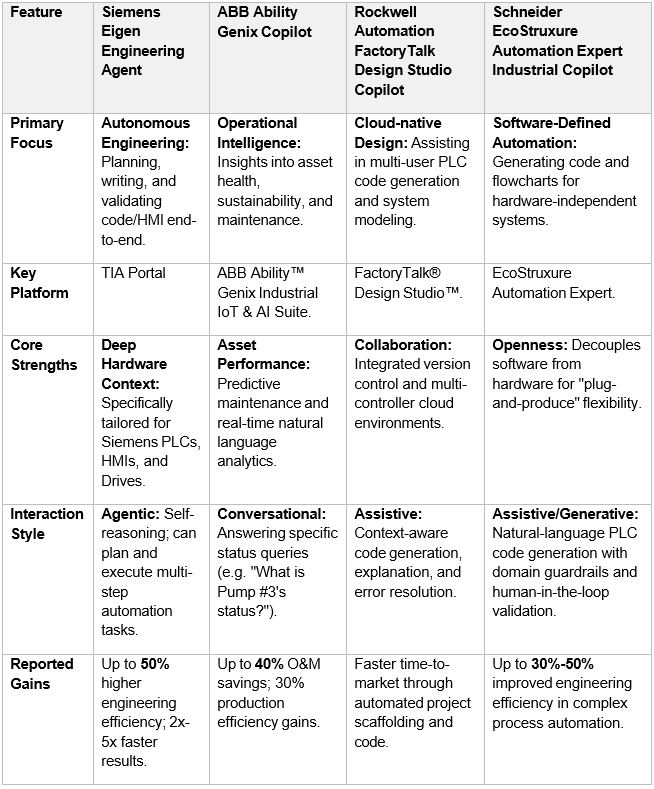
Roadmap: What to Watch Over the Next 12 Months
Eigen's first 12 months will be judged on four catalysts, and our read of the launch points to where investors and customers should focus. The first is multi-agent orchestration. Siemens is building toward Eigen instances that hand off work from one specialised agent to the next, with an engineering agent passing to a commissioning agent and then to a maintenance agent, closing the loop from design through operations. The second is platform expansion beyond TIA Portal into Teamcenter for product lifecycle management and InsightsHub for operations, which would convert Eigen from a single-purpose engineering tool into the connective tissue across the Xcelerator stack. The third is partner-led deployment through Accenture, Capgemini, and regional systems integrators, which we expect to dominate the go-to-market motion given the integration work each customer requires. The fourth is on-premises inference to address the data sovereignty concerns that have slowed cloud-based industrial AI in Germany and Japan.
Taken together, these catalysts will determine whether Eigen consolidates Siemens' lead or merely defines the category for fast followers to copy. The decisive watch-item is timing: whether Siemens can ship multi-agent orchestration before ABB and Rockwell close the single-agent gap. If it does, the software-defined factory becomes a Siemens-anchored ecosystem for the remainder of the decade. If it does not, the window we identified at the top of this note narrows significantly, and the competitive thesis will need to be revisited.
Category
Industry
AI
Service
Standard
Report Type
Report
Time Period
Other
Receive our insightful weekly newsletter and stay ahead of the competition.
Author
Mohit Agrawal


Mohit is responsible for tracking Digital Transformation and Internet of Things (IoT) at Counterpoint Research. He has over two decades of rich industry experience having worked with large tech companies like Accenture, Airtel, Nokia, and Microsoft in the past. Before joining Counterpoint, Mohit was the co-founder & CEO of a start-up in the competitive and market intelligence space utilizing big data and AI. He is a keen follower of the developments in devices and key internet technologies like IoT, Blockchain, AI, etc. Mohit is an engineer, MBA and a certified project management professional. He is based out of The Hague in Netherlands.