Beyond Perception: The Three Trends Shaping Automotive Intelligence - Takeaways from 2026 Qualcomm Summit
The 2026 Qualcomm Automotive Technology and Cooperation Summit took place in Wuxi, China on June 4th and 5th. Featuring more than 60 keynote speeches, the event brought together over 70 automotive electronics suppliers showcasing more than 50 real-vehicle demonstrations and test-ride experiences. Highlights included innovative solutions and real-world deployment breakthroughs across AI agent full-scenario experiences, AI multimodal interaction, cockpit-driving integration, and Advanced Driver Assistance Systems (ADAS) capability advancements. In this report, Counterpoint summarizes the key progress and industry trends unveiled at the summit across intelligent cockpits, ADAS, and cockpit-driving integration.
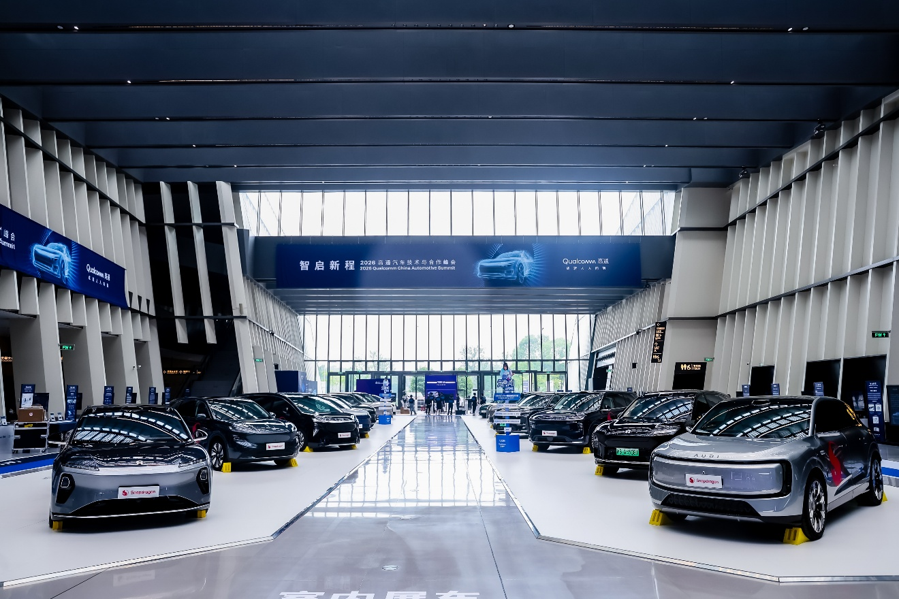
Source: Qualcomm
1. Intelligent Cockpit: Evolution from Perceptual Intelligence to Agentic AI
As automobiles evolve from “mobile terminals” into “mobile carriers for AI agents”, in-cabin interaction paradigms are shifting from voice-dominated to multimodal perception; the customer-oriented service models are upgrading from passive response to proactive service; and in-vehicle AI capabilities are undergoing an upgrade trajectory from computer vision-driven intelligence to responsive AI, and further to agentic AI.
During the summit, Qualcomm, together with ecosystem partners including ArcherMind, Autolink, Banma Intelligence, Desay SV, Megatronix, and Thundersoft, jointly announced the “In-vehicle Claw Ecosystem Initiative” marking an acceleration in the large-scale deployment of AI agent assistants in vehicles.
In the summit's exhibition area, the initial deployment outcomes of Qualcomm and its industry ecosystem partners' joint efforts to “bring AI agents on board vehicles” are already visible:
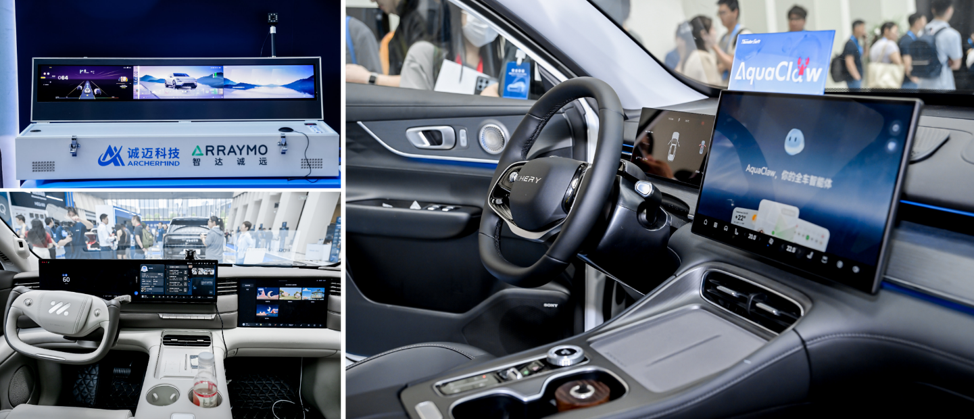
- ArcherMind presented “Firefly Claw”, built on the Snapdragon Automotive Elite Platforms (top left picture of Exhibit 1), delivering an OpenClaw-like agent experience for on-board assistants.
- Banma Intelligence showcased a real-vehicle solution for its AutoOmni full-modal on-device large model based on the Snapdragon 8397 (bottom left picture of Exhibit 1), as well as a real-vehicle demonstration of its “AutoClaw” cockpit collaboration service powered by the Snapdragon 8295, enabling multi-dimensional agent interaction experiences. According to Banma Intelligence, a "full-modal" (or "omni-modal") model goes beyond a conventional multimodal model in fundamental ways. The essence of the omni-modal model lies in its unified perception-and-generation engine with multi-sensory collaboration, whereas a conventional multimodal model is essentially built upon a text model augmented with visual plug-ins.
- ThunderSoft launched “AquaClaw”, an in-vehicle AI agent experience tailored for the Snapdragon Automotive Elite Platforms (right picture of Exhibit 1).
- Neusoft Smart Go (a wholly owned subsidiary of Neusoft) developed an on-device AI intelligent cockpit domain controller based on the Snapdragon 8397, which has secured design wins with multiple leading Chinese automakers.
According to Counterpoint's research, in-vehicle AI agents typically deliver capabilities spanning in-cabin and exterior visual perception with multimodal interaction, on-device memory and personalized services, as well as multi-turn dialogue and cross-domain coordination. Examples include:
- "What-you-see-is-what-you-get" comprehension of real-time interactive content — for instance, such as the car provides the answer in real time for, "What is the second icon in the top-left corner of the screen?", or "What does the crab icon on the screen mean?"
- Proactive service triggering — for example, the car automatically turns on the reading light when a rear-seat passenger is detected using a phone.
- Automatic extraction of user preferences from conversational interactions (e.g., taste preferences, favorite music, etc.).
Taking Banma Intelligence's solution as an example, the capabilities demonstrated are powered by a 4B-parameter on-device model running on the Snapdragon 8797. This model is built on a full-modal on-device architecture, supporting localized inference and execution.
Exhibit 1: AI Agent Demos in 2026 Qualcomm Automotive Technology and Cooperation Summit
Source: Counterpoint Research
According to Counterpoint's assessment, 2026 to 2027 will be an inflection point for the deployment of agentic AI in intelligent cockpits in the Chinese market. The main driving factors behind this include the advancement of on-device computing power, the interworking of hardware resources across cockpit and ADAS underlying platforms, and the prosperity of the on-device software and hardware ecosystem in China.
In addition to the announcements and demonstrations from the supply-chain side, Li Bin, the founder of NIO, also echoed Counterpoint's assessment in his speech. Li proposed working together with Qualcomm to promote efficient coordination of whole-vehicle computing power and cross-domain integration, to improve the utilization efficiency of core components such as memory and achieve overall cost control. Meanwhile, he also proposed jointly building an open agent platform with Qualcomm and fostering an open and thriving agent ecosystem.
2. Intelligent Driving: L2++ ADAS Evolves from a Differentiating Feature to a Standardized Safety Component
During the summit, ADAS solution providers showcased their respective commercialization progress*. Specifically,
- DeepRoute.ai: Over 10 vehicle models in mass production, covering a market scale of 300,000 units. Over one million vehicles are expected to be produced and delivered by the end of 2026.
- Momenta: Since 2022, over 100 vehicle models in mass production and more than 210 design wins. Over 900,000 vehicles equipped with Momenta's assisted driving solutions have been produced.
- QCraft: Over 30 vehicle models entered mass production in 2025; more than 50 new models are expected to be launched in 2026.
- WeRide: Secured 30 design wins, with three models already in mass production; the remaining models will roll out sequentially in the second half of 2026.
- ZYT: Over 50 vehicle models in mass production, with more than 130 design wins.
* Note: The above figures on mass production, design wins, and market scale are all sourced from the above companies' on-site promotional posters or forum speeches.
Furthermore, both DeepRoute.ai and QCraft have broadened their corporate positioning to become physical AI companies, moving beyond their original focus on autonomous driving vehicles. ZYT, meanwhile, has expanded its business scope into the category of "mobile physical AI products", which encompasses passenger vehicles, heavy-duty trucks, and autonomous logistics vehicles.
Counterpoint believes that as L4 solution providers (such as WeRide and QCraft) enter the L2 ADAS competition, the penetration rate of L2++ ADAS in newly launched passenger vehicles in the Chinese market is expected to further expand into entry-level and mid-range vehicles from 2026 to 2027. As L2/L4 solution providers expand their business scope into physical AI, the evolution of foundation models in the physical AI domain is expected to bring a new paradigm shift to autonomous driving models and algorithms. With greater adoption of L2++ ADAS and the introduction of this new paradigm, the functional positioning of L2++ ADAS will shift from its current role as a differentiating competitive feature toward that of a standardized safety component.
3. Cockpit-Driving Integration: A Critical Stage for Vehicle Intelligence on the Path to Central Computing
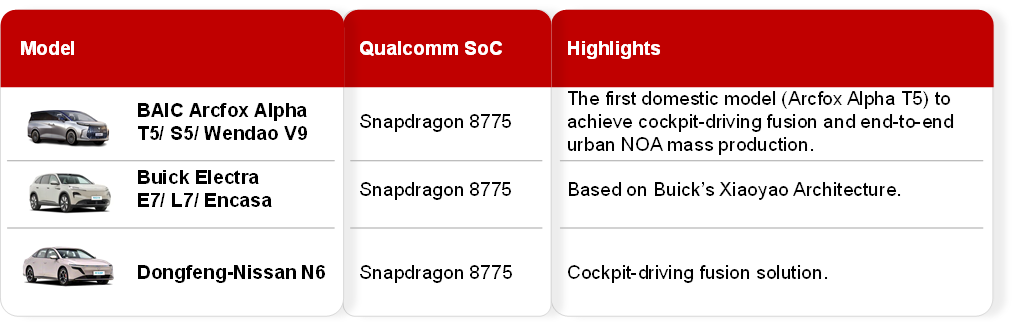
As revealed by Qualcomm at the summit, the Snapdragon Ride Flex SoC (Snapdragon 8775), launched in 2023 as the world's first single-SoC scalable platform supporting both intelligent cockpits and ADAS, has now entered mass production deployment with nine design wins. The Chinese market has undoubtedly become the primary stage for this SoC platform's adoption. According to Counterpoint's statistics, vehicle models already in mass production on the Snapdragon 8775 platform are listed in Exhibit 2.
Exhibit 2: Mass Production Models on the Snapdragon 8775 Platform
Source: Counterpoint Research
In addition, both Leapmotor D19 and D99 are equipped with central domain controllers powered by dual Snapdragon Ride Elite Platform (Snapdragon 8797) SoCs. According to Counterpoint's research, through the tripartite collaboration between Qualcomm, Leapmotor (self-developed hardware platform), and DeepRoute.ai (algorithms), the Leapmotor D19 — equipped with dual Snapdragon 8797 SoCs — achieved mass production just six months after the chip platform became available. This remarkable production turnaround was driven by the R&D pace of Chinese partners, combined with the maturity of Qualcomm's toolchain, software reusability across product generations, and local service and support capabilities.
According to Qualcomm, a multi-SoC platform based on multiple Snapdragon 8797 SoCs can deliver up to 2,000 TOPS-class overall effective computing power. Currently, Qualcomm is working to extend support for the Snapdragon Ride Flex cockpit-driving integrated architecture down to a single Snapdragon 8797 SoC. Meanwhile, to expand its capability coverage in lower-tier market segments, Qualcomm is also introducing new products to the Snapdragon Automotive Elite Platform family and will bring these capabilities to the Snapdragon 8787 in the future.
During the summit, Qualcomm presented multiple latest achievements based on the Snapdragon Automotive Elite Platforms:
- Deepening cooperation with SAIC Volkswagen to jointly advance innovative exploration of in-vehicle intelligent technologies based on the Snapdragon Automotive Elite Platforms.
- Co-launching with ZYT a next-generation cockpit-driving integrated domain controller based on the Snapdragon 8797, to jointly drive the large-scale adoption of cockpit-driving integrated solutions across more vehicle models and future mobility scenarios.
According to Counterpoint's statistics, in the exhibition area, over 10 Tier 1 suppliers and ecosystem partners showcased cockpit-driving integrated products based on the Snapdragon 8775 and Snapdragon 8797.
4. Analyst Take
Since 2021, Snapdragon Digital Chassis solutions have supported numerous Chinese automakers in launching over 300 intelligent connected vehicle models. If electrification represented the first wave of competition in China's automotive market, then in the second wave of intelligent competition, Qualcomm is injecting new vitality into China's fully competitive market through a portfolio of products including the Snapdragon Ride Flex cockpit-driving integrated platform, Snapdragon Ride Elite Platform, and Snapdragon Cockpit Elite Platform.
Amid the second wave of intelligent competition in China's automotive market, Counterpoint has identified the following trends:
- Intelligent cockpit: “On-device LLM + Agent framework” is now standard for leading automakers; future competition will pivot from feature count to service continuity and contextual understanding depth.
- Intelligent driving: L2++ ADAS will further penetrate entry-level models and Internal Combustion Engine (ICE) vehicles. The paradigm shift brought by AI models will drive the next round of user experience improvements.
- Cockpit-driving integration: From the Snapdragon 8775 to 8797, cockpit-driving integration in lower-end models is driven by cost reduction, while in high-end models it is driven by enhanced user experience. The organizational structure of automakers' R&D teams remains the major barrier to the rapid adoption of this type of solution.
Additionally, AI-native organizations are emerging as a new competitive moat. A company's ability to deeply integrate artificial intelligence into its operational processes will determine its long-term innovation capability.
Category
Industry
Automotive
Service
Standard
Report Type
Report
Time Period
Other
Receive our insightful weekly newsletter and stay ahead of the competition.
Author
Kevin Li

Kevin is an Associate Director at Counterpoint Research based in Beijing. At Counterpoint, he leads the China automotive market research. Kevin has 12 years of experience in 5G/V2X, connected vehicles, intelligent cockpits, and intelligent driving in market analysis firms, including Strategy Analytics and TechInsights. Previously, Kevin has worked for China Unicom/China Netcom as a Senior Engineer and International Cooperation Coordinator for 10 years. Kevin holds an MSc in Mobile Communications from Beijing University of Posts and Telecommunications.