

- In 2026, global OLED smartphone panel shipments are expected to decline nearly 3% YoY, reflecting the impact of the memory supply crisis and rising production costs.
- Rigid OLED smartphone panel shipments are expected to decline 24% YoY, while flexible OLED panels are forecast to decrease by only 3%. In contrast, foldable/rollable OLED panels are expected to grow by over 23% YoY.
- Global OLED smartphone panel shipments are projected to reach 858 million units by 2028, compared with 894 million units in 2025, representing a CAGR decline of approximately 1.4% over 2025-2028.
- LTPO technology is expected to account for more than 50% of flexible OLED smartphone panel shipments in 2026, highlighting the accelerating transition towards advanced backplane technologies.
- New power-efficient OLED technologies demonstrated by Tianma, BOE, SDC and other panel makers could create opportunities for product differentiation, support premium panel pricing and restore pricing discipline in the OLED market.
Seoul, Beijing, Berlin, Buenos Aires, Fort Collins, Hong Kong, London, New Delhi, Taipei, Tokyo – November 9, 2026
Counterpoint Research has released its latest Advanced Smartphone Display Shipment and Technology Report, Q3 2026, featuring updated full-year 2026 forecasts and market projections. The report provides insights into global smartphone display shipments, revenue, ASPs, technology transitions and panel supplier dynamics.
The global OLED smartphone panel market is expected to remain under pressure in 2026, with shipments forecast to decline nearly 3% YoY. Memory supply constraints and rising production costs are affecting smartphone demand and production, creating additional challenges for display panel manufacturers.
OLED Smartphone Panel Shipment by Form Factor
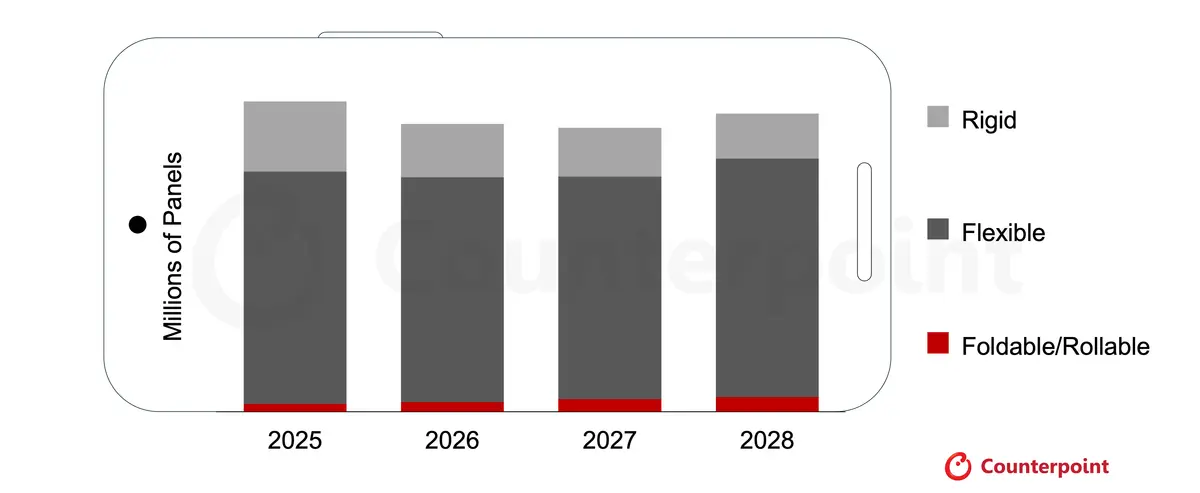
Source: Counterpoint Research's Advanced Smartphone Display Shipment and Technology Report
The chart above shows Counterpoint's forecast for OLED smartphone panel shipments across rigid, flexible and foldable/rollable technologies from 2024 through 2028. Total OLED smartphone panel shipments are projected to decline from 894 million units in 2025 to 829 million units in 2026, before gradually recovering to 858 million units by 2028. Overall, shipments are expected to register a CAGR decline of approximately 1.4% between 2025 and 2028.
Rigid OLED panels are expected to face continued pressure from the transition towards flexible OLED, while foldable/rollable displays are emerging as a promising growth opportunity. "While the smartphone display market is entering a more mature growth phase, foldable OLEDs are expected to remain a key growth driver as more brands introduce new form factors and expand their premium portfolios," said Senior Analyst Nikhil Kishor.
OLED smartphone panel revenue is expected to decline by over 5% YoY in 2026, reflecting weaker shipments and pricing pressure across key segments. However, revenue is projected to recover gradually as demand normalizes and the market shifts towards more advanced display technologies. Foldable/rollable OLED panels are expected to be the fastest-growing segment in terms of revenue, supported by premium positioning and increasing participation from smartphone manufacturers.
Supplier Landscape and Technology Trends
Samsung Display (SDC) is expected to maintain its leadership in the OLED smartphone panel market in 2026, while LG Display (LGD) and BOE are positioned to strengthen their presence through increased business with Apple and other smartphone brands. Competition among Chinese panel manufacturers is also expected to remain intense.
LTPO adoption continues to expand across premium smartphones. Its share of flexible OLED smartphone panel shipments is expected to exceed 50% in 2026 as more brands transition their flagship and gaming models to LTPO technology.
At SID 2026, Tianma demonstrated its polarizer-less GCL OLED Panel and Multi-Frequency Drive AMOLED technology, offering approximately 15-20% lower power consumption, while BOE showcased an AMOLED panel with over 20% lower power consumption through improved optical transmittance and voltage optimization. Samsung Display also highlighted its LEAD 2.0 technology, which combines a polarizer-free OLED architecture with Flex Magic Pixel privacy technology, enhancing light efficiency while enabling integrated privacy functionality.
"These innovations could find their way into upcoming OLED smartphones, enabling panel manufacturers to differentiate their offerings through improved power efficiency and performance. Wider adoption of advanced technologies could also support premium panel pricing and help restore pricing discipline in the OLED panel market," said Senior Analyst Nikhil Kishor.
As the OLED smartphone market enters a more mature growth phase, panel manufacturers will need to focus on cost optimization, power efficiency and technological differentiation to sustain competitiveness.
About Counterpoint Research
Counterpoint Research is a global market research firm specializing in products across the technology ecosystem. We advise a diverse range of clients – from smartphone OEMs to chipmakers and channel players to Big Tech – through our offices located in the world's major innovation hubs, manufacturing clusters and commercial centers. Our analyst team, led by seasoned experts, engages with stakeholders across the enterprise – from the C-suite to professionals in strategy, analyst relations (AR), market intelligence (MI), business intelligence (BI), product and marketing – to deliver services spanning market data, industry thought leadership and consulting. Our core areas of coverage include AI, Automotive, Consumer Electronics, Displays, eSIM, IoT, Location Platforms, Macroeconomics, Manufacturing, Networks and Infrastructure, Semiconductors, Smartphones and Wearables. Visit our Insights page to explore our publicly available market data, insights and thought leadership, and to understand our focus, meet our analysts and start a conversation.
Follow Counterpoint Research