

- Chinese material suppliers are set to capture 50% of the China market by 2028, reaching $603 million in revenues by 2030.
- Gen 8 OLED fabs from BOE, TCL CSOT and Visionox will expand capacity in China and drive supply chain localization.
- IT segment expected to grow at a 33.4% CAGR and replace TV in second place behind Mobile Phone in 2028.
- Tandem stacks and future MacBooks to drive demand for OLED materials in notebooks.
Beijing, Berlin, Buenos Aires, Fort Collins, Hong Kong, London, New Delhi, Seoul, Taipei, Tokyo – September 21, 2026
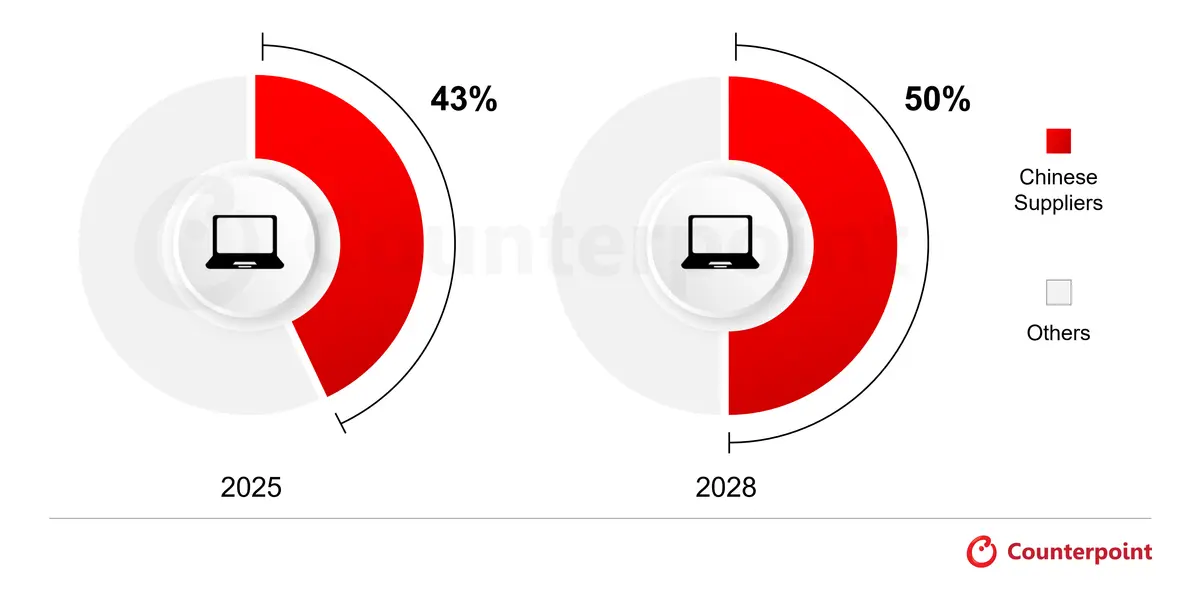
Chinese AMOLED material suppliers are expected to increase their market share and reach a combined revenue of $603 million by 2030, according to Counterpoint Research’s AMOLED Materials Report. 2028 will mark a turning point, when new Gen 8 fabs in China are scheduled to begin full-scale operation, driving a large increase in sales for local suppliers. From 2028 onwards, Chinese suppliers are expected to account for 50% of OLED materials sales in China, up from 43% in 2025.
Revenue Share of AMOLED Materials in China
Source: Counterpoint Research AMOLED Materials Report
Commenting on the market forecast, Associate Director Guillaume Chansin said, “In 2025, Chinese material suppliers saw a large increase in sales, beating our previous forecast by 7%. We expect a slight decline in 2026 as OEMs navigate challenging market conditions alongside the memory price hike. The new fabs from BOE, TCL CSOT and Visionox will not only expand capacity in China but are also expected to accelerate localization of the supply chain.”
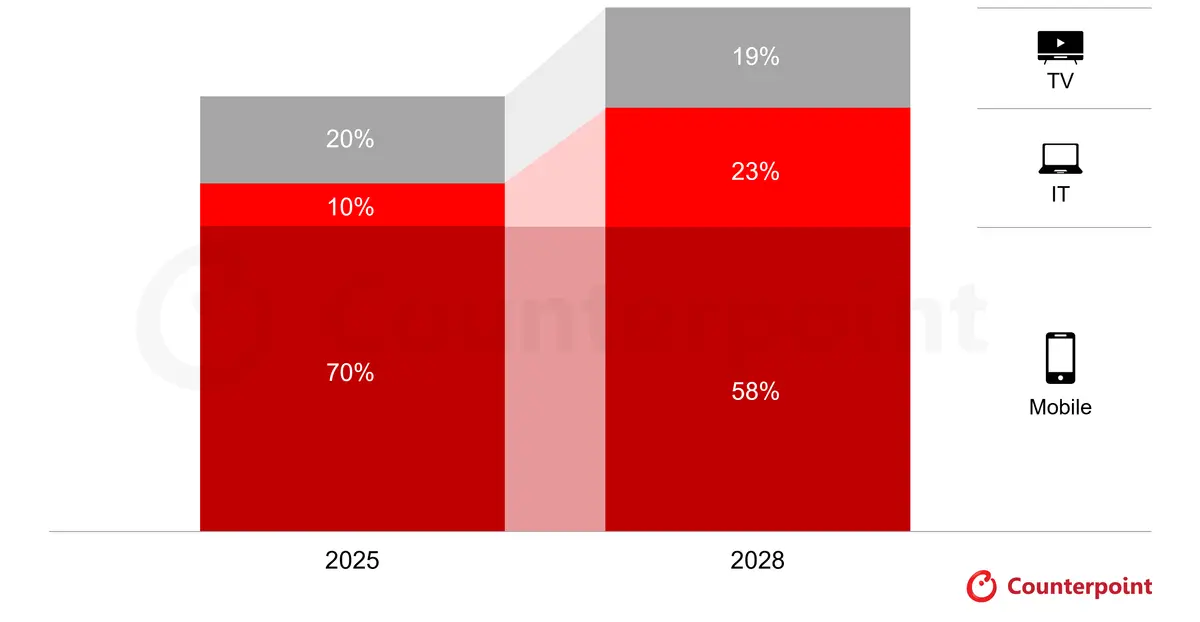
Together with Samsung Display’s A6 line in South Korea, the new Gen 8 fabs in China will also boost production of OLED panels for IT applications. By 2028, IT will replace TV as the second largest segment, capturing 23% of global AMOLED material revenues. IT revenues are expected to grow at a 33.4% CAGR between 2026 and 2030. Mobile phones will remain at the top spot, but revenues will only grow at 1.4% CAGR during the same period.
Commenting on the growing IT segment, Research Director Bob O’Brien said, “Demand for OLED in notebooks is increasing and offsetting lower growth for OLED TVs. Along with rising notebook panel shipments, material consumption is also higher in tandem OLED stacks used in premium models. While the memory shortage is still hurting smartphone demand, the launch of upcoming OLED MacBooks is expected to drive a new refresh cycle in IT.”
Global AMOLED Materials Revenues
Source: Counterpoint Research AMOLED Materials Report
About Counterpoint Research
Counterpoint Research is a global market research firm specializing in products across the technology ecosystem. We advise a diverse range of clients – from smartphone OEMs to chipmakers and channel players to Big Tech – through our offices located in the world's major innovation hubs, manufacturing clusters and commercial centers. Our analyst team, led by seasoned experts, engages with stakeholders across the enterprise – from the C-suite to professionals in strategy, analyst relations (AR), market intelligence (MI), business intelligence (BI), product and marketing – to deliver services spanning market data, industry thought leadership and consulting. Our core areas of coverage include AI, Automotive, Consumer Electronics, Displays, eSIM, IoT, Location Platforms, Macroeconomics, Manufacturing, Networks and Infrastructure, Semiconductors, Smartphones and Wearables. Visit our Insights page to explore our publicly available market data, insights and thought leadership, and to understand our focus, meet our analysts and start a conversation.
Follow Counterpoint Research
