- The global humanoid robot market maintained rapid growth in H1 2026, with shipments rising nearly 300% YoY to exceed 22,000 units.
- AGIBOT ranked first globally with shipments of 9,700 units, followed by Unitree, Galbot, UBTECH and Leju Robotics. The top five players together accounted for 86% of total shipments.
- In terms of applications, although the combined share of entertainment & performance and data production & research humanoids in total shipments declined moderately, it remained above 60%. Meanwhile, the shares of intelligent manufacturing and warehousing & logistics rose to 13% and 5%, respectively.
- In H2 2026, more pilot projects in the service and industrial sectors will move into mass deployment phases. Leading manufacturers are shifting toward building closed‑loop capabilities covering advanced model adoption, vertical scenario implementation, data system construction and rapid model iteration.
- Global humanoid robot shipments are projected to exceed 50,000 units in 2026.
Seoul, Beijing, Buenos Aires, Hong Kong, London, New Delhi, San Diego, Taipei, Tokyo – August 20, 2026
The global humanoid robot industry is currently at a critical stage for large‑scale commercial rollout. According to Counterpoint Research’s humanoid robot research service, global humanoid robot shipments topped 22,000 units in H1 2026, rising nearly 300% YoY and maintaining strong growth momentum.
Global Humanoid Shipment Share by Vendor, H1 2026
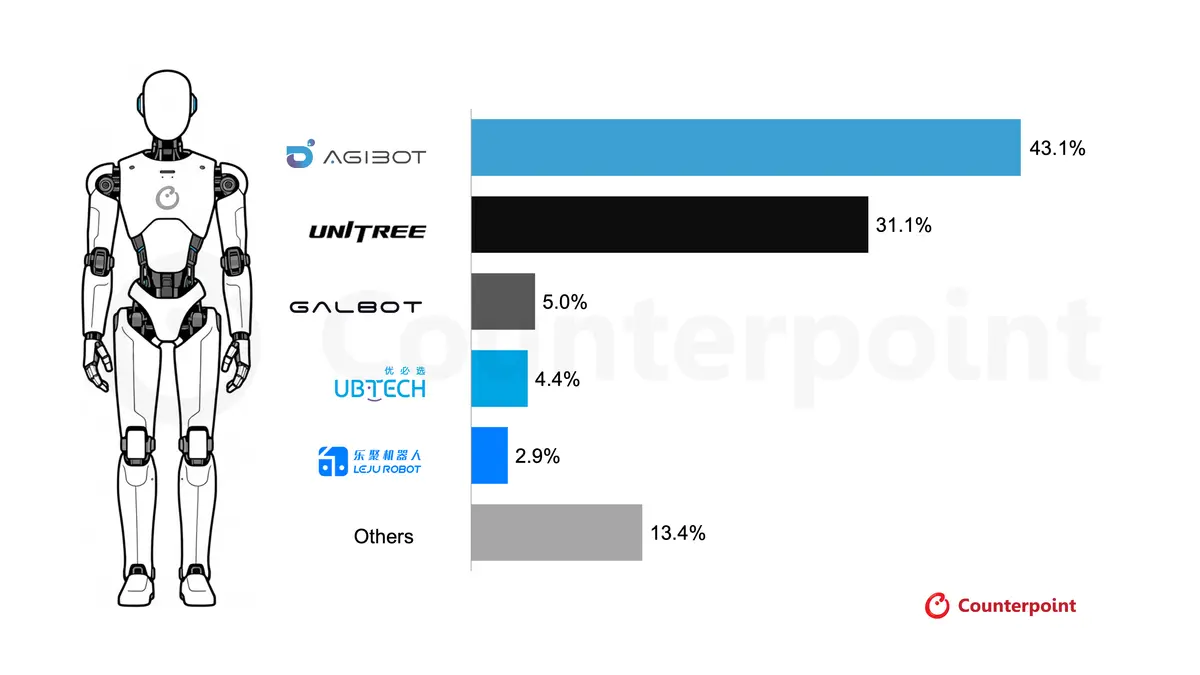
Note: Percentages may not add up to 100% due to rounding.
AGIBOT remained the world’s top humanoid robot vendor by shipments, shipping around 9,700 units in H1 to take a market share of over 43%. The company continues to advance toward its target of achieving revenue of over CNY 10 billion by 2027. Its three product lines – A series, G series and X series – are developing in a balanced manner. Multiple commercial variants have been derived from the X2 to cater to diverse use cases, including entertainment & performance, service & guidance, scientific research & education, and data production. In particular, this product series is widely adopted in China’s domestic entertainment‑performance rental market. Furthermore, tangible industrial progress has been achieved for the G series. Through partnerships with Longcheer Technology and Joyson Electronics, clustered deployments of the G2 have been made at production lines for consumer electronics and automotive components.
In the first half of the year, Unitree’s G1 series remained its main humanoid robot shipment driver, sustaining its competitive edge in the research & education segment. Unitree shipped more than 7,000 humanoid robots over the period, capturing a 31% market share. Backed by consistent profitability, Unitree has successfully listed on the Shanghai Stock Exchange’s Sci‑Tech Innovation Board, signalling strong capital market confidence in the long‑term growth potential of the humanoid robot track.
Since the start of 2026, Galbot has seen rapid shipment growth for its humanoid robots, with cumulative H1 shipments exceeding 1,100 units to take an approximate 5% market share. Beyond its smart pharmacy collaboration with Meituan and accelerated nationwide deployment of its “Galaxy Space Capsule”, Galbot has developed dedicated VLA models for real‑world industrial scenarios and keeps expanding its partner ecosystem in industrial manufacturing. In January 2026, Galbot launched the wheeled dual‑arm Galbot S1 for heavy‑load industrial and logistics scenarios. In March, it announced successful testing on CATL production lines, demonstrating its capability to rapidly adapt to brand‑new operational environments.
UBTECH, a publicly listed humanoid robot company, ranked fourth in H1. Its humanoid robot deliveries reached the thousand‑unit level, accounting for 4.4% of the market. UBTECH’s customer base is concentrated in sectors such as automotive and 3C manufacturing. Management has significantly raised the 2026 shipment guidance for the Walker S series from the original 2,000-3,000 units to 5,000 units. In addition, UBTECH has launched UWORLD, a sub‑brand focusing on home use scenarios like emotional companionship, education and entertainment.
Leju Robotics recorded humanoid robot shipments of 650 units in H1, representing a 2.9% market share. Its Kuavo series has been deployed in multiple humanoid robot data production and training centres. Meanwhile, the company is actively expanding its partner network in industrial manufacturing.
From an application perspective, the combined share of the entertainment & performance and data production & research categories in global humanoid robot shipments edged down in H1 but remained above 60%. Against this backdrop, there is strong tangible demand for small‑form‑factor humanoid robots. Despite competition from new entrants, the AGIBOT X series and Unitree G1 series remain the workhorses of this niche segment, supported by mature toolchains and content creation ecosystems.
Global Humanoid Robot Shipment Breakdown by Application, H1 2026
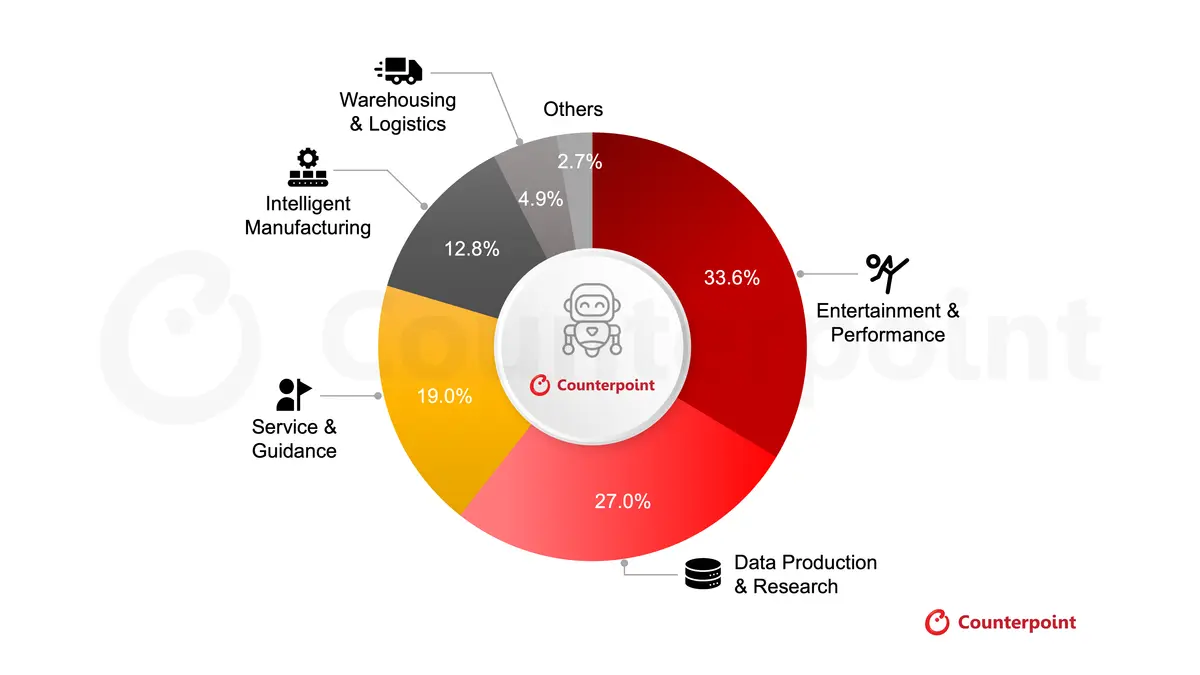
Humanoid robots deployed for the service & guidance segment rank third by shipment volume with roughly 19% market share. Offline retail scenarios, including unmanned pharmacies, have emerged as vital data training grounds. In the same period, market shares for intelligent manufacturing and warehousing & logistics segments also climbed, hitting 13% and 5%, respectively.
In H2 2026, more earlier‑stage pilot projects in the service and industrial sectors will move into mass deployment phases. Humanoid robots are being rolled out for regular operation at transportation hubs, even as automakers are progressively deploying humanoid robot use cases across the full value chain of production, sales and after‑sales services. For standardized tasks such as material handling, sorting and inspection within 3C manufacturing and warehousing & logistics environments, practical deployment solutions adapted to real‑world production conditions are emerging. As world‑model technologies are integrated into existing VLA architectures, humanoid robots face a critical breakthrough window for intelligence and task generalization capabilities.
Over recent months, the fusion of world models and VLA has gradually evolved into an emerging technical paradigm. Supported by world‑model components, the new end‑to‑end Transformer architecture can not only generate actions but also predict continuous states under long‑horizon tasks. This architecture addresses the weaknesses of VLA in physical rule learning and reasoning, delivers enhanced robustness in dynamic environments, and enables generalization under few‑shot or zero‑shot conditions.
AGIBOT has emerged as a key disruptive enabler for large‑scale humanoid robot deployments across industrial and commercial service scenarios. At the AGIBOT Partner Conference (APC 2026) held this April, the company unveiled its multi‑dimensional strategies spanning products, models, data, ecosystem co‑building and innovative business models. Iterated versions of the A3 and G2 robots were released. GO‑3, its self‑developed next‑generation embodied AI foundation model, is making solid progress and is scheduled for official launch this autumn. The RaaS model represented by SHAREBOT lowers commercial adoption barriers for humanoid robots. Meanwhile, Maniformer is positioned as a one‑stop Physical AI data platform integrating data collection and curation. Furthermore, to propel embodied intelligence into a “deployment‑centric” development phase, AGIBOT has rolled out seven productivity‑oriented solutions. AGIBOT’s productization capability has passed the “0‑to‑1” validation stage and entered the “1‑to‑N” scaling‑up phase. According to Counterpoint, as more players build out full‑stack humanoid robot industry ecosystems, the sector will achieve faster and healthier growth.
Counterpoint projects that global humanoid robot shipments will exceed 50,000 units in 2026, representing 210% YoY growth. Looking ahead, over the next five years, service sector and industrial use cases will supersede those from the entertainment & performance and data production & research segments to become the core engines driving demand growth for humanoid robots. At the same time, the core competitiveness of humanoid robot vendors will shift from pure competition over model performance and capacity expansion speed toward building closed‑loop capabilities covering advanced model development, vertical-scenario rollout, data-system construction and rapid model iteration.
About Counterpoint Research
Counterpoint Research is a global market research firm specializing in products across the technology ecosystem. We advise a diverse range of clients – from smartphone OEMs to chipmakers and channel players to Big Tech – through our offices located in the world's major innovation hubs, manufacturing clusters and commercial centers. Our analyst team, led by seasoned experts, engages with stakeholders across the enterprise – from the C-suite to professionals in strategy, analyst relations (AR), market intelligence (MI), business intelligence (BI), product and marketing – to deliver services spanning market data, industry thought leadership and consulting. Our core areas of coverage include AI, Automotive, Consumer Electronics, Displays, eSIM, IoT, Location Platforms, Macroeconomics, Manufacturing, Networks and Infrastructure, Semiconductors, Smartphones and Wearables. Visit our Insights page to explore our publicly available market data, insights and thought leadership, and to understand our focus, meet our analysts and start a conversation.


