- Revenue for the full year 2025 grew 16% YoY driven by robust system and service revenues.
- Strong EUV and immersion tool shipments led 12% YoY growth in system revenue.
- Total 2025 backlog reached €38.8 billion, order bookings in Q4 2025 hit record high of €13.2 billion.
- DUV tool shipments excluding immersion systems declined sharply, leading to a 22% drop in total lithography tool shipments versus 2024, mitigated by growth in EUV.
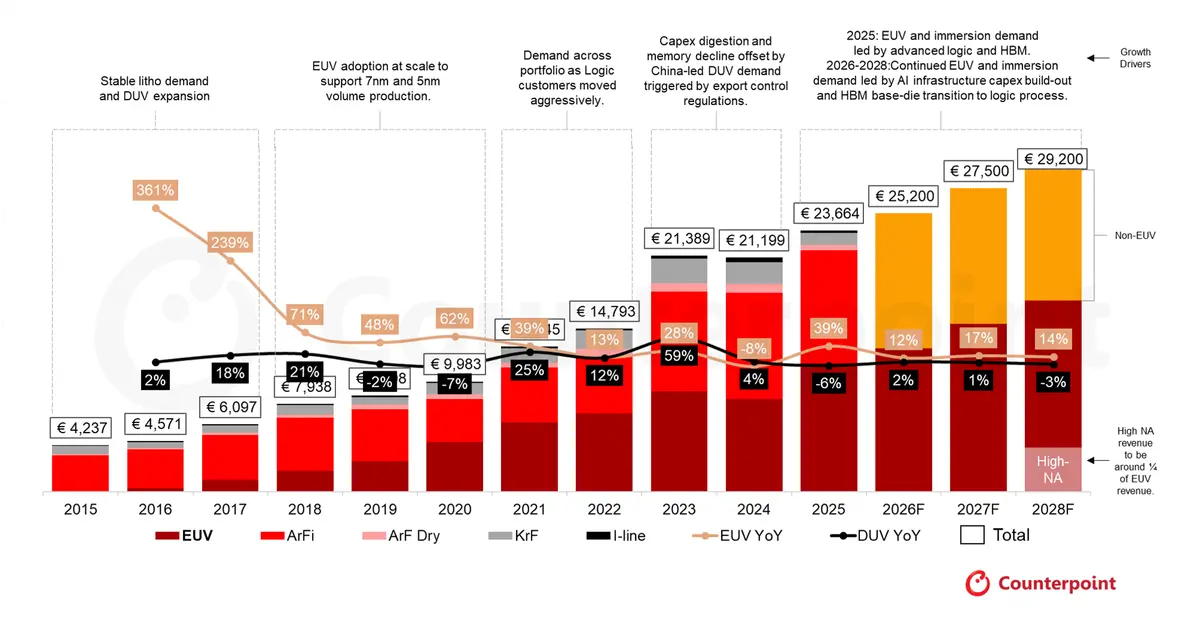
- High-NA tools shipments to account for one fourth of EUV revenue in 2028 primarily enabled by AI infrastructure capex spends and HBM growth.
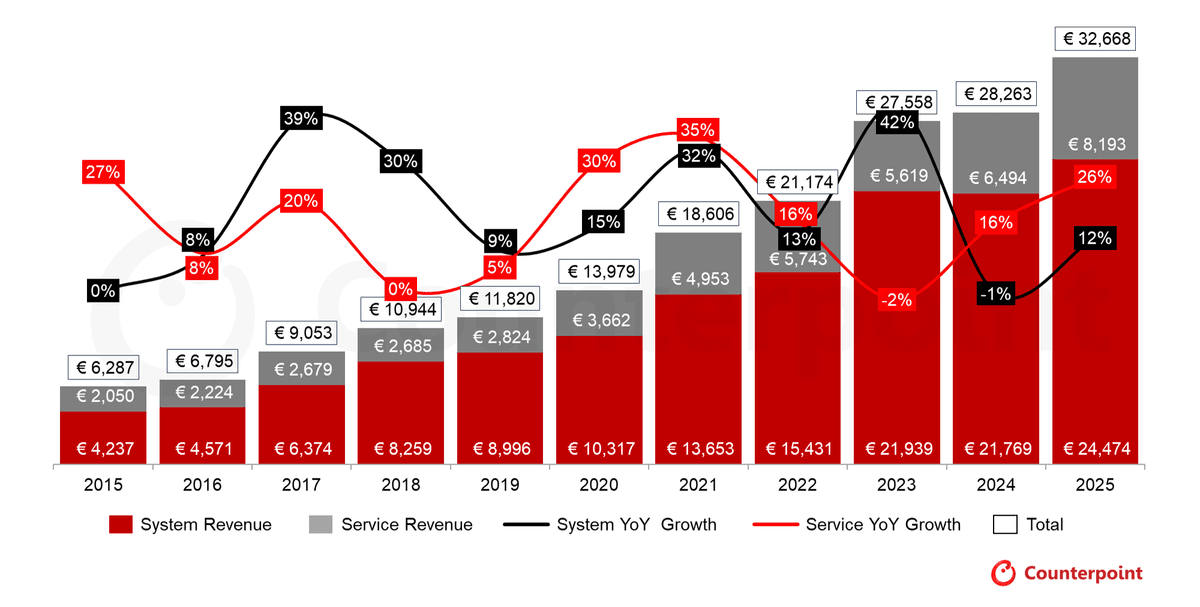
ASML’s full-year 2025 revenue climbed 16% YoY to €32.7 billion, hoisted by strong system revenue which was, in turn, driven by robust AI demand, combined with EUV and immersion momentum.
The Dutch semiconductor company’s revenue has grown at a CAGR of 18% from 2015 to 2025, mainly driven by advanced lithography equipment. ASML’s shipments grew at a CAGR of 7% over the same period. However, in full-year 2025, tool shipments declined 22% YoY due to weaker demand in mature node process, while EUV shipments grew 9% YoY and immersion grew 2% YoY.
DUV and EUV Revenue (In € Million), YoY (%) Growth, 2015-2028F
Source: Wafer Fab Equipment Tracker, Counterpoint Research
Revenue Growth Drivers: Compute and Memory
Compute: We forecast CSP capex to grow at a 37% CAGR from 2022 to 2027, driven by AI infrastructure which began as early as 2024. As shipments scale, wafer starts rising disproportionately, supporting both EUV and High-NA tool demand. This creates a structurally favorable revenue mix for ASML.
Key segment driving Litho demand:
• Data Center GPUs + HBM (Primary growth engine with highest EUV intensity) driving most EUV tools per fab, highest ASP mix and margin expansion.
• AI Server Compute ASICs (Custom accelerators with near-GPU intensity) will drive heavy EUV usage and fastest incremental EUV growth contributor as custom silicon proliferates.
• HPC CPUs/Accelerators (Sustained advanced-logic base load) driving steady leading-edge utilization and consistent EUV demand.
• Networking/Switch/SerDes/Optical DSP (Volume + large die) requiring moderate EUV + strong DUV immersion demand resulting in steady wafer starts.
• Consumer AI devices (Broad base mostly DUV) driving primarily DUV immersion with limited EUV.
Memory: HBM4 marks the first major architectural shift in high-bandwidth memory since inception/HBM2E, transitioning the base die from a traditional DRAM process to a logic process node. HBM4 is likely to hit the market in 2026 providing 2048-bit standard interface with data transfer rates of up to 12.8GT/s. According to Counterpoint Research’s Memory Tracker, HBM4 and HBM4E is likely to constitute 79% of the total HBM shipments in CY 2027.
When HBM base dies move from legacy memory nodes to logic-class processes, lithography steps per wafer rise sharply, EUV layers penetration increase, and litho demand per wafer grows faster, structurally lifting ASML revenue. Further, revenue from memory is expected to be strong as customers transition to their next nodes to support latest-generation HBM and DDR5’s adoption across AI infrastructure. Devices including PCs, servers, and mobile will drive increased tool shipment.
Results Summary:
Highlights:
System and Services Revenue (In € Million), YoY (%) Growth, 2015-2025
Source: Wafer Fab Equipment Tracker, Counterpoint Research
- ASML’s revenue grew 16% YoY to €32.7 billion in 2025 driven by increased systems and installed base sales.
- System sales increased 12% YoY driven by EUV and immersion tools.
- EUV revenue rose 39% YoY and accounted for 48% of net system sales, helped by advanced logic and strong HBM.
- Installed base revenue increased 26% YoY due to service business, installed base and customers upgrading their tools for enhanced performance.
- Gross margin for the full year was at 52.8% while it was at 52.2% in Q4 2025. Gross margin in H2 2025 is expected to be lower compared to H1 2025 due to the increased number of revenue recognitions from High-NA systems.
- Order bookings in Q4 2025 reached 13.2 billion, highest for any quarter, with €7.4 billion for EUV. Net system bookings during the quarter were weighted towards memory at 56%. The total order backlog was at €38.8 billion with EUV accounting for 65% of bookings.
- Revenue from foundry grew 42% YoY due to increased demand for advanced logic chips, while memory revenue declined 2% YoY. However, the decline was offset by strong HBM DRAM and increased adoption of EUV by chipmakers in memory.
- Taiwan revenue grew 134% YoY on account of capacity additions and N2 node ramp. Revenue from South Korea climbed 27% YoY in 2025 led by strong HBM demand, while revenue from China declined 10% YoY for the full year.
- ASML shipped its first advanced packaging scanner, the XT:260, in 2025 and is positioning itself to support 3D integration, seen as the next driver of Moore’s Law beyond 2D scaling and increase market share in i-line.
Outlook:
- Q1 2026 net sales are expected to be between €8.2 billion and €8.9 billion, gross margin at 51%-53%.
- FY2026 revenue is expected to be between €34 billion and €39 billion, with revenue from DUV likely to be flat.
- China revenue to account for 20% of total system sales in FY2026.
- In FY2026, revenue from memory is expected to be strong as customers transition to their next nodes to support the latest-generation HBM and DDR5 products.
What’s Next:
High-NA: ASML shipped the first EXE:5200B high-NA system, which is intended to support the High NA technology insertion into high-volume manufacturing in 2025. We expect High-NA shipments to account for roughly one-fourth of EUV revenue in 2028 driven by AI demand, advanced node advancements in logic and HBM capacity increase, along with new capacity additions.
Challenges: ASML will be able to significantly expand its addressable market beyond leading-edge logic, positioning itself as a core enabler of future memory scaling if memory manufacturers sustain their push into EUV adoption. The surge in memory-related bookings at ASML signals a key technology inflection point, as memory chipmakers adopt EUV for an increasing number of layers, marking a shift toward more complex architectures. However, in the longer term, realizing this potential will depend on successful execution of High-NA EUV ramp-up and overcoming potential yield and qualification delays, all while navigating an increasingly complex geopolitical landscape and technology ramp-up challenges.
Conclusion:
As AI infrastructure scales, we expect a step-change in lithography requirements:
- Leading-edge GPUs and HBM drive the highest EUV content,
- HPC and custom accelerators sustain advanced-logic capacity,
- Networking silicon adds incremental wafer demand, and
- Consumer devices underpin DUV utilization.
This diversified demand profile supports both higher system shipments and a favorable product mix over time, which will help ASML drive revenue growth over the next two to three years.
