AMD’s Full-Stack Vision for the AI Era
- AMD emerges as a full-stack AI platform, emphasizing system-level architecture over standalone chips.
- Helios-led infrastructure targets yotta-scale AI, as the industry shifts from training to inference.
- Major design wins validate AMD’s credibility, marking its transition from challenger to core AI supplier.
At CES, AMD positioned itself as a full stack, cost-effective and open software stack alternative in AI. It has rack-scale data centers for hyperscale and enterprises, sovereign AI infrastructure, AI PCs, robotics and space. At the event, a notable strength of partners ranging from OpenAI to Blue Origin took the stage, touching upon various design wins and partnerships, validating AMD’s ecosystem and its credibility. The keynote focus was on highlighting the message on system-level architecture rather than just the chip announcements.
AMD did launch a few AI PC-powered products but largely focused on the AI infrastructure, which highlights the infrastructure rather than consumer at CES.
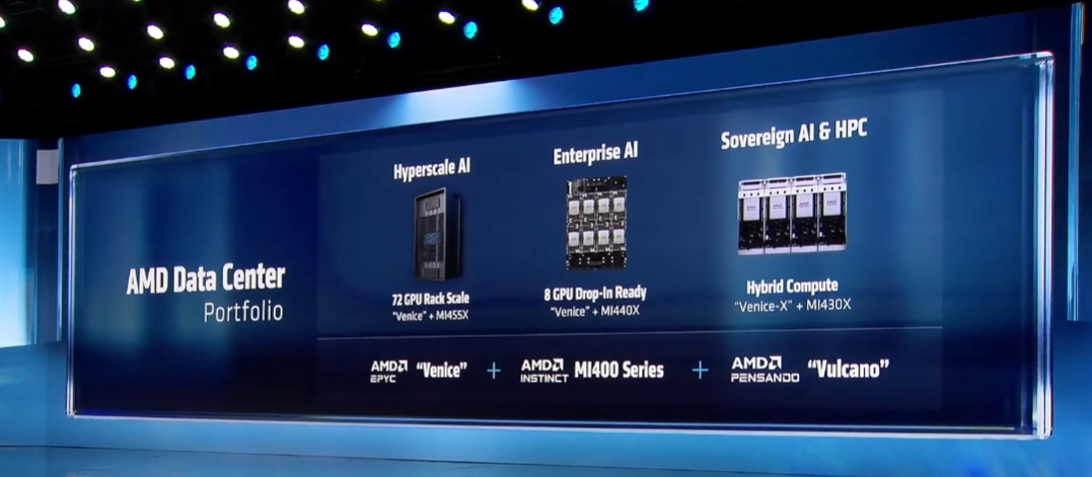
Data Center Focus: Powering the "Yotta-scale" AI Era
AI is being adopted on a massive scale. So far, the focus has been on training the AI, but now the focus is gradually shifting towards AI at edge, i.e. inferencing. AMD highlighted the growth of daily AI users to five billion in 2025 from one billion in 2020. The demand for computers has reached 100 Z FLOPS and is expected to grow 100x in the next few years. These highlight the fact that more compute is still needed and cloud players and hyperscalers will continue to increase their capex.
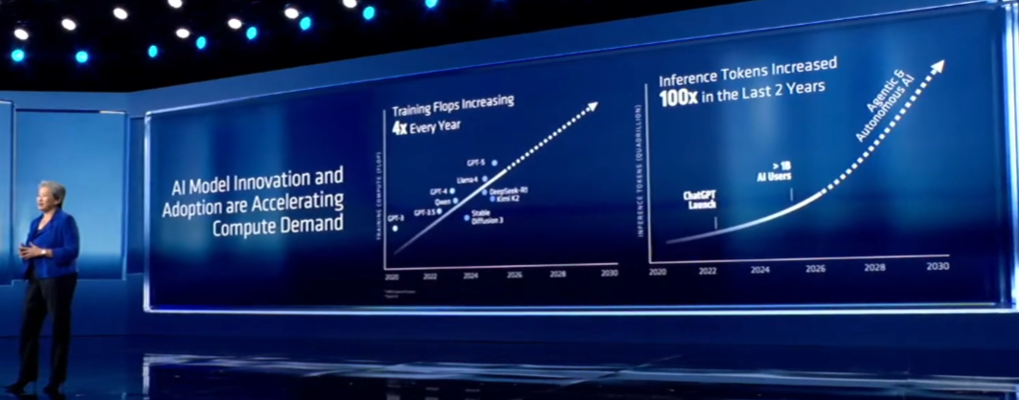
Below are the key announcements:
- Helios Rack Scale Platform: Next-gen rack scale platform Helios is a double-wide, liquid-cooled rack weighing nearly 7,000 pounds that functions as a single unified compute unit. A single Helios rack delivers up to 2.9 exaflops of performance, housing over 18,000 GPU compute units and 4,600 Zen 6 CPU cores.
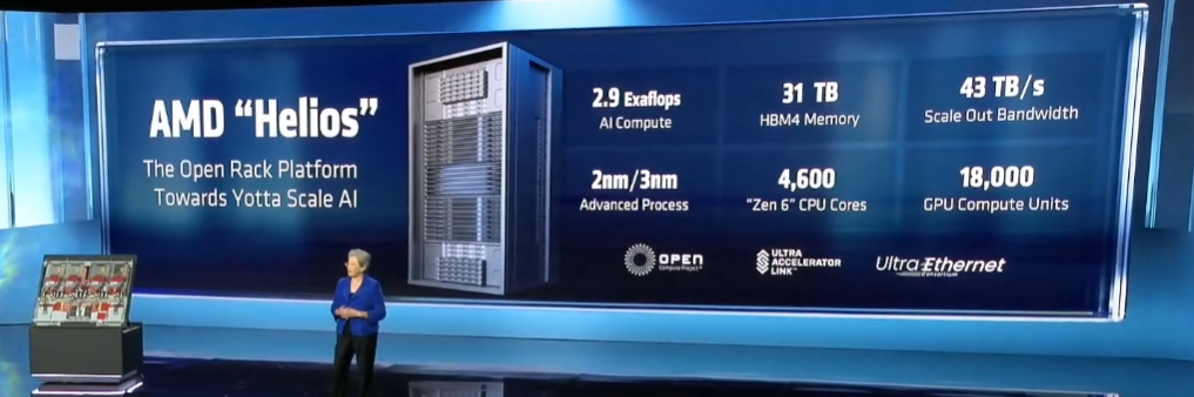
Source: AMD CES Keynote - Instinct MI455 Accelerators: The MI455X GPU features 320 billion transistors, utilizes 2nm and 3nm process technologies, and includes 432 GB of ultra-fast HBM4 memory. It provides up to a 10x performance increase across various AI workloads compared to previous generations.
- EPYC "Venice" CPUs: EPYC CPU Venice is built on a 2nm process, featuring up to 256 Zen 6 cores and has double memory and GPU bandwidth than the previous generation.
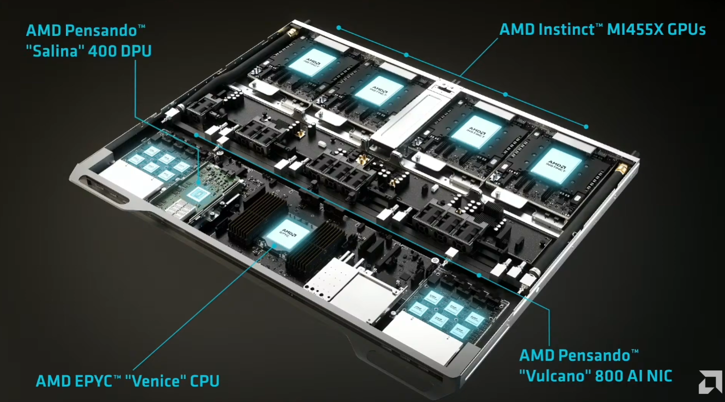
Source: AMD CES Keynote - Networking and Connectivity: The platform integrates Pensando Volcano and Selena 800 gig Ethernet chips, enabling tens of thousands of Helios racks to scale across a data center with ultra-low latency.
- Open Ecosystem and Software: AMD emphasized its commitment to an open software stack, specifically ROCm. ROCm is now used across major developer communities, strengthening AMD’s software credibility.
Strategic Partnerships and Future Outlook
OpenAI President Greg Brockman has publicly endorsed AMD, stating Helios is “a necessity for scale” and that OpenAI wants “as much compute as AMD can provide”. The ~$60-billion multi-year commitment signed with OpenAI provides AMD with institutional credibility in large-scale AI compute. Other sovereign-backed projects like HUMAIN with Saudi government and various other hyperscalers boost confidence. This lowers adoption risks for developers considering AMD’s platform, driving the cycle for more deployments.
| Customers | Details | Timeline/Scale |
| OpenAI | Multi-year partnership for up to 6 GW of Instinct GPUs; first 1 GW with MI450 series. Includes roadmap alignment and potential massive revenue for AMD. ~60-billionmulti-year commitment. | Initial 1 GW deployment H2 2026; multi-generation through 2030. |
| HUMAIN | A 2GW AI supercluster in Saudi, overall investment$50billion-$60billion. HUMAIN targets ~6.6GW total data center capacity by 2034. Long term demand for AMD products. | Deployment2026-2028. |
| Microsoft Azure | Deployed MI300X for inference (e.g.powering OpenAI GPT-4 Turbo, Copilot services); firsthyperscalerwith public MI300X instances. Expanded consumption in 2025. | Ongoing since 2024; scaled in 2025. |
| Meta | Broadly deployed MI300X for inference infrastructure; exclusively uses MI300X for Llama 3.1/405B model live traffic. | Scaled deployments in 2025. |
| Oracle Cloud Infrastructure (OCI) | Adopted MI300/MI355X with rack-scale architecture; launch partner for 50,000 MI450 GPUs in public AI supercluster (using Helios rack, EPYC Venice CPUs). | Initial MI355X in 2025; 50,000 MI450 starting Q3 2026, expanding 2027+. |
| Other (e.g.Vultr,TensorWave) | MI300X/MI355X clusters;Vultrbuilding 24,000 MI355X supercluster. | Deployments in 2025-2026. |
2026 is shaping up as a breakout year for AMD in AI, with Helios deployments, sovereign AI clusters, and expanding enterprise traction. These partnerships represent AMD’s breakthrough yet in overcoming historic skepticism around its AI software and platform readiness. However, much of this upside is already priced into market expectations and future deployment and supply chain execution will determine AMD’s growth.
AMD has marketed a strategic inflection point with ecosystem validation and platform credibility led by design wins. It has moved from being an aspiring AI brand to a major player. Success for AMD will depend on faster execution, supply chain management and breakthrough innovations on performance and efficiency as we move toward inferencing.
Receive our insightful weekly newsletter and stay ahead of the competition.
Author
Parv Sharma


Parv is a Senior Analyst with Counterpoint Technology Market Research based out of Gurgaon, India. He has over 10 years of experience at Counterpoint in market research and strategic consulting across the global technology and telecom sectors. He tracks the global semiconductor ecosystem, with a focus on HPC and data center compute, server CPUs, and AI infrastructure — covering competitive dynamics across Intel, AMD, Arm, Nvidia, and hyperscaler custom silicon. His research also spans the smartphone semiconductor ecosystem — including the Application Processor (AP)/SoC market, foundry, node and manufacturing technology, the RFFE ecosystem and value chain, and smartphone Bill of Materials (BoM) analysis — as well as the Automotive and Connected Car value chain. He leads a team driving data analysis and insights and contributes regularly to media coverage on semiconductors and AI infrastructure.