

- Advanced nodes (5nm and below) shipments exceeded 50% share in 2025, driven by performance, efficiency, and AI capabilities.
- Samsung leads 2nm adoption, followed by Apple, Qualcomm, and MediaTek using TSMC manufacturing.
- Although smartphone SoC shipments will likely decline in 2026, advanced nodes share will climb to 60%, supported by premium and mid-tier smartphones.
- 3nm and 2nm shipments will grow 18% YoY in 2026, but higher N2 wafer costs will increase flagship SoC pricing.
- TSMC leads the foundry market, while Samsung Foundry and SMIC are gradually tightening competitive pressure.
Beijing, Berlin, Buenos Aires, Fort Collins, Hong Kong, London, New Delhi, Seoul, Taipei, Tokyo – March 23, 2026
Advanced nodes (5nm and below) shipment share exceeded 50% in 2025, according to Counterpoint Research’s Global Smartphone SoC Shipments Forecast by Vendor by Node. This shift reflects the industry’s transition from mature nodes to advanced nodes to enable better performance, improved power efficiency, enhanced AI capabilities, superior gaming, and richer photography and videography experiences. Samsung was the first to deploy its own 2nm-based Exynos 2600 SoC with the Galaxy S26. Apple, Qualcomm and MediaTek are also set to adopt the 2nm process node, supported by TSMC, which is starting mass production this year.
Despite this technology transition, smartphone SoC shipments in 2026 are projected to decline by double-digit percentages YoY due to memory constraints. However, the share of advanced node-based SoCs is expected to rise to nearly 60% in 2026, driven by continued adoption across both premium and mid-tier smartphone segments. Currently, 3nm accounts for nearly half of total advanced node shipments.
Commenting on advanced node migration, Senior Analyst Shivani Parashar said, “Samsung is emerging as an early adopter of the 2nm process node, similar to how Apple previously led the transition to the 3nm node. At the same time, its gradual increase in in-house chipset adoption in mid-range smartphones is intensifying competitive pressure on Qualcomm and MediaTek.”
Advanced Node Smartphone SoC Shipment and Revenue Share by Brand
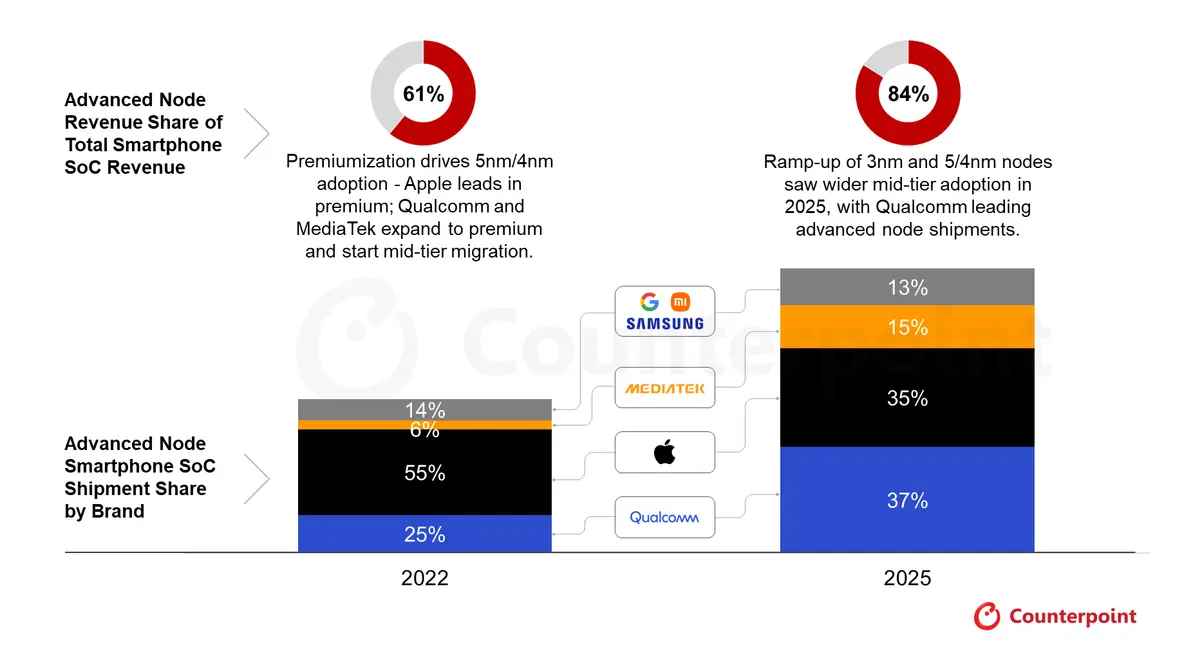
Source: Counterpoint Research Global Smartphone SoC Shipment Forecast by Vendor by Node, March 2026
*Advanced Nodes : 5/4nm, 3nm, and 2nm nodes
Leading nodes (3nm and 2nm) shipments are projected to grow 18% YoY in 2026, accounting for nearly one in three smartphones sold in 2026. However, the transition to the N2 process node will likely bring pricing pressure, with wafer costs estimated to be around 30% higher than N3. As a result, next-generation flagship application processors are likely to see a price hike, as vendors such as Qualcomm and MediaTek are unlikely to fully absorb the higher manufacturing costs. The rising ASP will drive higher revenues for advanced nodes, which are expected to account for more than 86% of smartphone SoC revenues in 2026.
Commenting on the market outlook, Principal Analyst Soumen Mandal said, “The rising wafer cost and design complexity are limiting broad migration and confining leading nodes to premium smartphones, while mid-range smartphones are starting to adopt advanced nodes.”
From a manufacturing perspective, TSMC continues to dominate the foundry landscape with an over 86% market share. However, its share is expected to decline slightly with Samsung Foundry and SMIC’s growing presence. In addition to expanding its in-house SoC usage, Samsung Foundry is looking to partner with Qualcomm, which could be a win-win situation for both players in the smartphone market.
About Counterpoint Research
Counterpoint Research is a global market research firm specializing in products across the technology ecosystem. We advise a diverse range of clients – from smartphone OEMs to chipmakers and channel players to Big Tech – through our offices located in the world's major innovation hubs, manufacturing clusters and commercial centers. Our analyst team, led by seasoned experts, engages with stakeholders across the enterprise – from the C-suite to professionals in strategy, analyst relations (AR), market intelligence (MI), business intelligence (BI), product and marketing – to deliver services spanning market data, industry thought leadership and consulting. Our core areas of coverage include AI, Automotive, Consumer Electronics, Displays, eSIM, IoT, Location Platforms, Macroeconomics, Manufacturing, Networks and Infrastructure, Semiconductors, Smartphones and Wearables. Visit our Insights page to explore our publicly available market data, insights and thought leadership, and to understand our focus, meet our analysts and start a conversation.

