$40 Smartphone for Africa: Greenfield Opportunity or High Barrier?
- A $40 smartphone’s success in Africa is not about creating demand; it is about the economics of producing such a device under current market conditions.
- Practicality complements the price. Even in a $25 device, consumers will continue to prioritize battery life, storage and a seamless interface.
- The $40 smartphone market is a greenfield opportunity with only a few manufacturers present. However, the economics require a risk appetite given the component supply shortages.
Recently, handset vendors have increasingly discussed the possibility of extensively introducing affordable smartphones at an average selling price (ASP) of $40 in price-sensitive regions such as the Middle East and Africa (MEA), particularly Africa. The main objective of this approach is to expand digital access and bring more consumers online, improving technological inclusion across the region.
Although the MEA region represents the world’s largest market for smartphones priced below $150, the feasibility of such an initiative depends on several key factors. The technology market evolves quickly, but smartphone demand in Africa is still shaped by a few clear purchasing priorities that must be carefully assessed.
In 2025, around 52% of MEA smartphone sales were concentrated in the sub-$150 segment. Within this segment, 89% of devices had displays of 6.5 inches or larger, 88% included at least 64GB of NAND storage, and 86% were equipped with batteries of 5,000 mAh or more. In contrast, only about 30% had more than 4GB of RAM, around 5% supported 5G, and AI capabilities were almost absent in this price band.
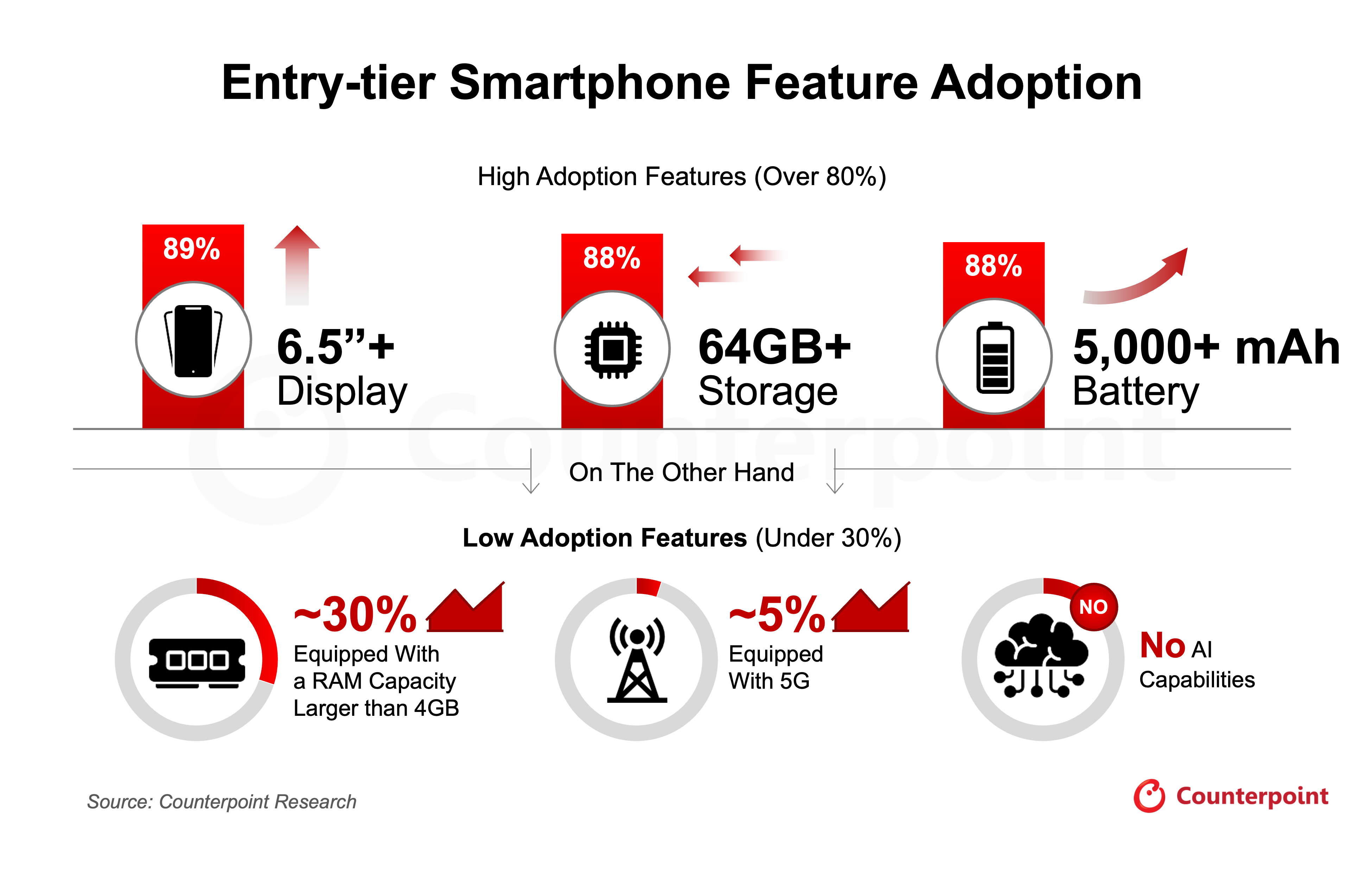
In a market like the MEA, affordability is strongly tied to ASPs. Although a $40 ASP is likely to boost smartphone sales, the volume here might still not be as appealing as it might sound, since the target audience of such a smartphone is the feature phone users. That is where the gap becomes wider.
The shift from a $25 feature phone to a $40 smartphone represents a significant price jump for many consumers in Africa, where the minimum wage in many countries is below $112 per month, according to the International Labour Organization (ILO), which closely reflects the income level of a typical feature phone user.
To further probe this price sensitivity, 2G feature phones accounted for 89% of feature phone sales in the MEA in 2025. Although a 4G feature phone sells at around $33 and a 2G one sells at around $25, consumers strongly prioritized affordability, as the additional features offered by 4G feature phones provide only limited perceived value for their daily usage.
In many rural areas, consumers continue to prefer feature phones due to unreliable network coverage and long battery life. For these consumers, a phone is not for web browsing; it is a tool for daily tasks. And banking or many business essentials can be completed through USSD, which does not require a data plan or a stable 4G connection. This again highlights the practical priorities of consumers in the region. Long battery life, sufficient storage capacity, and simple, reliable interfaces remain the key factors influencing purchase decisions.
Hence, maximizing the success of a $40 smartphone means ensuring that it meets the key practicality standards and adds more value on top so that the 60% price increase is justified.
If the boxes above are checked, feature phone migration will accelerate, and creating demand will unlikely pose a big challenge. The key challenge, however, is likely to be the practicality of producing a $40 smartphone while maintaining the practicality standards under the current market conditions.
Historically, producing smartphones at this price point could have been more feasible when memory costs were much lower. Today, however, ongoing memory shortages and higher component prices have changed the economics. Manufacturers can technically produce smartphones at an ASP of $40, but this would leave them with extremely thin profit margins.
In 2025, a few brands, such as M-Kopa, IKU and VODACOM, were able to produce smartphones with an ASP of around $40. Among these devices, around 76% were equipped with 4GB of RAM, 96% offered between 32GB and 64GB of storage, and 88% had display sizes of 6.51 inches or larger. These specifications align closely with the practicality needs of consumers in the region. However, the overall sales volume was negligible and did not exceed 0.5% share, with no presence from any major brand.
Reaching this price point under the current market constraints would likely require further reductions in device specifications. Battery capacity, NAND storage and RAM would likely shrink to offset the rising cost of components. Consequently, this would weaken the key purchase drivers of these devices and shift consumers’ focus to more suitable options.
More critically, securing low-capacity memory has become increasingly difficult, as major memory suppliers are prioritizing higher-capacity components that offer stronger margins and are in high demand from large technology companies.
To sum up, the economics of producing a $40 device under current component cost conditions make it is challenging for manufacturers to drive profit and hence sustain this price band.
Receive our insightful weekly newsletter and stay ahead of the competition.
Author
Team Counterpoint
Counterpoint research is a young and fast growing research firm covering analysis of the tech industry. Coverage areas are connected devices, digital consumer goods, software & applications and other adjacent topics. We provide syndicated research report as well as tailored. Our seminars and workshops for companies and institutions are popular and available on demand. Consulting and customer