

- MEA’s smartphone shipments increased 5% YoY in Q4 2025, driven by a strengthening infrastructure, proliferation of affordable 5G devices and stabilizing macroeconomic conditions.
- Growth remained concentrated in the entry and premium segments due to feature phone migration in Africa and increasing consumer financing and trade-in programs.
- Q4 2025 likely marked the final growth quarter for the entry segment before a projected 2026 decline, as the market exhausted components procured at comparatively low costs before the onset of memory price hikes.
- Samsung recorded 53% YoY growth, maintaining volume leadership over Transsion by strategically front-loading lower-cost inventory ahead of rising market prices.
- Rising component costs led to significant shipment declines of 14% and 4% for Xiaomi and Transsion, respectively. HONOR sustained growth by leveraging strong existing inventories and early-year momentum.
Dubai, Beijing, Berlin, Fort Collins, Hong Kong, London, New Delhi, Seoul, Taipei, Tokyo – Feb 27, 2025
Smartphone shipments in the Middle East and Africa (MEA) rose 5% YoY in Q4 2025, according to Counterpoint Research’s latest Market Monitor. This was the region’s third consecutive quarter of expansion. The upward trajectory was underpinned by technological evolution, premiumization and intelligence.
Rapid 5G smartphone adoption is accelerating the MEA’s premiumization trend, particularly in emerging markets where high-speed connectivity remains a primary catalyst. This has resulted in the region’s 5G shipments surging 22% YoY in Q4 2025. While established markets lead the charge, emerging markets are seeing a significant acceleration in 5G infrastructure and coverage, specifically countries including Jordan, Iraq, Tunisia, Egypt, Morocco and Sierra Leone. Though AI is also becoming widely available across the region, it has a limited impact in driving sales.
The regional landscape remains nuanced. While a temporary easing of political tensions mid-year provided a tailwind, a resurgence of friction in late 2025 moderated the growth rate. However, the market’s underlying health remained intact due to core indicators remaining steady QoQ, supported by stable oil prices, consistent purchasing power, and a high appetite for premium technology.
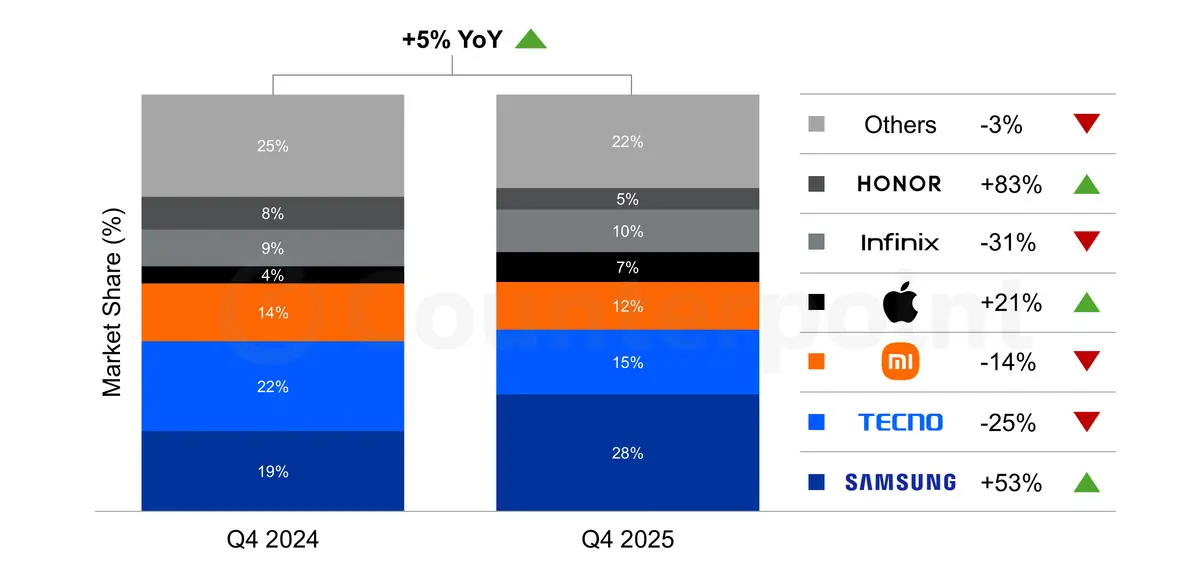
MEA Smartphone Shipment Share and Rise by OEM, Q4 2025 vs Q4 2024
Further, the market’s growth remains concentrated in the entry and premium segments. The $100-$249 price band recorded 28% YoY growth, while the over-$700 price band recorded 46% YoY growth. The entry segment’s growth was pushed by the feature phone migration, especially across Africa. However, the premiumization trend was the main driver for the premium segment growth, especially with the wide availability of several financing options and trade-in programs.
However, Q4 2025 is expected to be among the last growth quarters for the entry segment (sub-$150) for the next several quarters. This is largely due to the ongoing global memory shortage (DRAM), which is impacting the budget segment the most, and mainly the MEA, the region being the world’s largest market for that price segment. This deceleration is also expected to slow down 5G adoption in the MEA, whereas feature shrinkflation is likely to become the main strategy for OEMs to offset the high component costs.
Insights on key brands during Q4 2025
- Samsung reclaimed the top position in the MEA with a record 53% YoY growth, outpacing Transsion for the second consecutive quarter. This performance was driven by a strategic front-loading to hedge against rising component costs and prepare for the upcoming Ramadan sales season.
- Chinese OEMs like Transsion and Xiaomi were among the first brands to be constrained by the ongoing memory shortage. The shortage originating in mid-2025 affected the Q4 2025 production cycle, resulting in shipment declines of 14% and 4% for Xiaomi and Transsion, respectively.
- HONOR maintained a significant YoY growth of 83%, but this growth was largely due to the low base YoY and the resilient component inventories that supported HONOR to hold both volume and price.
The comprehensive and in-depth ‘Q4 2025 Market Monitor Smartphone Tracker’ is available for subscribing clients.
Feel free to contact us at [email protected] for questions regarding our latest research and insights.
The Market Monitor research relies on sell-in (shipments) estimates based on vendors’ IR results and vendor polling, triangulated with sell-through (sales), supply chain checks and secondary research.
About Counterpoint Research
Counterpoint Research is a global market research firm specializing in products across the technology ecosystem. We advise a diverse range of clients – from smartphone OEMs to chipmakers and channel players to Big Tech – through our offices located in the world's major innovation hubs, manufacturing clusters and commercial centers. Our analyst team, led by seasoned experts, engages with stakeholders across the enterprise – from the C-suite to professionals in strategy, analyst relations (AR), market intelligence (MI), business intelligence (BI), product and marketing – to deliver services spanning market data, industry thought leadership and consulting. Our core areas of coverage include AI, Automotive, Consumer Electronics, Displays, eSIM, IoT, Location Platforms, Macroeconomics, Manufacturing, Networks and Infrastructure, Semiconductors, Smartphones and Wearables. Visit our Insights page to explore our publicly available market data, insights and thought leadership, and to understand our focus, meet our analysts and start a conversation.