Robotaxis and the Future of Urban Mobility
- Robotaxis are expected to see rapid growth through 2035 with the market value for services projected to reach $168 billion, and the size of the global robotaxi fleet to reach 3.6 million vehicles.
- The evolution to robotaxis is not merely a replacement of the human driver, but a complete reimagining of the relationship between cars and the city.
- Robotaxi operators are proactively considering their future role and have their own strategic perspective on the scaling and integration of autonomous vehicles into the urban fabric.
Robotaxis are currently going through a pivotal stage of growth, moving from pilots to city-by-city fleet launches and expansion. The robotaxi boom is occurring at a time when there are other structural changes to urban society — the rise of artificial intelligence, connectivity becoming ubiquitous and cleaner transportation through electrification and all underpinned by the generations-long trend to urbanization. Robotaxis are at the center of this structural transformation of the global urban landscape and are set to become consequential to cities’ transportation systems.
The robotaxi market is expected to see rapid growth through 2035, with the market value for services projected to reach $168 billion, and the size of the global robotaxi fleet to reach 3.6 million vehicles according to Counterpoint Research’s comprehensive new Global Robotaxi Vehicle Sales and Services Market Forecast.
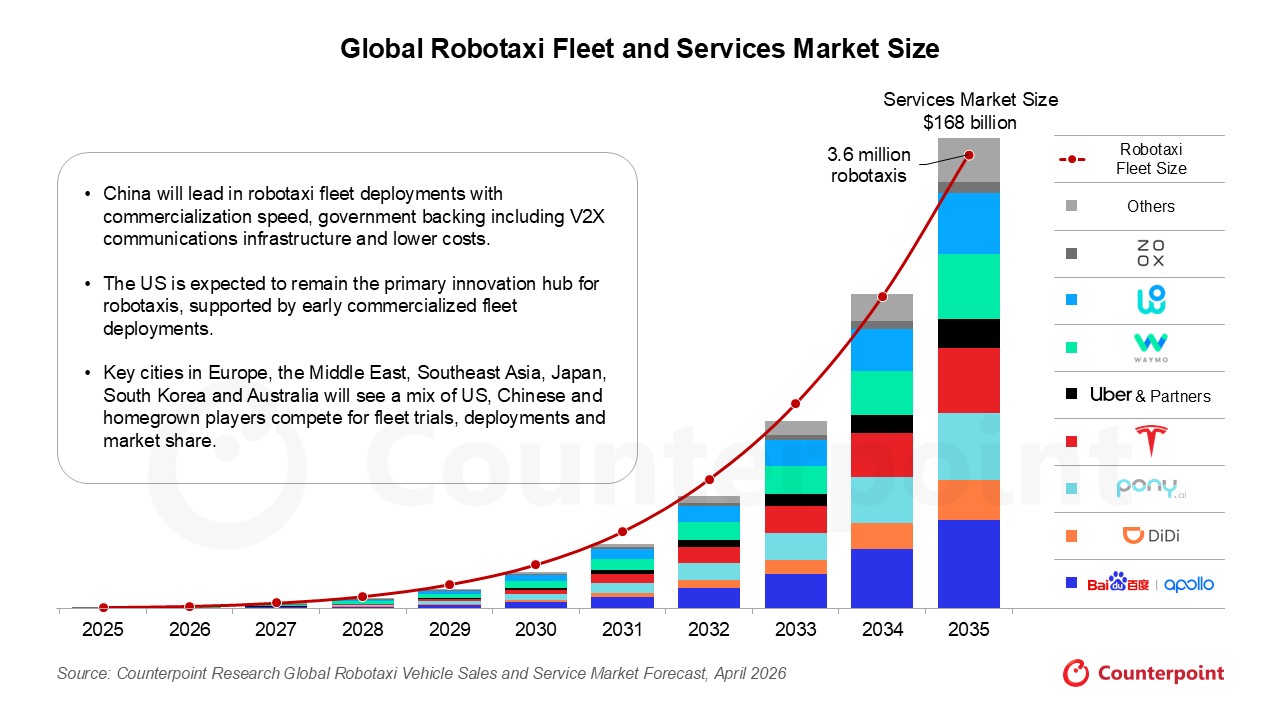
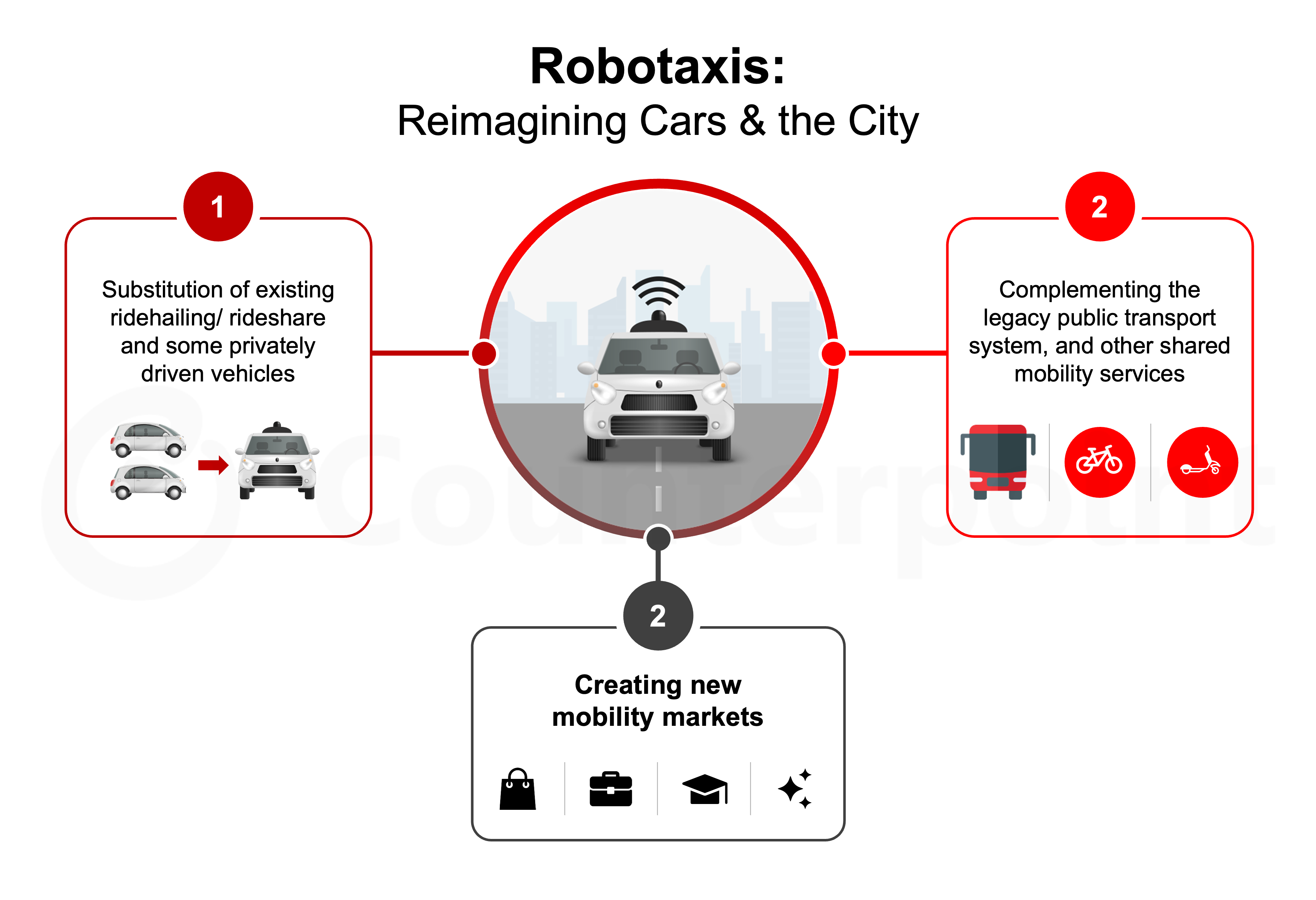
Counterpoint expects this growth and the ubiquity of robotaxis in major cities to fundamentally alter the foundational elements of city infrastructure with significant impact on urban life. The evolution to robotaxis is not merely a replacement of the human driver, but a complete reimagination of relationship between cars and the city. The three ways this impact is expected to play out are:
- Substitution of existing ridehailing/rideshare vehicles and some privately driven vehicles
- Complementing the legacy public transport system, and other shared mobility services
- Creating new mobility markets.
1. Substitution of existing transportation modes
The natural and obvious impact of robotaxis deployments will be the cannibalization of legacy taxis and ride hailing/ ridesharing markets. A large proportion of legacy services face an existential crisis due to the positive business case expected for driverless robotaxis. Robotaxi services will not only lower operational costs (due to removing the cost of employing a human driver), but also (at least theoretically) enable services that can operate 24/7. Most human-driven taxis, rideshare, and ride hailing fleets are expected to disappear, with only smaller fleets running in severe peak periods or those that require human assistance, such as loading/unloading a wheelchair.
2. Complementing existing transportation
In dense urban areas, the most efficient mode of transport is mass rapid transit, like metro trains and light rail, as it helps move large volumes of people. Here, robotaxis can complement the city’s rapid transit system by providing first- and last-mile transportation, for example of commuters from homes and offices to transit system stations. This is particularly appealing for suburban stops where the population density is lower than in urban areas and setting up of tertiary rail lines or public buses may neither be cost efficient nor provide timely service. Micro transit models that can integrate robotaxis into a city’s existing mass rapid transit infrastructure and complement the transport network will become crucial in supporting the growing urbanization and expansion of cities. Robotaxis can fill the gap in which traditional ride haling/ride share, traditional taxis, public city transport cannot serve either due to higher costs or lower availability, at the same time ensuring viability for the wider public transit system.
3. Creating new mobility markets
While robotaxis can replace traditional taxi and ride hailing/rideshare services, they can also enable and democratize wider public mobility. The lower cost of service (due to removal of driver from vehicle) can potentially attract a demographic who previously would not have considered the use of public transportation away from using private vehicles. There will be some early adopters of robotaxis who also shift away from shared mobility modes like car and bike sharing services. Robotaxis taking market share from private vehicles, while possible, has higher barriers and may take longer. The vast majority of private car users would require a change in mindset as many will have a sunk cost perception of existing cars owned. However, as robotaxi costs come down, related services will be significantly cheaper than prevailing ride hailing services by 50-75% and on par with private vehicle operating cost (less depreciation). As their availability and average waiting times improve, they will eventually make more economic, as well as rational, sense to use than private cars. As robotaxi deployments spread to more emerging economies, there could be a leapfrogging from an automotive ownership phase entirely to where the reliable, low-cost transport opportunity would appeal when compared with under-developed transport infrastructure and the high cost of vehicle ownership. Two other underserved segments (by proactively designing a service to adapt for this sector) include elderly citizens and citizens with certain disabilities.
Overall, robotaxis have the potential to significantly lower the barriers for access to personal mobility. If they succeed it will have a profound impact not only on car sales but the way housing and living spaces (city, shopping) are designed and configured with respect to parking spaces, garages, driveways, muti-story car parks, and other urban infrastructure currently designed to service human-driven cars. Various studies show a significant fall in parking requirements for robotaxis. An MIT paper that explores impact of shared Autonomous Vehicles (AVs) on Urban parking demand through simulation shows a 90% reduction in parking requirements. Another study on long-term effects of AVs on the built environment shows that each shared AV has the potential to eliminate 20 parking spaces. Further, a study from Harvard Kennedy School on Urban Mobility Policy in Response to AVs that simulations emphasize that widespread adoption of robotaxis will allow municipalities to reduce legacy parking to housing ratios. This will unlock additional living spaces and green zones from the denser housing with space currently utilized for garages and surface parking. It is a measure of how prevalent private car use has become that citizens are almost blind to the impact that cars play in urban landscapes. In cities that have reclaimed some space from vehicles, the transformations possible are profound – with more green space and consequent reductions in noise, heat and pollution.
Some robotaxis operators are proactively considering their future role and have their own strategic perspective on the scaling and integration of autonomous vehicles in the urban fabric.
- Waymo: Waymo has articulated its vision for robotaxi services as part of an integrated layer within urban mobility systems and not merely as a taxi replacement business. The company has repeatedly emphasized safety, accessibility and multi-modal urban connectivity as themes and has discussed via its blog how it is solving the first and last mile problem in metropolitan areas, where fixed transit becomes inefficient. Waymo’s methodical expansion framework of tight geofenced rollouts, focus on high reliability and safety metrics, and gradual city-by-city scaling prioritize building consumer trust as key to adoption. Thus, Waymo’s approach at least as being played out currently aligns more closely with complimenting the public transport framework.
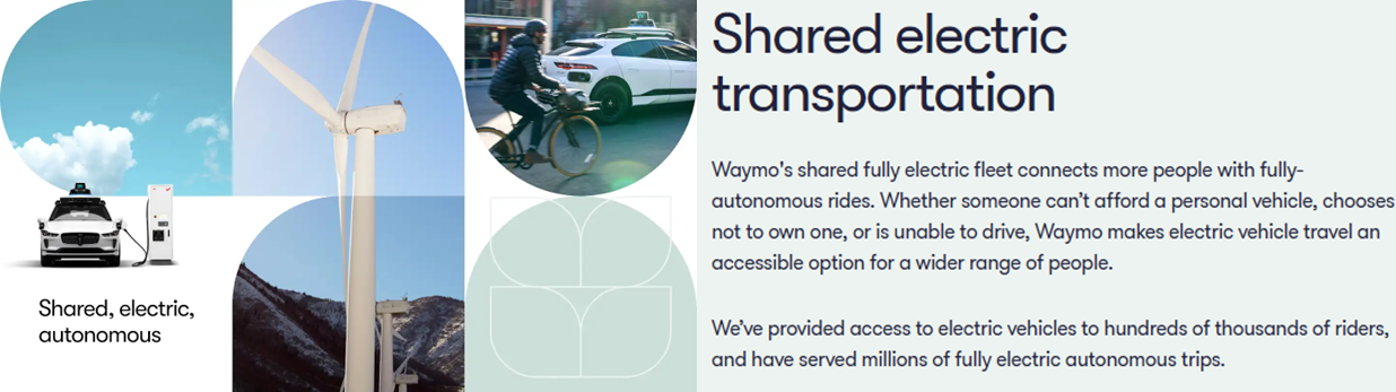
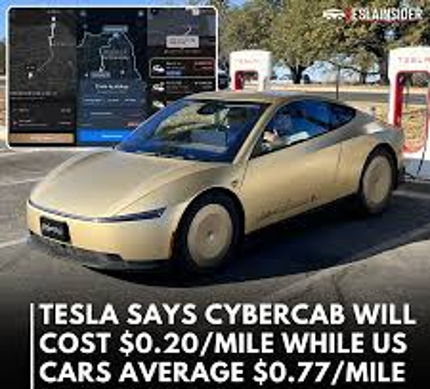
Waymo’s articulation of its vision of robotaxi as shared electric transportation. Source: Waymo - Tesla: Tesla has focused on transforming private vehicles into revenue generating assets for their owners. The company’s goal has been to enable owners to participate in a decentralized transportation marketplace, where owners’ vehicles could provide transportation services while not in use by their owners. During Tesla’s Q1 2026 earnings call, Elon Musk also talked about Tesla’s future being predominantly autonomous. The company is also making a pure robotaxi play with its Cybercab, but the promise of Full-Self Driving (FSD) has always been to make Tesla owners’ cars’ achieve full autonomy. This hybrid scenario of robotaxis and private autonomous vehicles will lead to abundant supply, and Tesla is assuming high utilization leading to a dramatic fall in operating costs which founder Musk has talked about coming in as low as $0.2 per mile.
If the company does prove out its autonomous driving technology, it will also make Tesla owners rethink vehicle ownership. This will lead to a decline in vehicle sales but in parallel an increase in robotaxi and shared ownership service revenues for Tesla and owners of its cars alike. The big question here for urban planners is whether this leads to a lower number of vehicles (due to reduced ownership) or worsen urban congestion due to many private vehicles operating on roads, where each vehicle is traveling more miles. Tesla’s approach combines both the substitution of existing transportation and creating new mobility market frameworks.
- Baidu Apollo Go: Unlike Western robotaxi operators, Baidu Apollo Go, the largest among the Chinese robotaxi players, aims for its robotaxis to be part of a broader smart city infrastructure ecosystem. Baidu Apollo Go has positioned its robotaxi as a means to reduce congestion and emissions, improve transport efficiency, and encourage urban digitalization. It has a focus on affordability, working with OEM partners to reduce hardware and overall vehicle costs to $30,000-$40,000, and charging low fares to encourage mass adoption. It is also among the largest robotaxi operators in China having deployed over 2000 vehicles by the end of 2025, again aiming to speed up large-scale deployments with strong coordination with municipal authorities in cities where it operates. Although substitution and complementing existing transportation modes will result from a growing number of Baidu Apollo Go deployments, the service aspires to create a widely accessible mobility service.
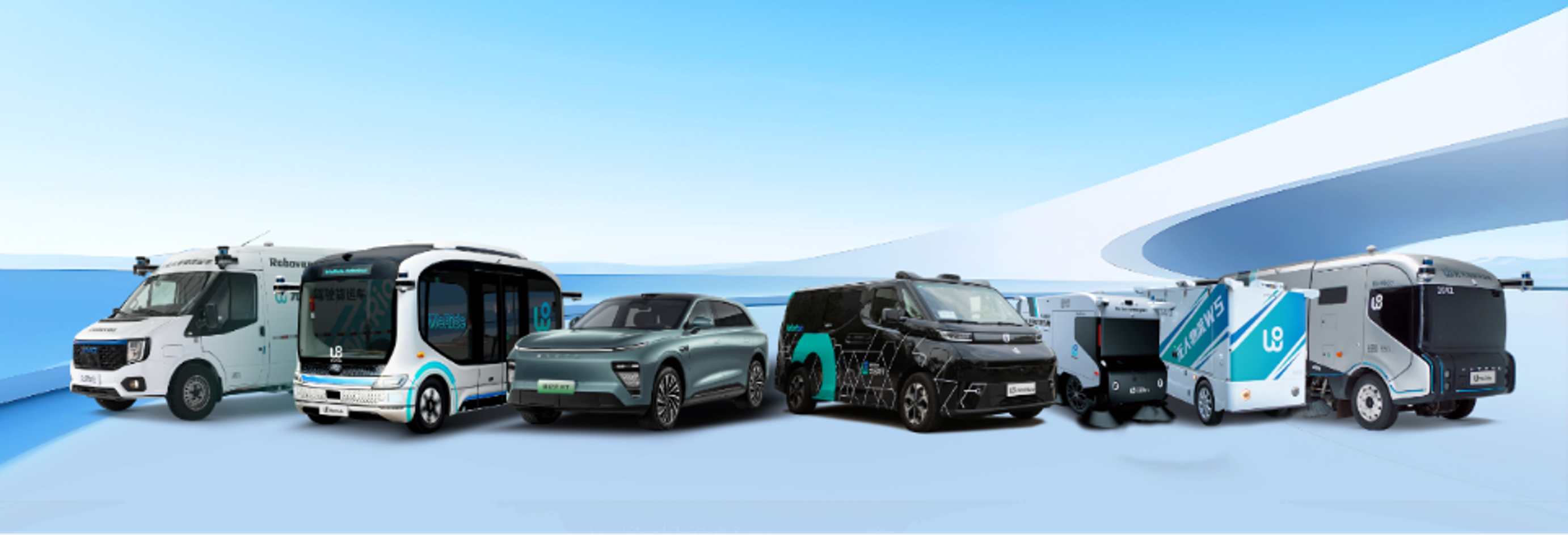
- WeRide: WeRide is pursuing a diversified autonomy ecosystem rather than solely focusing on robotaxis. WeRide’s autonomous vehicle portfolio spans multiple applications including robo-buses, robo-vans, robo-sweepers and of course robotaxis. While diversification has a commercial angle, it also enables WeRide to provide a wider autonomy platform for future smart cities. The company’s goal is to provide first and last mile transportation of people through robotaxis and mid-mile transportation on fixed routes served by robo-buses. The robo-van supports last-mile goods delivery and the robo-sweeper sanitation vehicle fills an important municipal service role. WeRide offers modular autonomous solutions that fit into the urban infrastructure and can become interconnected, thus not just providing mere substitution of ride hailing and taxi services but also complementing not just public transport but also wider smart city infrastructure.
- Pony.ai: Pony.ai has taken a lead in positioning itself as a regional autonomy network through its robotaxis. The company focuses on deploying its fleet on airport corridors and routes that link transport hubs, and in mini townships e.g. university town area. This is partially a commercial choice as Pony.ai sees these higher density areas as providing an existing group of customers to serve, making the business case for deployment more compelling. However, through these targeted deployments Pony.ai has better transit system integration, complementing existing public transport. Pony.ai, through its strategy, is more in the complementary camp than substitution, though this may change as it expands overseas and focuses on the bottom line.
- Zoox: Amazon-owned Zoox uses a purpose-bult bi-directional vehicle with social style seating (where occupants face each other) for its robotaxi application. The bi-direction ability enables the vehicles to travel equally well in both directions and perfectly suits narrow city streets. But with design advantages apart, Zoox has a big advantage when it comes to fitting in with the urban infrastructure from offering passenger transport through robotaxis and extending to shuttle services between fixed service points (Zoox is soon to launch an airport shuttle service between Las Vegas airport and hotels in the Las Vegas strip). The potential of integrating public transport services into Amazon’s logistics and delivery ecosystem would give it a unique advantage to grow in the mobility space, where it becomes a real alternative to owning a private vehicle. Zoox’s vehicle design also lends itself to more uses — the flat floor with the removal of seating could provide a last-mile delivery vehicle capable of delivering e-commerce parcels for Amazon. Zoox, on account of its versatile vehicle design and its potential to be integrated with the company’s Amazon delivery ecosystem, straddles all three aspects — substitution of private vehicles, complementing public transport and creating a new mobility market, while its e-commerce goods delivery potential (in non-peak hours) provides more integration potential, making it key city infrastructure. A deeper analysis of the potential for Zoox can be read in the blog: Purpose-Built for the Future: The Pioneering Approach Behind Zoox’s Scalable Robotaxi Vision
While we so far have discussed robotaxi operators that have deployed vehicle fleets, there are also several noteworthy robotaxi players waiting in the wings that merit mention, particularly due to their strong urban mobility focus.
- Wayve: Wayve has a unique philosophical approach to robotaxi scaling that matters enormously for urban mobility. Through its embodied AI approach, it aims to deploy autonomous vehicles across hundreds of cities without needing to adapt to the different road structures, or urban environments. While this sounds nightmarish from an urban congestion perspective, Wavye is confident that its adaptive AI reasoning system can enable it to do a zero-shot generalization enabling it to scale autonomous technology and applications rapidly. This means Wayve could implement scalable ADAS levels where private passenger cars can be equipped with lower cost L2+ autonomous systems whereas robotaxis can be provided with L4 autonomous driving capabilities. Wayve’s approach complements, not just substitutes, ride hailing/rideshare vehicles. It also provides private car drivers with technology that can improve safety in the city and democratize technology not just faster but potentially at a lower cost. A deeper understanding of Wayve’s philosophy can be read in the blog: British Wayve of Robotaxis Incoming
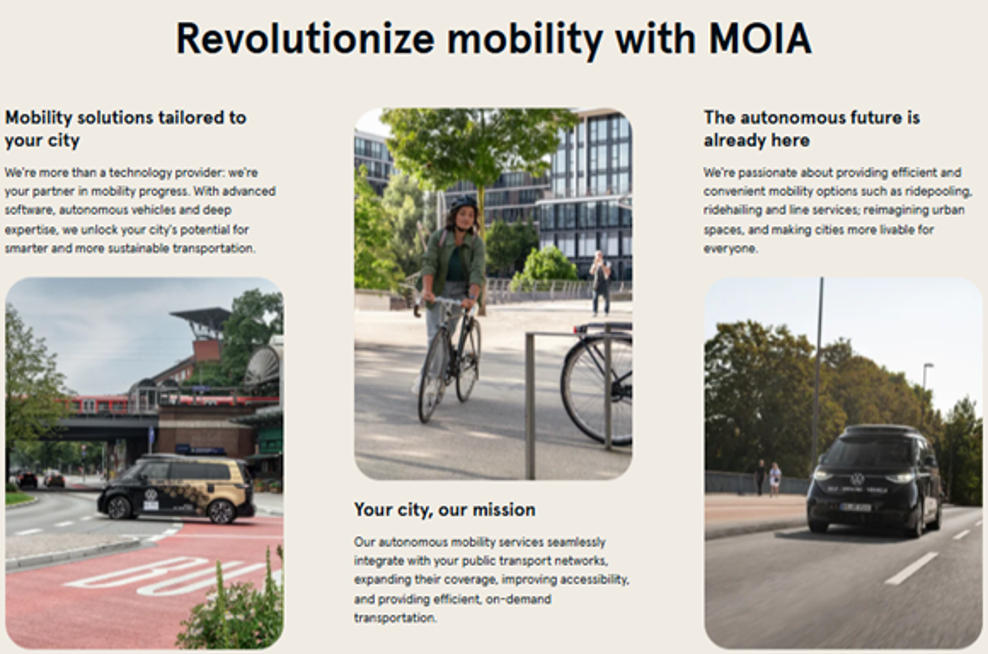
- MOIA: MOIA, a 100% subsidiary of automaker Volkswagen Group, positions itself less as a robotaxi operator and more as a city mobility system integrator. Its autonomous mobility services strategy is centered around vehicles that provide ride pooling services that are integrated into local public transport networks. The company aims to improve geographic coverage and increase accessibility while reducing congestion and emissions. MOIA views autonomous ride pooling as a demand-based transport layer sitting between fixed-route mass transit with no explicit intention to replace public transport. MOIA’s approach aligns strongly with the European smart-city planning model where the emphasis is on reducing the parking footprint and supporting transport modes that help shift people away from private car use. MOIA’s (non-autonomous) ridesharing and ride pooling services in Hamburg, Germany have already demonstrated how when fleets are coordinated with public transport and deeply integrated into the rapid transport ecosystem (accessible from local transport app) rather than as a standalone taxi network they can positively, and in a complementary way, impact public transport. MOIA plans to deploy robotaxis in Los Angeles through its partnership with Uber and in Oslo in partnership with Nordic transit operators Ruter and Holo. These deployments will demonstrate the company’s ability to both substitute ride haling/ ridesharing services and complement public transport through the ride pooling aspects of its operation.
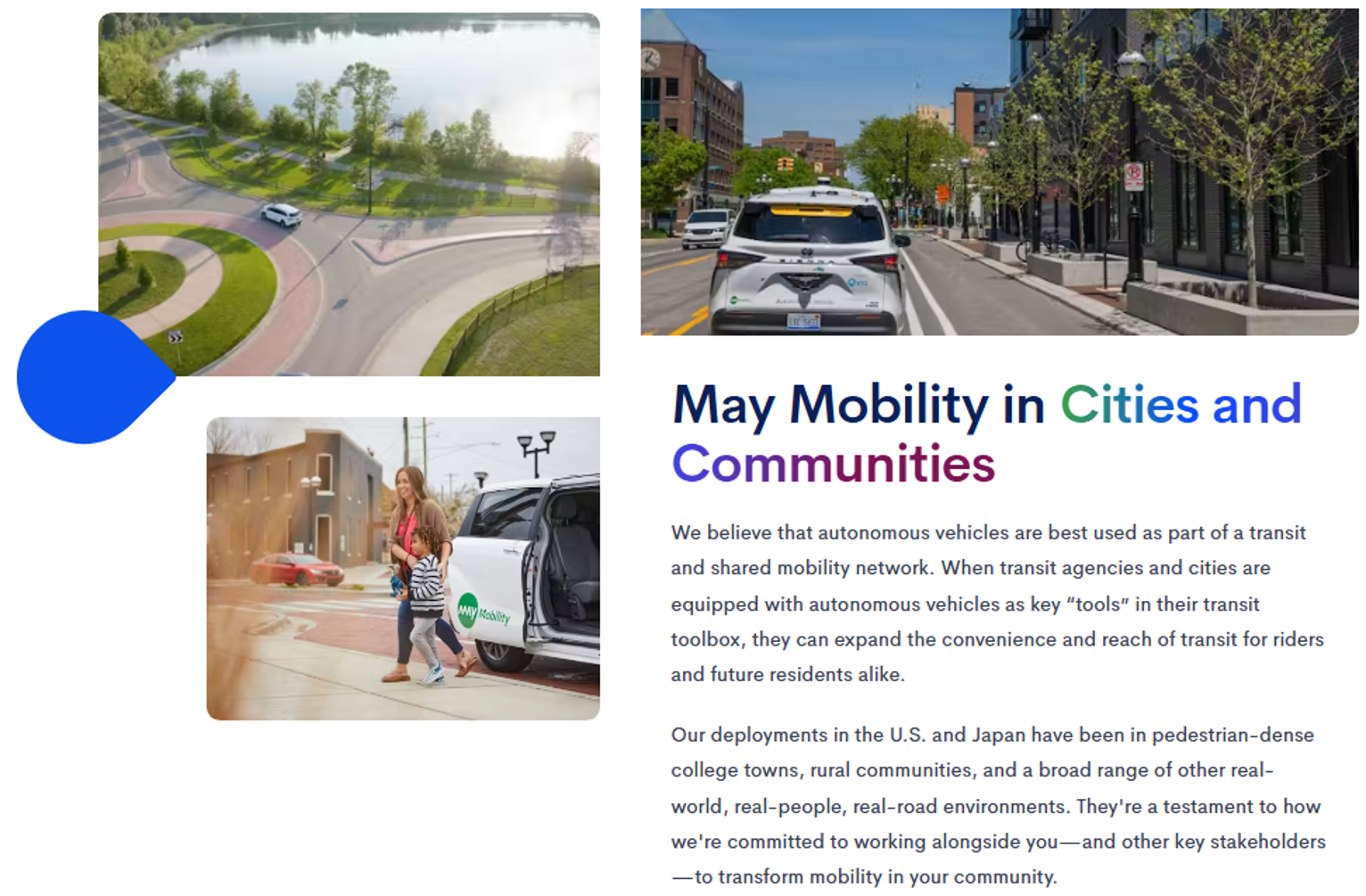
- May Mobility: May Mobility has one of the clearest microtransit-first approaches among robotaxi companies. May Mobility’s focus has been on low-density suburbs and corridors, campuses, airports, retirement communities and other underserved transit zones. As such, the deployments May Mobility has made focus on ride pooling, first/last mile connectivity through integration with local transport companies and providing wheelchair accessibility. This emphasis puts May Mobility squarely in the role of complementing public transport. It provides on-demand autonomous vehicles that serve economically inefficient low-demand bus routes. This positions May Mobility in a unique niche where it can serve several growth markets that robotaxis will operate in. While most operators focus on substituting existing rideshare/ ride hailing vehicles, May Mobility can focus on complementing existing public transportation.
- Motional: Motional has a unique take on robotaxis, where it sees itself as a scalable commercialization partner within the existing rideshare/ride hailing ecosystem and is not aiming to replace those services but rather complement them. Its focus is on creating frictionless mobility irrespective of whether a vehicle has a human driver or is autonomous by existing as a robotaxi within existing transportation networks. This also aligns with Motional’s tie-ups with Uber and Lyft for deployment, where both those operators are aiming to act as marketplaces for human-driven and driverless rideshare/ride-hailing services.
Conclusion
The future success and trajectory of the robotaxi market is framed as hinging on solving the technical challenges associated with developing AI models that enable vehicles to drive safely in all conditions, bringing down the cost of hardware and successfully managing operational deployment challenges. While all of this is true, the real societal problem of solving urban mobility, the original aim for any form of intra-city transportation, is much overlooked by industry and analysts alike. How robotaxis fit into the urban transportation fabric is a highly consequential question, one that directly impacts long-term value creation.
The three distinctions where the robotaxis can make an impact on urban mobility, namely substitution of existing transport (rideshare/ride hailing), complementing public transport (through first/last mile) and new mobility growth (through adoption of robotaxis by private vehicle owners and other mobility users) will be the real battleground where robotaxis not only provide services and fit into the urban transportation landscape but also gain market share and grow their market size.
As the growth story of robotaxis expands beyond the US and China into cities in Europe with a highly transit-integrated approach, and in Asia, with a highly app-integrated mobility approach, how robotaxis will fit within these transport ecosystems matters more. The robotaxi operators that seamlessly fit in and integrate with existing transport infrastructure and other mobility mediums will benefit from higher public acceptance, lower regulatory hurdles and more sustainable growth which will directly drive market share growth and value creation.
Category
Industry
Automotive
Service
Premium
Report Type
Report
Time Period
Other
Receive our insightful weekly newsletter and stay ahead of the competition.
Author
Murtuza Ali

Murtuza is a Senior Analyst at Counterpoint Research based out of the UK. In Counterpoint, he closely tracks the Automotive Industry and Markets with a focus on pivotal technologies such as Electric Vehicles, Autonomous Vehicles, Software Defined Vehicle, Infotainment & Digital Cockpit, Mobility and Connectivity. He started his career at Tata Motors developing Electric Vehicles graduating into Strategy roles. His most recent experience prior to joining Counterpoint Research has been as a Consulting Manager at the Transport & Mobility consultants Ricardo UK. He holds an Executive MBA from Warwick University, MSc in Automotive Systems Engineering from Loughborough University and a BEng. in Automobile Engineering from Mumbai University.