Ford Playing the Long Game with New Sub-$30K Fathom Mid-size Electric Pickup
0
August 12, 2026
Ford wants to appeal to retail and commercial buyers with the new pickup, broadening its customer base.
The new Fathom will be crucial to Ford’s Model e division meeting its revenue and profitability goals.
Ford has an advantage in this segment due to its Ford Pro fleet solutions and ongoing operations, and history, in the US fleet market.
Ford has announced fresh details on its new mid-size ‘Fathom’ pickup truck, the brand’s first model built on its Universal Electric Vehicle Platform (UEV). This new model is key to Ford’s EV strategy in the US market, where it aims to offer competitively priced EVs in the pickup truck vehicle segment, of which Ford is a market leader.
The automaker also announced the new model will have a sub-$30,000 starting price. The base model will cost $28,350 (not including destination and delivery, which will cost an extra $1,595) and will launch in late 2027, with pre-orders beginning earlier in that year.
The new Fathom pickup truck is Ford’s latest effort to compete in the US EV market. According to Counterpoint’s Global Passenger Vehicle Electric Vehicle Tracker, Tesla had the top two best-selling battery electric vehicle (BEV) models in Q1 2026, Hyundai came in third during the quarter with its IONIQ 5, Toyota came in fourth with the bZ4X, and Chevrolet ranked fifth with its Equinox EV.
Straddling the pickup truck segment and BEV powertrain category, the Fathom is designed to appeal to both retail and fleet customers, with affordability, high-tech features, and a range of options for using the vehicle as a daily driver or as a work truck.
For features, the pickup truck will offer Ford’s BlueCruise assisted driving system, embedded cellular connectivity, and over-the-air (OTA) update capabilities. According to a Ford representative, software capabilities will be delivered to the vehicle via OTA updates, though the company’s representative noted it will share more details about its software-related plans in the future.
The vehicle will be the first model to use embedded Apple Maps, which will not only provide navigation and routing information but also interface with in-vehicle systems, for example linking mapping data to the battery management system to pre-condition the vehicle’s battery prior to arriving at a charging location.
The automaker has not officially announced its battery’s specifications and related driving range, but Ford stated its goal was to offer a model that can provide 300 miles of range, though as an available option, based on media reports.
Overall, Ford’s new Fathom is the result of a new production program designed to help make its Model e division profitable while simultaneously establishing a market position in the mid-size battery electric truck market. Although the US EV market has been down, about 23% YoY, according to Counterpoint’s Global Electric Passenger Vehicle Tracker, with the decline fueled in part by the expiration of the $7,500 US federal EV tax credit, EVs are still selling and competition is increasing as automakers add models to their lineups. The company’s focus on offering an affordable BEV pickup truck that will appeal not only to retail customers but also commercial and fleet buyers is a sound strategy, though one that will be tested in the currently cost-sensitive US market. Will it be a breakout hit? That will depend on what buyers ultimately get for the price.
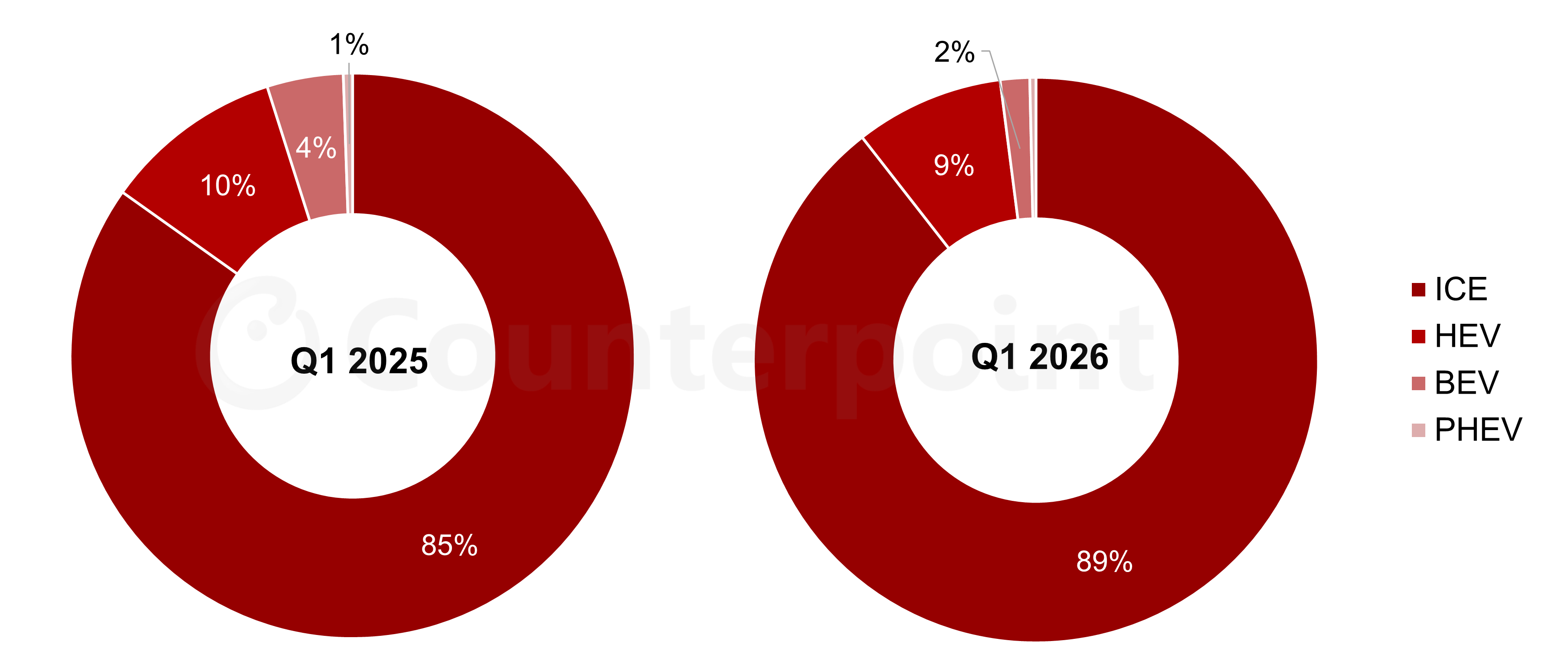
Ford Brand’s Share of US Sales by Powertrain Type, Q1 2025 vs Q1 2026
Source: Counterpoint Research
Strategic Focus
Although many automakers have changed their product lineups by shifting away from developing new EVs for the US market, they have not totally given up on the category. Even in the pickup truck segment, there are several competitors, though most offer electric pickup trucks at higher price points. Examples include Rivian’s R1T, which starts at $79,990, Scout Motors’ Terra, which starts at $60,000, the electric version of Chevrolet’s Silverado, starting at $55,895, GMC’s electric Sierra, starting at $62,4000, and Ford’s F-150 Lightning (the next generation of which will be an extended range EV rather than a pure BEV), which started at $63,345. One of the few exceptions is the new Slate Auto, which starts at $24,495 and offers a range of customization options.
Ford’s new model will be entering a market for EVs in the US that has become even more challenging. The elimination of the US federal tax credit of $7,500 for the purchase of an EV has had a negative effect on EV sales in the US since it ended in 2025. EV sales in the US are down YoY about 23%, according to Counterpoint’s Global Passenger Vehicle Electric Vehicle Tracker.
Despite the difficult operating environment, Ford’s Model e division’s fortunes have been improving. In Q2 2026, for example, the automaker reported its third consecutive quarter where the company narrowed its losses for this division, with a $0.9 billion loss in Q2 2026 vs a $1.3 billion loss in Q2 2025. This was a $482 million YoY improvement in its EBIT margin for the division. The OEM’s revenue for the quarter was $1 billion, down YoY from $2.4 billion in Q2 2025, largely due to the automaker discontinuing production of the BEV version of its F-150 Lightning (though as noted, the next-generation will be an EREV), and ‘right-sizing’ production of its Mustang Mach-E SUV.
In light of these changes to production, the new Fathom is crucial to this division’s future revenue and profitability goals. As outlined in a previous Counterpoint blog post on how Ford is approaching designing and building the new Fathom and future UEP models, the company has rethought its approach to designing and building BEVs.
To build the new Fathom, the automaker has discontinued production of its popular Escape mid-size SUV (the Escape was in the top five for retail sales from 2022 through 2025) and Lincoln Corsair, which the company produced at its plant in Louisville, Kentucky. Ford has invested $2 billion in its Louisville plant to build the new Fathom, and the automaker has radically re-thought its approach to production in order to accelerate production and reduce cost and complexity.
Ford is using the OEM’s new ‘assembly tree’ production method, where production starts with three sub-assembly lines (one for the front, one for the rear, and the final sub-assembly is for the battery, seats, console, and carpeting) that converge into a single line.
The new process will produce the Fathom 15% faster than vehicles previously produced at the OEM’s Louisville plant. The vehicle will also require 20% fewer parts to produce compared with the OEM’s typical vehicle production programs.
Analyst take
When considering the new Fathom and how it will perform for Ford, it is important to look not only at its BEV competitors but also its competition within the mid-size pickup truck segment, even within Ford’s own lineup. Retail and commercial buyers looking for a mid-size truck option can also choose the Ford Ranger, which has a starting MSRP of $35,550 (excluding destination, delivery, and other fees). If they want a smaller truck, the Maverick (which also has hybrid version) is an option, at a starting MSRP of $28,145. These prices put the Fathom at not much more than the Maverick and less expensive than the Ranger. Within Ford’s lineup, the Maverick has grown in share of Ford’s brand’s sales in the US market, from about 4.6% in 2022 to 8.4% in 2025. Its Ranger mid-size pickup has varied in share of Ford’s sales from about 3.5% in 2022 to 4.4% in 2025.
Looking at Ford’s mix of US sales by powertrain, its BEV models account for a small but growing share, ranging from 3.4% in 2022 to 4.3% in 2025. The BEV share of Ford’s sales fell in Q1 2026, though that was primarily due to Ford’s shift in production, having discontinued the F-150 Lightning BEV and reducing production of the Mustang Mach-E. Ford’s sales share of hybrid models has grown from 5.8% in 2022 to 10.5% in 2025.
Looking beyond Ford’s lineup, example choices in the mid-size truck segment include the Chevrolet Colorado or GMC Canyon, Honda Ridgeline, Nissan Frontier, and Toyota Tacoma (with an available hybrid). For BEVs, the range is even wider, with more than 50 models to choose from.
Regardless of how the vehicle performs, though, Ford has learned from its development and production, reducing parts count, bringing development of more systems in-house, speeding up production, using a new assembly process, and ultimately developing a low-cost EV for the US market. Within the vehicle’s segment, where Slate Auto is the main competitor, Ford has the larger production capacity and brand awareness among retail and fleet buyers. Especially in the fleet segment, long-term support, parts availability, and a related competitive allowance program are advantages for Ford. Slate Auto’s pickup, with an MSRP of $24,950 for the ‘Blank Slate’ version, which does not even come with a radio, is less expensive than the Fathom but will require extensive customization (and therefore a higher price) before it would have the same features as the Fathom.
Ford also has its BlueOval charging network and a deal with Tesla that allows Ford EV owners to use Tesla’s SuperCharger network.
Looking at the larger picture, US automakers are still global organizations. However, the rest of the world is adopting EVs at a faster rate than the US. For Ford and others to compete, they must develop cost-effective EV platforms or over the long term risk losing market share. Ford’s bet on the Fathom is not only building its EV portfolio in the US but it will be able to take what it has learned from developing this platform to the larger organization and to other markets.
Category
Industry
Automotive
Service
Premium
Report Type
Report
Time Period
Other
Receive our insightful weekly newsletter and stay ahead of the competition.
Author
Greg Basich
As Associate Director at Counterpoint Research, Greg Basich focuses on the automotive industry. Prior to joining Counterpoint Research, Greg worked at TechInsights and Strategy Analytics for a combined 11 years, providing market intelligence and advisory services to companies in the automotive electronics market and related verticals. Prior to his career as an analyst, Greg was a business-to-business journalist at Bobit Business Media for 13 years, focused on automotive interiors, aftermarket electronics, and the fleet market. Greg holds a bachelor’s degree in economics from the University of California, San Diego.