Apple N2 Position in TSMC Under Pressure
- Apple’s dominant position at TSMC is weakening as other major customers aggressively adopt the latest process technologies, such as N2.
- Apple may not secure sufficient N2 capacity in 2026. Its bargaining power is declining as AI/HPC customers are willing to pay premium prices for advanced nodes.
- To mitigate capacity constraints, Apple is diversifying its AP lineup and adjusting launch schedules with the A20 Pro in H2 2026 and the A20 in H1 2027 to balance N2 wafer demand across different product cycles.
- In the long term, Apple is likely to pursue a second production source for leading nodes. Intel could be a potential partner, leveraging its Intel 14A-E process for external customers, potentially starting in 2029.
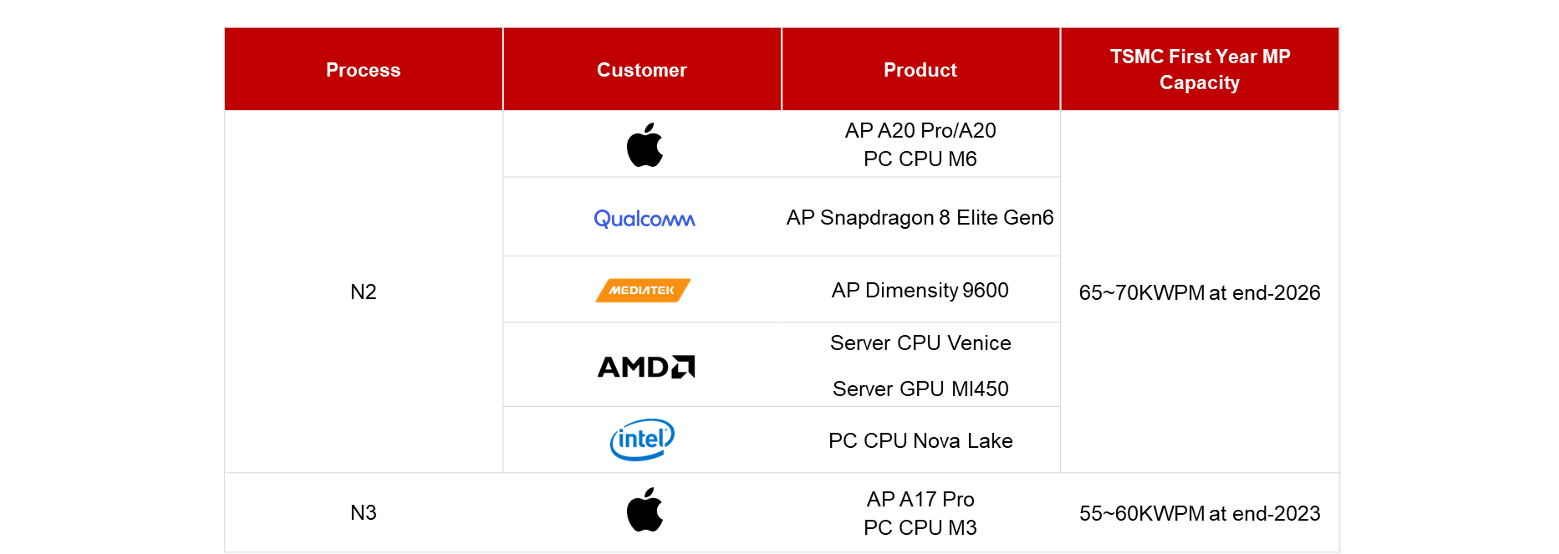
Counterpoint projects that Apple may fail to secure sufficient N2 capacity at TSMC in 2026, as other customers are adopting N2 sooner than the adoption pattern seen with N3. When N3 entered mass production in 2023, Apple was the sole customer using the node at that time, applying it to the A17 Pro and M3 chips. However, in the first year of N2 mass production, not only Apple’s A20 Pro and M6, but also Qualcomm’s Snapdragon 8 Elite Gen6, MediaTek’s Dimensity 9600, AMD’s Venice server CPU and MI450 server GPU, and Intel’s Nova Lake PC CPU are expected to adopt the N2 family starting in H2 2026.
From a demand perspective, we believe N2 demand will be stronger than N3 during the same phase of production. AI-driven demand is pushing these customers to pursue higher performance and better power efficiency, making N2 demand much stronger than N3’s during its first year of ramp-up.
From a supply perspective, although TSMC plans to expand N2 capacity more aggressively than N3 (55~60KWPM for N3 by end-2023 vs 65~70KWPM for N2 by end-2026), it is still unlikely to meet all customers’ requirements.
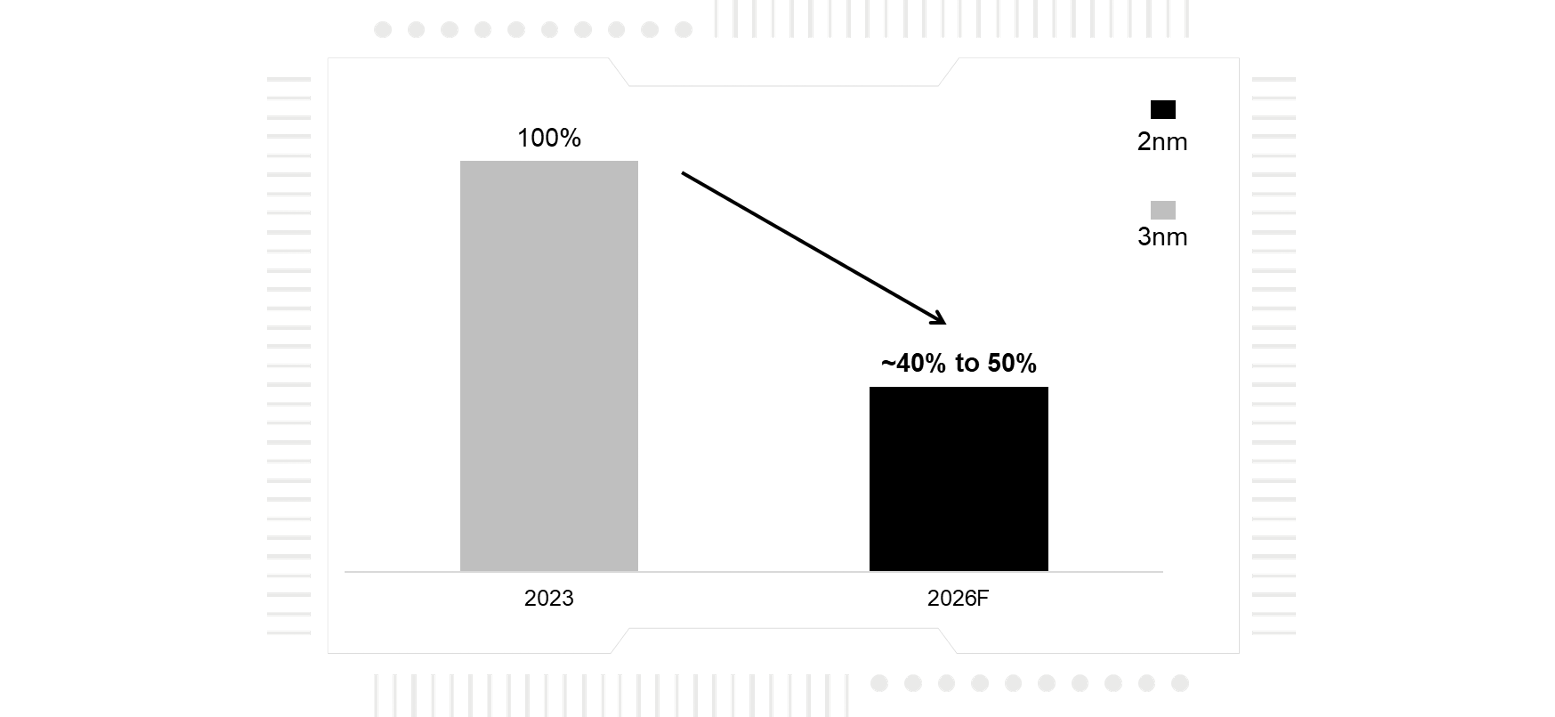
As a result, we expect N2 capacity to remain constrained in 2026, forcing Apple to compete with other TSMC customers for capacity allocation. Unlike previous generations, when Apple was the exclusive first-year user of the most advanced process, its dominance in securing early access to leading nodes is diminishing. Consequently, Apple may lose part of its process leadership advantage. While Apple’s A20 Pro will adopt N2, Qualcomm and MediaTek’s flagship APs may even move ahead with the enhanced N2P version.
TSMC Customer, Capacity Estimation in Leading Nodes - First Year Mass Production
Apple has usually been the first one to launch products with chipsets on the latest available leading node and “Apple Silicon” has been a key differentiation for its products. Hence, securing leading edge node capacity is important for Apple, especially for iPhone, iPad and Mac. Together, these three products contributed to 65% of Apple’s global revenues in FY 2025.
Apple’s Share of TSMC’s Leading Node Capacity Allocation
Implications and Strategy for Apple
As Apple’s dominance in securing leading node capacity weakens, we see two major implications:
1. Limited Capacity Support
As more customers are eager to adopt the latest process technologies at an earlier stage, Apple may find it increasingly difficult to secure sufficient leading node capacity. From TSMC’s perspective, the company is now more willing to allocate advanced capacity across a diversified customer base to reduce reliance on a single large customer.
2. Weaker Bargaining Power on Wafer Pricing
Before 2024, Apple was TSMC’s largest customer and enjoyed favorable wafer pricing compared to other major clients. In previous tight-capacity environments, TSMC’s wafer price hikes for Apple were generally smaller than those for other customers. However, with surging AI and HPC demand, these customers are now willing to pay premium prices for advanced nodes, weakening Apple’s pricing leverage. As a result, we believe Apple’s bargaining power with TSMC has eroded, potentially leading to higher production costs going forward.
In response, Apple has been diversifying its application processor lineup. This strategy began with the iPhone 15 series in 2023 and is expected to continue through 2026. For the iPhone 18 series, Apple is expected to introduce two chips – A20 Pro and A20 with N2 technology. The A20 Pro will likely power high-end models, such as the iPhone 18 Pro, 18 Pro Max and foldable models, in H2 2026, while the A20 will power the iPhone 18, 18 Air and 18e in H1 2027.
The A20 is expected to launch in H1 2027 rather than H2 2026 and feature a smaller die size to reduce production costs in N2. This staggered launch strategy will also help Apple distribute its N2 wafer demand more evenly at TSMC. By implementing a dual-chip strategy and separating launch timelines, Apple may secure sufficient N2 capacity to support its full product lineup.
In the long term, we believe Apple may also seek a second source for leading nodes to diversify its supply chain and regain pricing leverage. Intel could be a potential partner, thanks to the geopolitical advantages, leveraging its Intel 14A-E process for external customers, with possible collaboration beginning around 2029.
Category
Industry
N/A
Service
Premium
Report Type
Report
Time Period
Other
Receive our insightful weekly newsletter and stay ahead of the competition.
Author
Varun Mishra


Varun is a Principal Analyst at Counterpoint Research based out of Gurgaon. In Counterpoint, he closely tracks mobile devices and ecosystem with a focus on Apple. He started his career as a Consultant with Infosys Limited where he was able to identify strategic avenues for business growth through deep research and analysis of markets and companies in various domains. He holds a Master of Business Administration in Marketing from Institute of Management Technology, Ghaziabad and a bachelor's degree from Coventry University, UK.