China’s Digital Cockpit Application Processor Market Heats Up: Qualcomm Leads, Local Brands Close In
- Qualcomm leads China’s digital cockpit application processor market with more than half of the sales share, currently.
- China’s digital cockpit application processor sales are set to grow at a CAGR of 3% between 2026 and 2035, driven by electric vehicle (EV) growth and software-defined vehicle (SDV) transition.
- Domestic vendors like SemiDrive, SiEngine, AutoChips, Rockchip, and HiSilicon are expanding quickly, with their combined share expected to rise to 31% by 2035 from 17% in 2025.
- The process node technology for application processors used in infotainment systems is moving from 7nm and above to more advanced 5nm-and-below nodes to handle increasing AI workloads.
- Lower and mid-range cars are adopting integrated cockpit-plus-ADAS application processors, while premium models prefer separate application processors for better performance and safety.
As cars move toward software-defined architectures, automakers now require much more powerful processors, ones capable of running multiple displays, advanced audio systems, telematics, voice assistants, in-car gaming, camera processing, and even parking and ADAS features, all from a single platform. This shift is transforming China’s passenger vehicle digital cockpit application processor market at an impressive pace, supported by global semiconductor leaders, fast-growing domestic vendors, and traditional suppliers evolving their portfolios.
Many Chinese electric vehicle (EV) brands, such as Li Auto, Zeekr and Lynk & Co are already using dual-chip configurations in their higher-end models to deliver faster performance, smoother graphics, and more responsive user experiences. Looking ahead, the number of digital cockpit application processors in cars sold in China is expected to grow at a steady 3% CAGR from 2026 to 2035, with potential for even faster expansion as more automakers adopt multi-chip architectures to differentiate their vehicles.
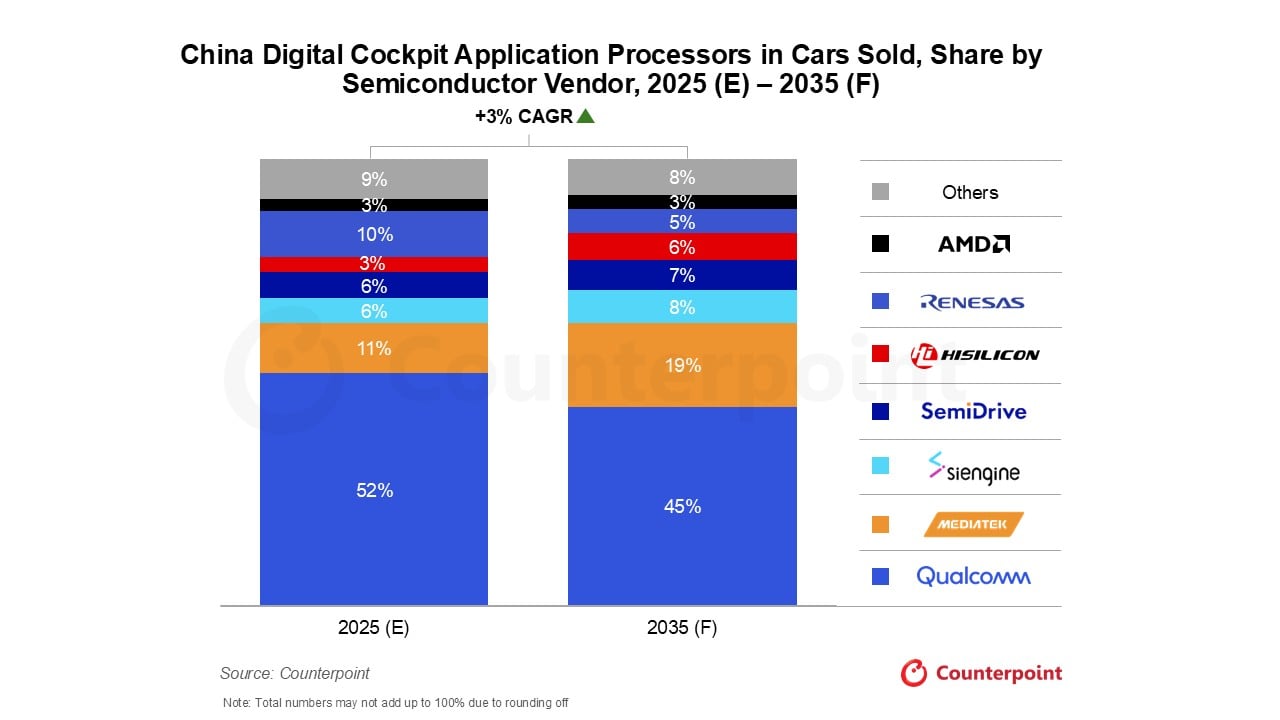
Qualcomm continues to dominate China’s digital cockpit application processor market, commanding a share of more than half the market in 2025. Its broad product lineup, strong collaborations with more than 25 automakers, including BYD, Chery, Geely, BMW, Li Auto, and NIO, and steady technology upgrades have helped it stay on top. By 2035, domestic players like SemiDrive, Siengine, Rockchip, UNISOC and AutoChips are expected to significantly close the gap, with their combined share of digital cockpit application processors in cars sold rising to roughly 31% from 17% in 2025.
MediaTek is trying to grow its automotive footprint after surpassing Qualcomm in smartphones, and its collaboration with the world’s largest EV brand, BYD, is helping it capture significant market share in China. Meanwhile, Huawei’s HiSilicon remains focused mostly on the Seres Group, which restricts its ability to scale.
On the technology side, more than 40% of vehicles in China in 2025 use chipsets built on 7nm or advanced nodes, driven largely by Qualcomm’s top-selling SA8155P. As AI workloads increase, the market is now moving toward 5nm and eventually 4nm and 3nm platforms. Other semiconductor suppliers, such as NXP, Renesas, and Texas Instruments, have application processor portfolios that are tied to the 16nm process node. Although they are developing new products at more advanced nodes, they are not available in volume. This has weakened their competitiveness in China.
Another big shift is the growing appeal of integrated system-on-chip (SoC) solutions that can handle cockpit functions, parking, and ADAS together, especially for cost-sensitive mid-range cars. Premium vehicles still tend to use separate cockpit and ADAS chips for higher performance and redundancy. At the same time, AI-driven features are accelerating rapidly, pushing vendors to boost NPU performance and explore chiplet-based designs, which are expected to gain significant traction after 2027.
For our full research note, please log in to our Research Portal.
If you are not a client, reach out to us at [email protected]
Receive our insightful weekly newsletter and stay ahead of the competition.
Author
Soumen Mandal


Soumen is a Senior Analyst tracking IoT, Automotive and Telecommunication ecosystem at Counterpoint Research. He is interested in IoT applications, connections, components, electric vehicles, connected cars, autonomous vehicles, semiconductors, shared mobility, services and emerging technologies. He started his career as an Energy Analyst with Manikaran Power Ltd. He has experience working with DISCOMs and SLDCs in the Indian power and energy industry. He is currently based in Gurgaon. He holds an Electrical Engineering degree and an MBA in Marketing & Finance.