- Companies developing artificial intelligence models for autonomous driving are making improvements on rules-based systems to make autonomous vehicle behaviour more human like while at the same time improving safety and performance.
- End-to-End and Visual-Language-Action models are optimizing autonomous driving, from perception to controls, using a single neural network, enabling faster scalability by training on diverse datasets that require minimal adaptability for new/ different environments.
- The lack of interpretability and explainability of the decision-making processes of End-to-End and VLA models will require autonomous driving players to invest in a multi-layered safety ecosystem to convert the opaqueness of neural network policies to accountable systems.
Access to the full report here: How Artificial Intelligence Is Accelerating ADAS & Autonomous Driving Development
Advanced Driver Assistance Systems (ADAS) and Autonomous Driving (AD) are developing rapidly with the help of Artificial Intelligence (AI), including deep learning, probabilistic modelling and large-scale data engineering. Companies are advancing perception (what the vehicle sees), prediction (what other road users will do), planning (what the vehicle should do), and the development cycle through improvements in simulation, continuous learning and validation. These developments are speeding up iteration across each technical layer.
Current ADAS-equipped vehicles, up to SAE Level 2, have largely relied on deterministic, rules-based and signal-processing safety systems. As higher levels of autonomy, represented by L2+ hands-free highway and city assist functions, become more common, the focus on autonomous vehicle development has shifted. Engineers are now using transformer networks for complex vision and sensor processing, applying deep sensor fusion to combine raw camera, radar and LiDAR data, and deploying End-to-End and Vision-Language-Action (VLA) models for more accurate trajectory prediction and the replication of nuanced driving behavior. This shift replaces rules-based AI models with learning models, improving perception accuracy and complex scene understanding. As a result, data, compute, validation and safety engineering have become increasingly critical.
Companies developing AI models for autonomous driving are improving rules-based systems to make vehicle behavior more human-like while enhancing safety and performance. End-to-End and VLA models optimize autonomous driving from perception to controls using a single neural network, enabling faster scalability by training on diverse datasets that require minimal adaptation for new or different environments.
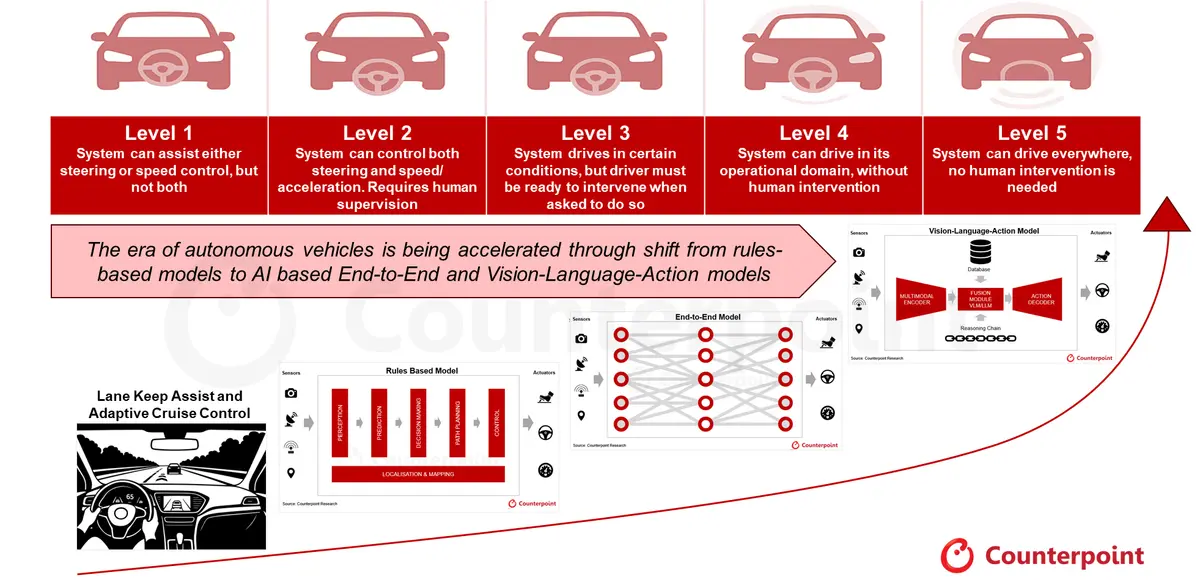
However, AI implementation introduces challenges related to safety and verification. The lack of interpretability and explainability in the decision-making processes of End-to-End and VLA models will require investments in multi-layered safety ecosystems capable of converting the opaqueness of neural-network-based policies into accountable systems.
Companies of all sizes, including NVIDIA, Qualcomm, Mobileye, Horizon Robotics, Huawei and Momenta, are investing heavily in automotive SoCs, simulation ecosystem tools and data platforms to accelerate ADAS and AD development and deployment.

