Microsoft Build 2026: Agents, Context, and New Developer Stack
- MSBuild 2026 was less about launching a single breakthrough product and more about showing that Microsoft now controls nearly every layer of the AI stack.
- Microsoft is trying to become the operating system for enterprise AI, not just a cloud provider.
- Microsoft continues to offer OpenAI models while simultaneously offering Anthropic, Meta, Mistral, DeepSeek, xAI, NVIDIA, Cohere, and its own MAI models through Foundary.
Microsoft Build 2026, held on June 2nd – 3rd at the Seattle Convention Center, was far more than a showcase of new products and features. It highlighted a broader shift in the AI landscape, the battle is no longer centered solely on models, but on the platform and ecosystem that enables them.
Build 2026 provided the clearest demonstration yet of that strategy. Microsoft presented an integrated AI stack that connects GitHub for software development, Microsoft Foundry for agent creation and deployment, Azure for infrastructure and compute, and Mircosoft 365 as the enterprise-facing user interface.
The message to developers was clear, build once, deploy at scale and manage everything through a unified platform. By embedding governance, security and AI capabilities throughout the development lifecycle, Microsoft is positioning its ecosystem as the foundation for the next generation of AI applications and agents.
Project Solara: A new category for agents-first devices
Among the announcements at Build 2026, one of the most ambitious was Project Solara; a newly-designed platform specifically developed for AI-powered devices to streamline workflows. This represents a transitional shift from an app-first economy towards an agentic-first economy where users can execute tasks with the help of AI agents across devices and applications.
Counterpoint has published an in-depth look at what Project Solara means for enterprise hardware strategy. Read: Project Solara: Microsoft's Bet on Agent-First Enterprise Hardware.
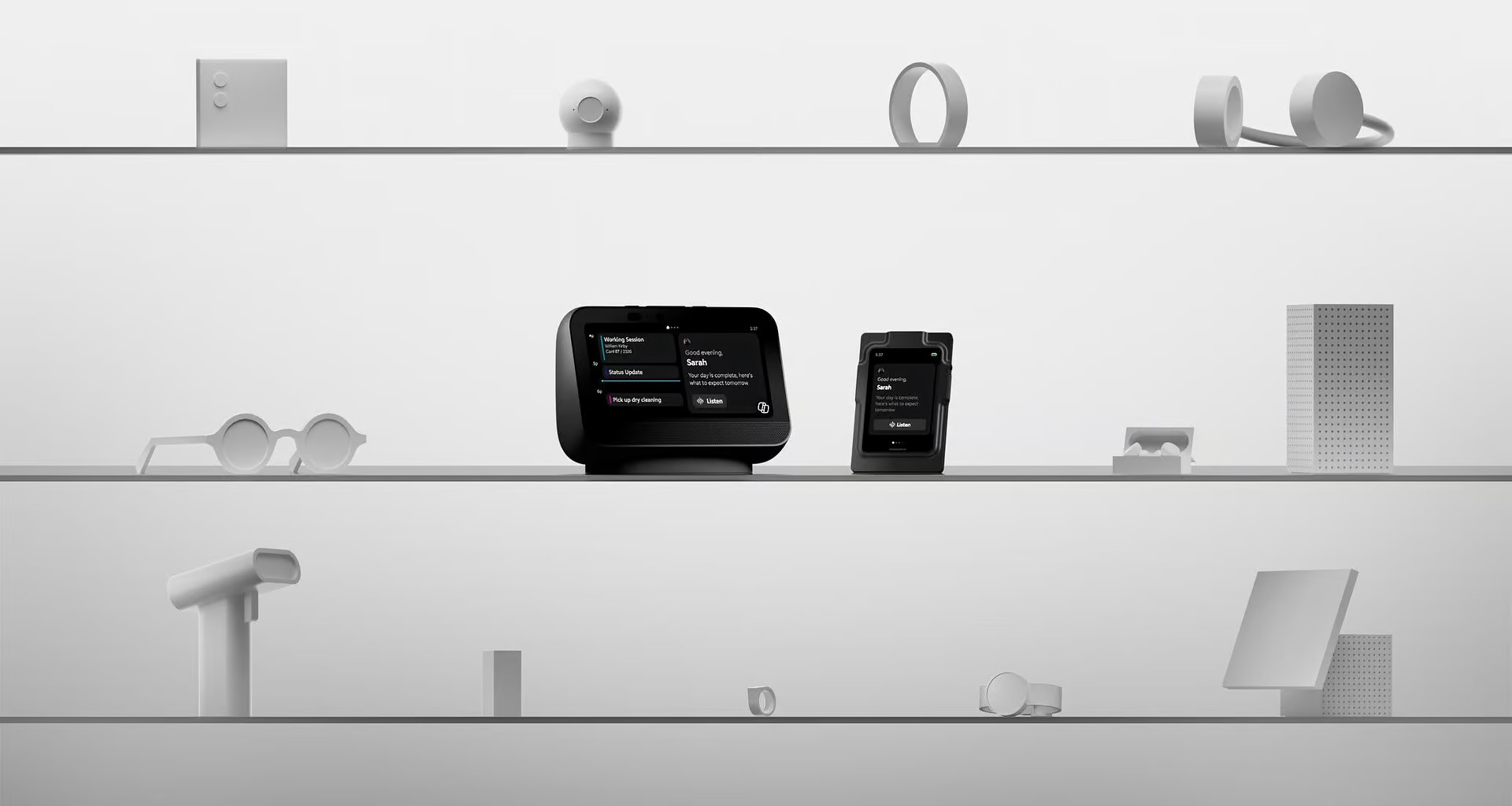
For context, Microsoft previewed two concept reference designs, a desk-mounted AI hub powered by MediaTek IoT silicon, featuring a touchscreen, dual far-field microphones, a UWB presence sensor for seamless auto-login, and a USB-C port that can also function as a Windows 365 cloud PC client.
The second is a wearable AI badge built on Qualcomm hardware, offering 5G connectivity along with voice and vision capabilities, and secured by a Windows Hello for Business fingerprint sensor. Together, these concepts illustrate Microsoft’s push toward always-on, AI-native experiences across both desktop and wearable form factors. They work by using microphones, sensors, and AI agents to capture context while on the move, providing hand-free assistance in activities such as check-ins for healthcare, retail and field services.
For a comprehensive view of the emerging Physical AI device landscape, see Counterpoint’s latest Global Physical AI Device Market Tracker, 2025.
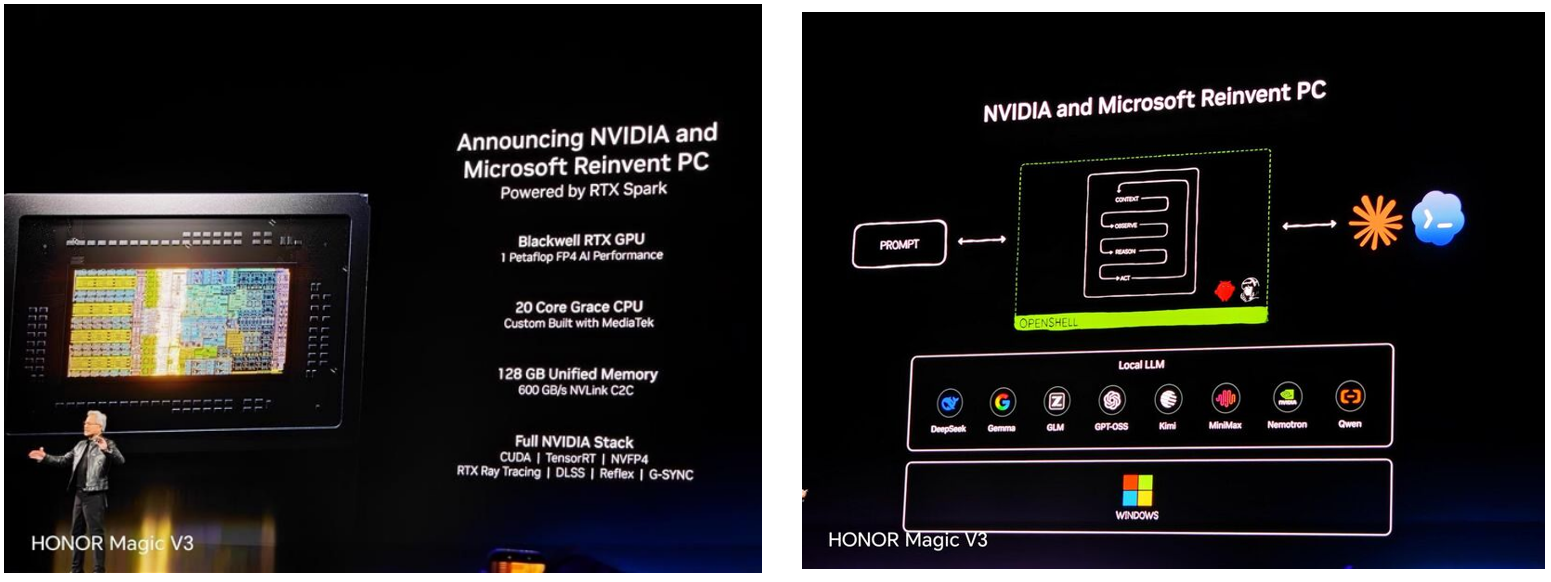
Alongside the software announcements, Microsoft has unveiled the Surface RTX Spark Dev Box, a compact AI developer workstation powered by NVIDIA’s RTX Spark superchip. Featuring a grace CPU, blackwell RTX GPU and 128GB of unified memory, the system delivers up to 1 petaflop of AI performance, enabling developers to run models with more than 120 billion parameters locally.
The launch highlights Microsoft’s broader push towards edge-AI computing, where increasing AI workloads can be executed directly on increasingly-capable devices, rather than in the cloud.
According to our Global Quarterly AI Laptop Tracker and Forecast, AI Advanced PC penetration is projected to reach approximately 70% of global shipments in 2030, up from 37% in 2025. The Surface RTX Spark Dev Box and Microsoft’s focus on the NPU moment reflects a broader strategy to strengthen Window’s role and opportunity in AI PC development. Rather than focusing solely on larger cloud models, Microsoft is betting that future AI workloads will be distributed across cloud infrastructure, GPUs, and increasingly capable NPUs embedded in PCs
The announcement reflects Microsoft’s broader push to create an end-to-end AI stack spanning silicon, operating systems, developer tools, and cloud services.
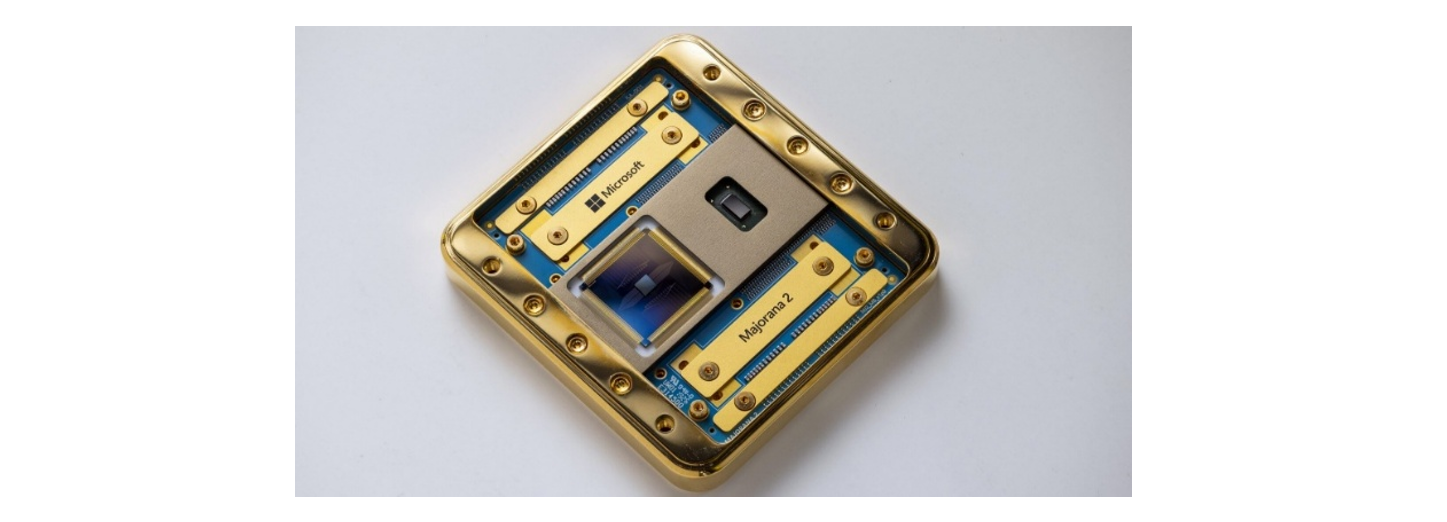
Microsoft unveiled Majorana 2, its next generation quantum processor promising more stable and durable qubits. The company claims the chip delivers 1,000 times greater qubit reliability than its predecessor Majorana 1, marking a transition from proving the underlying physics to advancing towards scalable engineering. Microsoft also updated its roadmap, targeting a commecially viable, fault-tolerant quantum computer by 2029 approximately two years earlier than previously expected.
Microsoft’s focus on Majorana 2 at Build 2026 relects its continued effort to bring quantum computing closer to mainstream enterprise conversations. While practical, large-scale quantum applications are still some distance away, the company is using Azure and its developer ecosystem to help organizations explore potential use cases and build familiarity with quantum technologies.
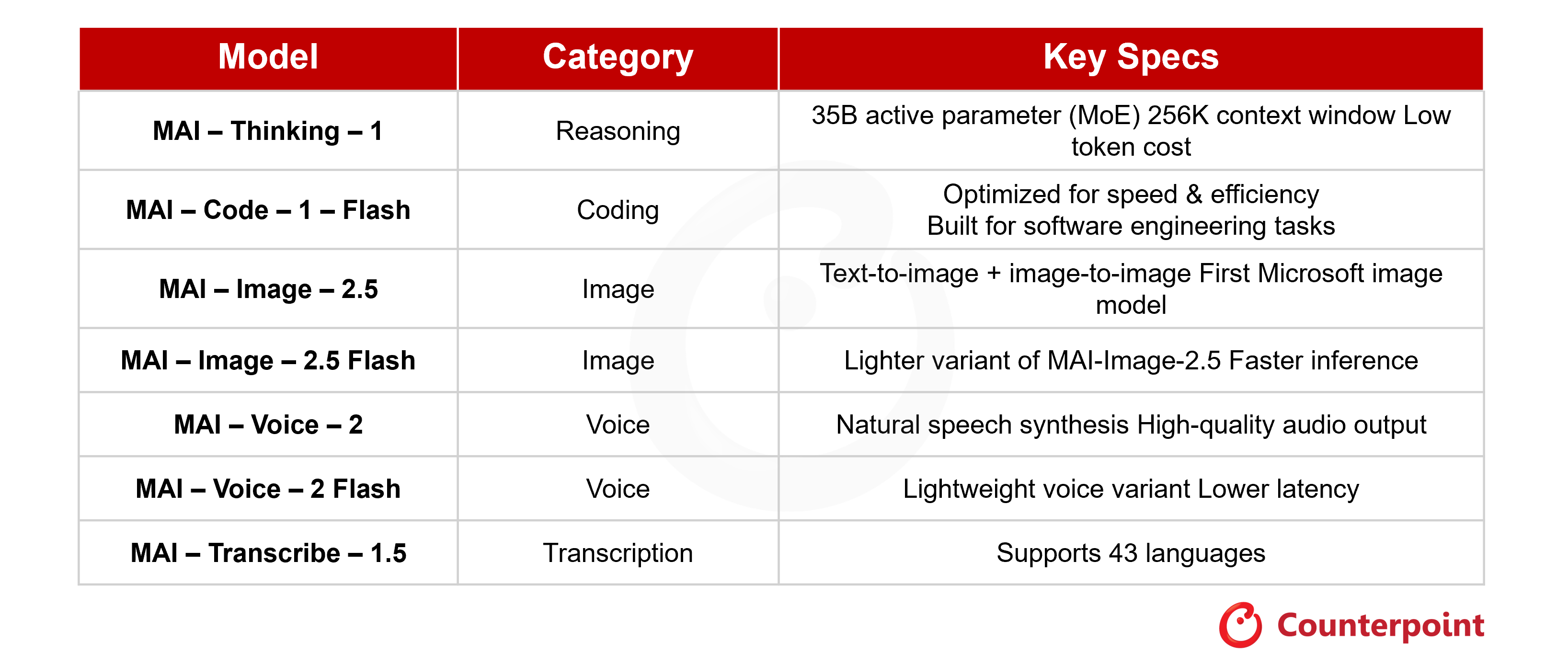
Microsoft launched seven new in-house AI models under the MAI (Microsoft AI) brand. Making its biggest step yet toward developing proprietary foundation models rather than relying primarily on OpenAI.
MAI-Thinking-1 is Microsoft’s first proprietary reasoning model and is designed to compete with leading models from OpenAI and Anthropic while keeping costs lower. The company says it performs well on a range of reasoning and software engineering tasks, suggesting that businesses may not have to choose between strong performance and affordability.
Microsoft AI has positioned itself as a contender in the global AI race by prioritizing economic viability and multimodal capabilities for enterprise-scale deployments rather than competing purely on model size.
This approach reflects a broader shift in the industry, where long-term adoption is increasingly determined not only by model intelligence, but also by the ability to deliver AI at a sustainable cost across text, speech, image, and coding applications.
The launch is part of Microsoft’s broader effort to build more of its AI capabilities in-house, while still giving customers access to models from OpenAI, Anthropic, and other providers through its Azure AI Foundry.
Counterpoint Research’s Global LLM Adoption Snapshot tracks Monthly Active Users (MAUs) across leading LLMs worldwide, giving a data-driven context to benchmark Microsoft’s MAI push against ChatGPT, Gemini, Claude and others.
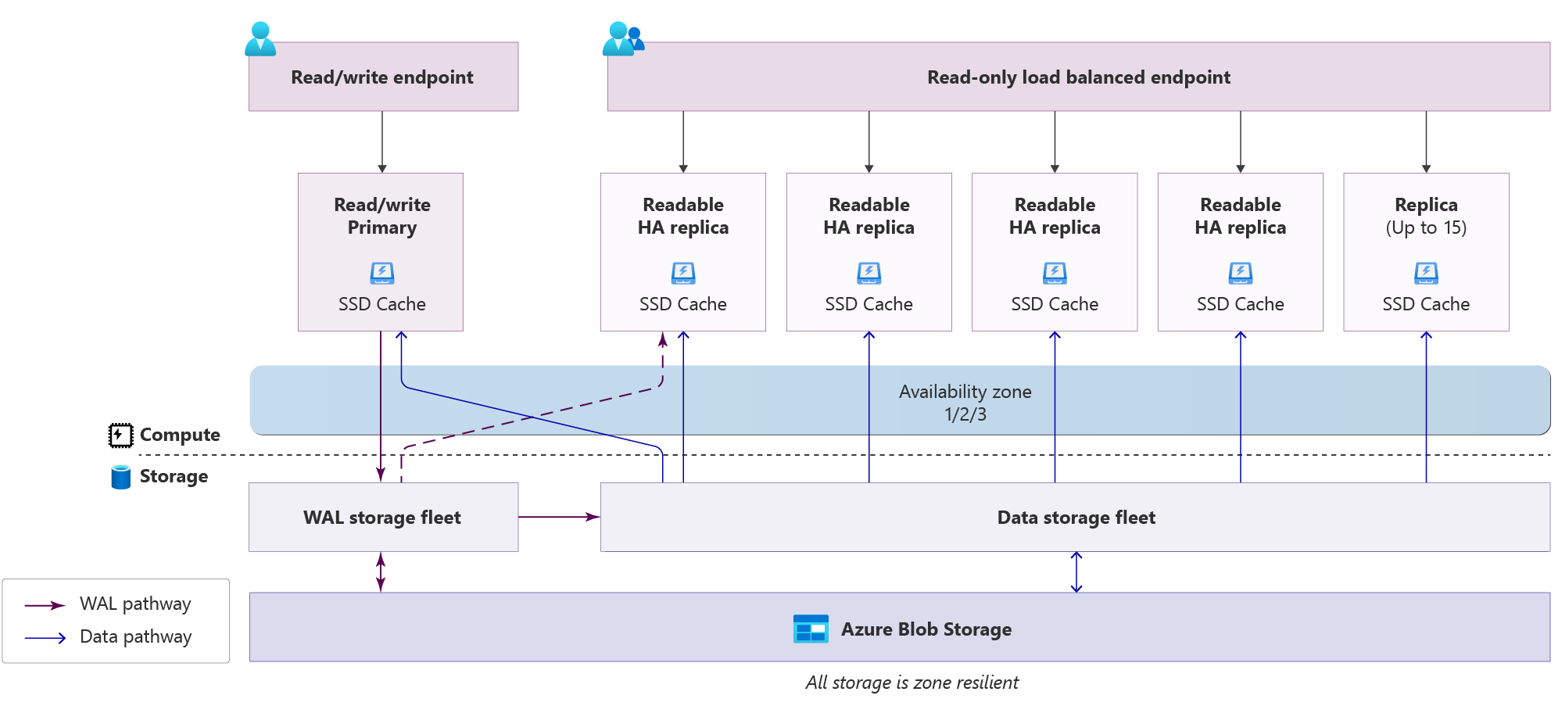
Azure HorizonDB entered public preview at Build as a fully managed, postgreSQL compatible database designed specifically for AI-native and agent-driven applications. Microsoft positioned the service as a response to a growing challenge, traditional database architectures were not built to support autonomous agents that require low-latency access to consistent, real-time context across distributed environments.
As the foundational data layer for Foundry-based agent deployments, HorizonDB is intended to help enterprises build and scale AI applications that depend on persistent memory, coordination and state management.
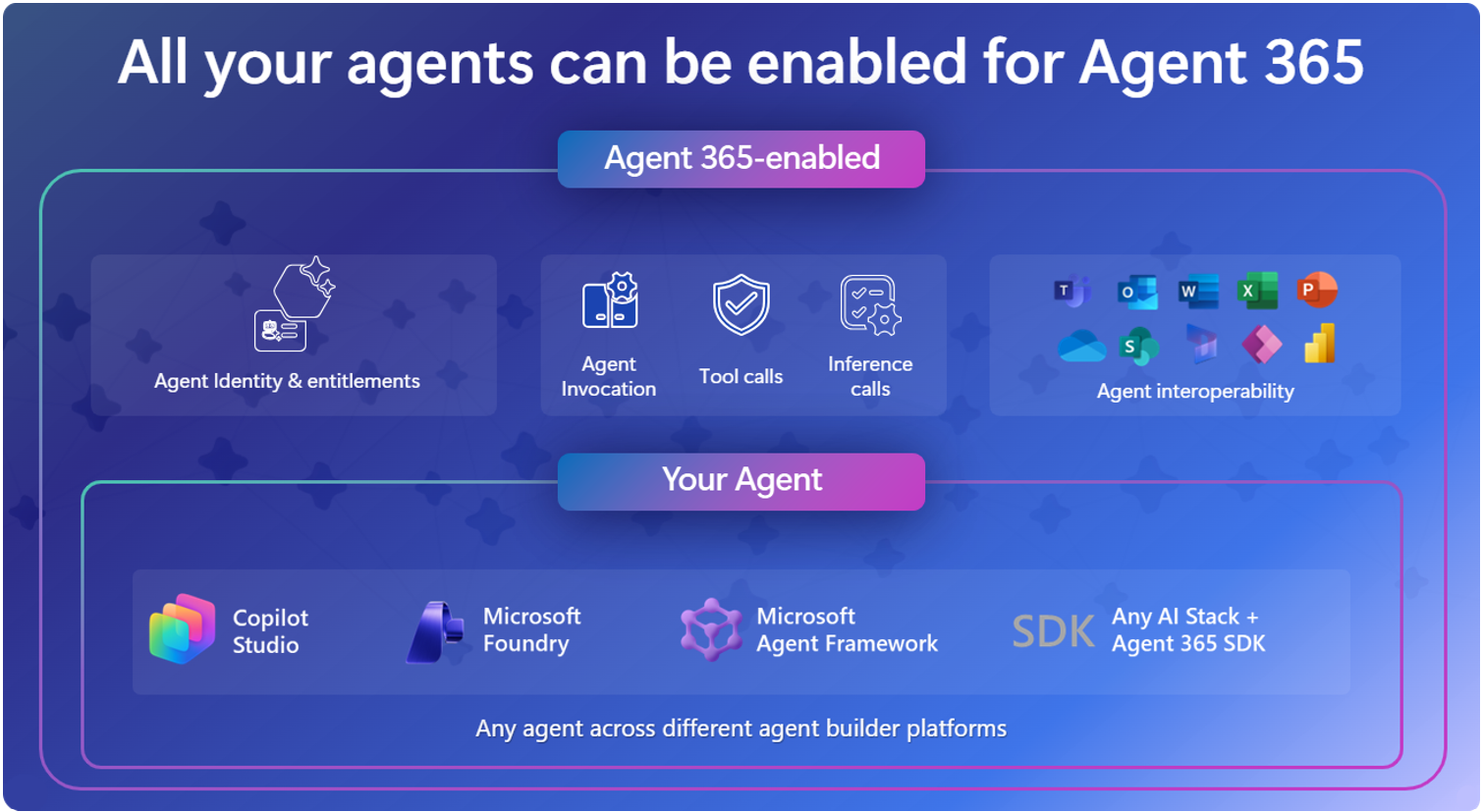
Microsoft’s expanding security framework for Agentic AI and the general availability of the Agent 365 SDK, embeds compliance enforcement, access controls, governance policies, and observability directly into the agent development lifecycle, reflecting Microsoft’s view that enterprise AI security must be built into applications from the outset rather than added later.
Microsoft also extended its security-first strategy into software development with MDASH, a scanning harness that integrates Microsoft Defender and GitHub to identify and remediate vulnerabilities using AI. By embedding automated security analysis directly into development workflows, Microsoft aims to reduce risk throughout the software lifecycle while accelerating the adoption of AI-assisted coding and agent-driven applications.
From an industry perspective, the Agent 365 SDK and related security announcements reflect Microsoft’s efforts to address one of the key barriers to enterprise AI adoption: governance and security.
As organisations move from AI assistants to more autonomous agents, concerns around identity, access control, data protection, and oversight become increasingly important. By extending enterprise security and management capabilities to AI agents, Microsoft is positioning its platform to support large-scale agent deployments while giving organisations greater visibility and control.
Microsoft is executing on a deeply integrated platform strategy. Azure serves as the foundation cloud layer. While the MAI model family reduces third-party dependency. Copilot and Scout capture the productivity and workflow layer. GitHub owns developer mindshare. Project Solara aims for a new hardware category. And the Majorana program stakes a claim in the next decade of computing.
Microsoft’s AI revenue run rate surpassed $37 billion in its most recent quarter, growing 123% YoY. Azure cloud services grew 39% in the same period, with AI contributing an estimated 13% to 16% of that growth, indicating that AI is now responsible for roughly one-third of Azure’s revenue expansion.
Microsoft’s scope expanded from being an AI-enabled software company to becoming a full-stack AI platform provider. The biggest competitive gain was reducing its dependence on OpenAI through MAI models and Azure AI Foundry, while the biggest growth opportunity is the emergence of enterprise AI agents.
If agent adoption scales over the next three to five years, Build 2026 may be remembered as the point where Microsoft moved beyond copilots and began building the infrastructure for the enterprise AI economy.
Category
Industry
AI, IoT
Service
Standard
Report Type
Report
Time Period
Other
Receive our insightful weekly newsletter and stay ahead of the competition.
Author
Vaibhaw Verma


Vaibhaw Verma is a Research Associate at Counterpoint Market Research, based out in Noida, India. He is a part of Automotive Research team, exploring the various segments of Smart Automotive and specializing in Advanced Driver Assistance System (ADAS).Vaibhaw holds a (PGDM) Post Graduation Diploma in Management degree in Business Analytics and Marketing from Ramaiah Institute of Management, Bangalore, India.