

- India’s tablet market grew 5% YoY in Q1 2026 despite rising memory prices and uncertain macroeconomic conditions.
- Larger-screen tablets above 12 inches gained further traction as consumers increasingly preferred productivity-oriented devices.
- Average Selling Prices (ASPs) increased 20% YoY, driven by ongoing premiumization trends alongside the price increases linked to memory cost inflation.
- Domestic manufacturing grew more than 61% YoY, supported by increased localization from Lenovo, Xiaomi and OnePlus.
- Tablet exports crossed 200 thousand units during the quarter, led by Samsung and Lenovo, strengthening India’s manufacturing ecosystem.
New Delhi, Beijing, Berlin, Buenos Aires, Fort Collins, Hong Kong, London, Seoul, Taipei, Tokyo – 1 June, 2026
The Indian Tablet market experienced 5% growth in Q1 2026 despite the rising memory price pressure and the uncertain market conditions, according to Counterpoint Research Tablets tracker. The key reasons for the growth have been the evolution on both the demand and supply sides. On the demand side, consumers continue to have a growing inclination towards the larger screen sizes, 5G capabilities and higher configurations. Adding to it is the strong demand momentum from earlier quarters, along with tablets being viewed as a value-efficient alternative to laptops and smartphones amid sharp memory price increases across categories. On the supply side, domestic manufacturing has been growing strongly as more brands shift their portfolios towards localized products. Adding to the synergy is the expansion of the export market as more brands expand their operations.
India Tablet Shipment Market Share by Screen Size, Q1 2025 vs Q1 2026
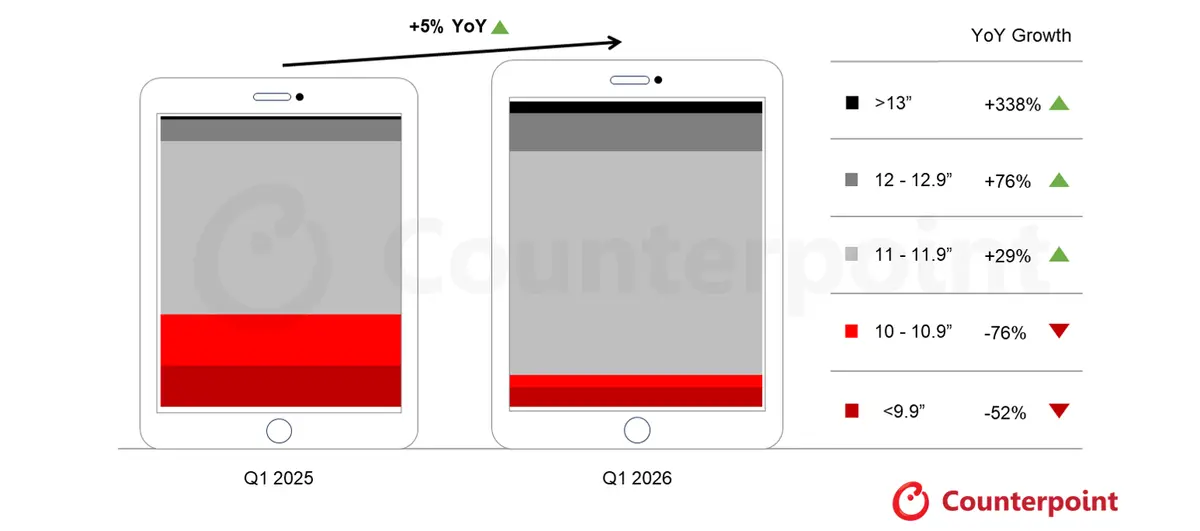
One of the key trends emerging over the quarters has been the consumer inclination towards larger screen sizes. The tablet screen size used to sit between a smartphone and a laptop; however, the lines between the categories keep getting blurred as each encroaches on the other’s defined landscape area. Strengthening the trend has been the Idea Tab series by Lenovo and the Samsung Ultra series, which have shown decent performance over the quarters. Q1 2026 was essentially the launch period for Apple and Xiaomi, both of which launched at least one product with a larger than 12-inch display, further supporting the larger screen trend.
On the supply side, domestic manufacturing expanded further, growing 61% YoY in volume terms. Samsung continues its strong lead in domestically produced tablets. Lenovo has pivoted its portfolio towards localized products, while Xiaomi and OnePlus have been benefiting from local production. Over the past few quarters, more brands have expanded their domestic manufacturing capabilities, including realme and OPPO, further strengthening the manufacturing ecosystem.
Commenting on the evolving dynamics, Principal Analyst Anshika Jain noted, “Lenovo recaptured the second position in the Indian Tablet Market after eight quarters. The key factor for growth was the increased domestic production and the sustained demand for the Idea Tab series within the larger display category. Another key change was the entry of OnePlus into the top five, driven by the strong performance of the Pad Lite and Go 2 series over the quarters, which too are being domestically produced. Exports continue their expansion, reaching more than 200 thousand units during the quarter, with more brands like realme exploring the export market. There is positive momentum in domestic manufacturing and consumer demand, which is helping the tablet market to grow even during adverse market conditions.”
Commenting on the features, Jain added, “The market is seeing an increased preference for larger screen sizes, as consumers are using tablets as both a media consumption device and a productivity tool. This is strengthening the premiumization trend as consumers demand higher configurations and better displays. In Q1 2026, the market experienced a double-digit increase in ASP. Though the memory cost inflation also affected the prices, its impact was relatively limited in the quarter. The rising memory price impact is expected to become more evident from Q2 as brands increase prices to manage margin and cost pressure.”
About Counterpoint Research
Counterpoint Research is a global market research firm specializing in products across the technology ecosystem. We advise a diverse range of clients – from smartphone OEMs to chipmakers and channel players to Big Tech – through our offices located in the world's major innovation hubs, manufacturing clusters and commercial centers. Our analyst team, led by seasoned experts, engages with stakeholders across the enterprise – from the C-suite to professionals in strategy, analyst relations (AR), market intelligence (MI), business intelligence (BI), product development and marketing – to deliver services spanning market data, industry thought leadership and consulting. Our core areas of coverage include AI, Automotive, Consumer Electronics, Displays, eSIM, IoT, Location Platforms, Macroeconomics, Manufacturing, Networks and Infrastructure, Semiconductors, Smartphones and Wearables. Visit our Insights page to explore our publicly available market data, insights and thought leadership, and to understand our focus, meet our analysts and start a conversation.

