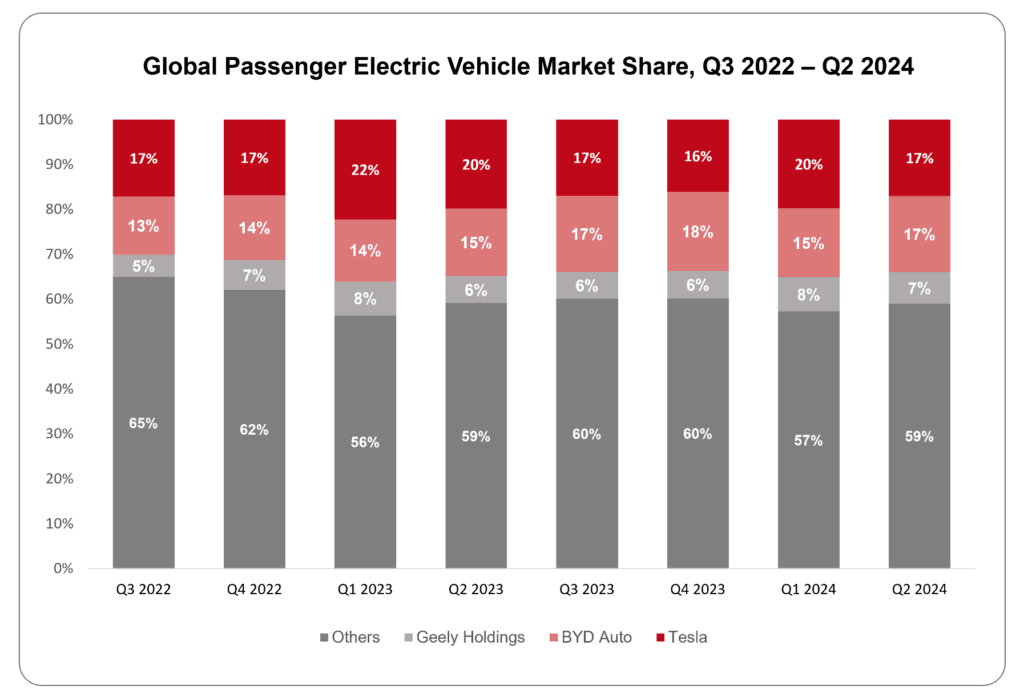
Global Electric Vehicle Market Share: Quarterly

| Brands | Q2 2024 | Q3 2024 | Q4 2024 | Q1 2025 | Q2 2025 | Q3 2025 | Q4 2025 | Q1 2026 |
|---|---|---|---|---|---|---|---|---|
| Tesla | 17% | 17% | 14% | 12% | 12% | 13% | 10% | 13% |
| BYD Auto | 17% | 16% | 16% | 15% | 18% | 16% | 15% | 11% |
| Geely Holding Group | 8% | 9% | 9% | 11% | 11% | 10% | 9% | 10% |
| Others | 58% | 59% | 61% | 61% | 60% | 61% | 66% | 66% |
*Note: For EVs, we consider only BEVs.
Market Highlights
Key Takeaways:
- Global battery electric vehicle (BEV) sales grew 5% YoY in Q1 2026.
- BEVs continued to dominate total EV sales with a two-thirds share, while plug-in hybrids sales (PHEVs and EREVs) declined by 5% YoY in Q1 2026.
- BEVs accounted for 14% of global PV sales, similar to last year.
- China remained the key growth engine, contributing 45% of all global BEV sales, followed by Europe and the US. However, BEV sales in China declined 15% YoY.
- A lack of consumer demand, expiration of government incentives, rollback of tax exemptions on EVs, and changes to car trade-in subsides pushed down BEV sales in China.
- At the model level, the Tesla Model Y, Galaxy Xingyuan and Tesla Model 3 emerged as the world’s best-selling EVs during the quarter.
Top OEM Analysis:
Tesla
Tesla regained the position of global BEV sales leader in Q1 2026, holding nearly 13% share with 6% YoY growth. However, Tesla’s sales in the US declined 2% YoY, reflecting a gradual shift in consumer demand from EVs toward other powertrains following the expiration of federal EV tax credits. Tesla also continues to face increasing competition from Chinese automakers, particularly in the affordable EV segment, where pricing pressure remains intense. At the same time, the company’s focus on software updates, autonomous driving technologies, and manufacturing efficiency continues to differentiate it from traditional automakers. The Tesla Model Y, Model 3 and Model S were the company’s best-selling BEV models during the quarter. Tesla has officially discontinued its Model S and Model X and will only be focusing on Model Y, Model 3, Cybertruck and the upcoming small EV based on the Model 3.
BYD Auto
BYD’s BEV sales in Q1 2026 declined 25% YoY, reaching nearly 0.3 million units. However, the company continued to perform strongly in overseas markets such as Europe, Southeast Asia and Latin America. BYD exported nearly a quarter million vehicles, with more than one-third of its BEV sales coming from international markets. BYD’s key strength lies in its diversified portfolio across BEVs, PHEVs and EREVs, especially in the compact SUV and sedan segments. Its competitive pricing, large-scale production, and strong vertical integration continue to support its market position. The BYD Dolphin Mini, Sealion 7 and Dolphin were among the company’s top-selling models in Q1 2026.
Geely Holding
Geely Holding Group ranked third in global BEV sales in Q1 2026, capturing around 10% market share despite a 4% YoY decline in sales. The company benefited from strong demand for its Galaxy and Zeekr brands, particularly in China’s budget and mid-tier EV segments. Geely’s strategy of offering affordable EVs with advanced software and smart features continues to attract domestic consumers and strengthen its position in China’s highly competitive EV market. Among its brands, Galaxy accounted for nearly half of the group’s total BEV sales. The Galaxy Xingyuan and ZEEKR 7X were the group’s top-selling BEV models during the period.
*Data on this page is updated every quarter
Sales* here refer to wholesale figures, i.e. deliveries out of factories by respective brands.
For EVs, we consider only BEVs. PHEVs, HEVs and fuel cell vehicles (FCVs) are not included in this study.
If you are a member of the press, please contact us at [email protected] for any media enquiries.
Receive our insightful weekly newsletter and stay ahead of the competition.
Author
Team Counterpoint
Counterpoint Research is a global industry and market research firm providing market data, intelligence, thought leadership and consulting across the technology ecosystem. We advise a diverse range of global clients spanning the supply chain – from chipmakers, component suppliers, manufacturers and software and application developers to service providers, channel players and investors. Our veteran team of analysts serve these clients through our offices located across the key innovation hubs, manufacturing clusters and commercial centers globally. Our analysts consistently engage with C-suite through to strategy, market intelligence, supply chain, R&D, product management, marketing, sales and others across the organization. Counterpoint’s key coverage areas: AI, Automotive, Cloud, Connectivity, Consumer Electronics, Displays, eSIM, IoT, Location Platforms, Macroeconomics, Manufacturing, Networks & Infra, Semiconductors, Smartphones and Wearables.