

- The Edge AI Package aims to accelerate secure, affordable smartphone availability across the Indo-Pacific region through foreign assistance and partnerships.
- The program treats smartphones as trusted endpoints for identity, payments, work, and public services, not just consumer devices
- Key uncertainties include partner selection, minimum technical requirements, target segments, and distribution channels
Edge AI Package is a US State Department initiative that uses foreign assistance to speed up the availability of smartphones that are secure, high-quality, and affordable across the Indo-Pacific. Organizations will propose programs and partnerships, and selected proposals can receive funding from a pool of up to USD 200 million.
The announcement highlights the growing role of the handset as part of national and regional digital infrastructure, positioning it closer to a trusted endpoint for identity, payments, work, and public services than as a discretionary consumer gadget.
What still needs to be clarified are the program’s operational framework, the identity of its partners, the technical standards to be applied, the initial target groups, and the execution timeline. These details will determine whether the initiative delivers meaningful impact that could shape OEM strategies and channel priorities across the Indo-Pacific.
Why “secure + affordable” is becoming a policy objective?
“Secure” and “affordable” are often framed as a trade-off in the mass market, but policymakers increasingly see them as linked. When large populations rely on smartphones for banking, government services, and commerce, weak device security becomes a systemic risk: fraud scales quickly, misinformation spreads faster, and trust in digital services erodes. At the same time, security standards that only exist in premium tiers leave most users exposed. A policy push that raises the baseline without pricing devices out of reach signals a shift toward minimum security expectations, longer and clearer software support, and deployable standards that work in high-volume, cost-sensitive Indo-Pacific markets. In practice, that can translate into short, concrete requirements: trusted U.S.-aligned OS support, funding to close price parity versus “untrusted” incumbents, preference for Pax Silica–partner headquartered OEMs, and stronger supply chain transparency and traceability (including potential pilot participation with the U.S. Department of State and partners). The package also appears structured around tech providers versus recipient countries, with Indo-Pacific countries positioned as recipients, including Southeast Asia and nearby islands.
Which markets benefit first?
If the Edge AI Package transitions into real deployments, its early impact will likely be concentrated in the largest and most strategically important Indo-Pacific markets, such as India and Southeast Asia. For example, according to Counterpoint Research’s SEA Tracker 2025, entry-level smartphones priced below $250 currently account for 65% of smartphone shipments in SEA.
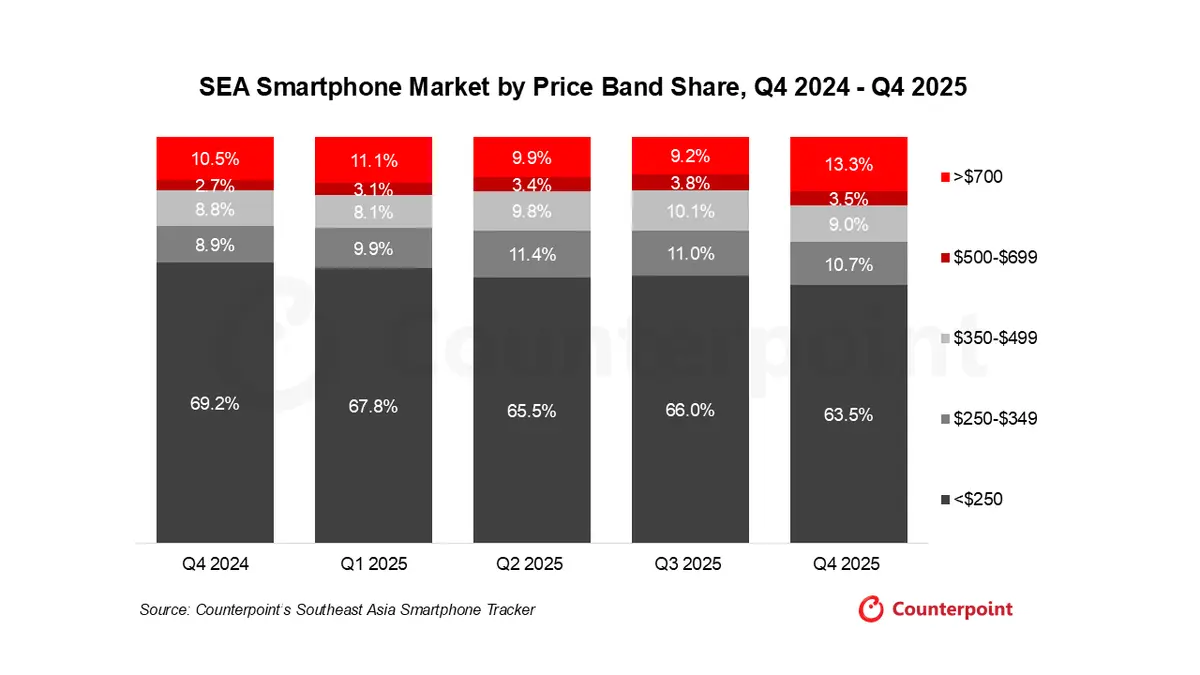
This is where Pax Silica becomes relevant. Pax Silica is the Department of State’s flagship effort on AI and supply chain security, aimed at building a shared economic security consensus among allies and trusted partners. A key policy goal is to ensure that the “next billion” users in the region adopt devices running trusted operating systems, specifically Android and iOS. This framing likely benefits Samsung and Google in particular. The benefit to iOS, however, is less clear, as the initiative emphasizes low-cost smartphones.
Pax Silica signatories: Australia, Greece, India, Israel, Japan, Qatar, Republic of Korea, Singapore, United Arab Emirates, United Kingdom
Non-signatory participants: Canada, European Union, Netherlands, Organization for Economic Cooperation and Development, Taiwan
But bigger question is if $200 Mn good enough for smartphones that are likely to be expensive due to memory crunch?
That said, current incentives are expected to provide only modest relief, given the Indo-Pacific’s scale of roughly 20 million units and ongoing price increases driven by memory costs. Importantly, such programs can lower effective ASPs in targeted channels through subsidies or bundled financing, without necessarily boosting total shipments. The impact lies more in shifting who buys what, and through which channels, than in expanding overall demand.
The competitive shift is not that consumers will purchase phones simply due to foreign assistance. Rather, such programs are more likely to assist or act as a subsidy within institutional and semi-institutional channels such as government, education, NGOs, and enterprise fleets. Brands that can credibly meet security baselines, commit to predictable update policies, and support device management requirements will gain an edge in these segments and in the narratives surrounding them.
This dynamic could favor Samsung and other brands perceived as lower risk in compliance-heavy contexts. Meanwhile, Chinese brands may continue to dominate open retail through strong value-for-money propositions, but they are likely to encounter greater friction where security assurances, supply chain transparency, and eligibility requirements shape vendor selection.
What OEMs and channel partners should do next?
For OEMs, the immediate priority is to treat security and support commitments as product features, not footnotes. That means clearer update policies, stronger default protections, and a roadmap for on-device capabilities that reduce dependence on cloud services for sensitive data. For channel partners telcos, distributors, and retailers the opportunity is to package “trusted devices” as part of broader solutions but from monetary point of view $200 Mn might be just the start.


