

It has been a little over a month since the three major carriers in Korea - SK Telecom, KT and LGU+ - took the country into the 5G era by launching commercial services simultaneously. The three companies launched the world's first 5G service at a launch event with celebrities including Korean pop-stars, famous sports players, gamers on April 5, 2019. Impressively, the commercial rollout of 5G has been achieved in a short span of time as it was only four months ago in December 2018 that the first successful 5G transmission took place in Korea.
The number of subscribers exceeded 100,000 within one week of service beginning, and after 25 days, 260,000 people have subscribed to 5G. The rapid increase in initial subscriber numbers compared to 4G LTE shows that users' interest and expectations for 5G are huge.
Let’s take a look at what we have learned from the first month of 5G in Korea:
What has changed?
- Data transmission speed
5G enables three core use-cases – Enhanced Mobile Broadband (eMBB), Massive Machine Type Communication (mMTC), and Ultra-Reliable Low Latency (uRLLC). Of these, only eMBB is considered possible on the 5G NSA (non-standalone). The remaining two require 5G SA (standalone) commercialization. Therefore, the data transmission speed is the key to judge the quality of the 5G NSA.
Counterpoint Research used Samsung’s Galaxy S10 5G and measured the download speed using a mobile app. The highest speed was 682Mbps measured at Gimpo city, followed by 497Mbps near Gangnam subway station. Latency is about 20-40ms on average, which does not show a big difference from 4G LTE.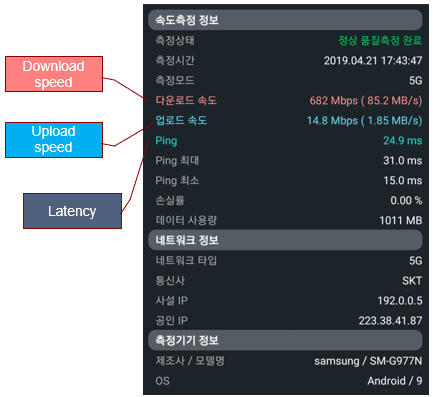
- Subscription tariff increased by about 12% compared to 4G LTE
Due to the characteristics of 5G and its use-case eMBB, users cannot experience proper 5G service with data consumption of less than 10GB per month. According to a recent announcement by the Ministry of Science and Technology, average LTE traffic reached 8.34GB per month just before 5G was commercialized. Since 5G is expected to increase data consumption at a fast pace, slim plans, which provide less than 10GB per month, are difficult for 5G use.
As such, if we look at the standard tariff plans for 5G from each carrier, on an average the rates are about 12% higher than that of 4G LTE. However, 5G plans offer more than 150GB of data per month. Of course, there are differences between carriers.
- 5G Contents
Preparation of related content is critical for the success of 5G as it is the most intuitive way for smartphone users to feel the need for upgrading from 4G LTE. As a result, carriers are operating a separate section on their website where users can experience 5G content. Examples of initial 5G content are ultra-high-definition media, VR/AR, and games.
What are the problems?
- Insufficient number of base stations, difficulty in access, and coverage limitations: Seoul and metropolitan areas have the highest concentration of 5G base stations, which limits coverage.
- 5G Quality issue: In many cases, there was no significant difference in speed compared to 4G LTE. Also, smartphones could not easily switch between 5G and 4G LTE. Further, battery consumption is about 1.5 to 2 times higher.
- Lack of content: Even in areas where 5G has good coverage, there is a lack of content to make good use of it.
How will it do in the future?
- Carriers: The plan is to focus on expanding coverage by the end of the year, by increasing the number of base stations while work on optimizing 5G devices and telecommunication equipment will continue. They are also trying to find suitable content that can take advantage of 5G.
- Government: It has announced a support policy for early stabilization of 5G which includes tax benefits for purchasing 5G telecommunication equipment and support for 5G network-based projects. The government has also promised an investment plan of more than KRW 30 trillion (roughly US$25 billion) by 2022 through a ‘5G+ Strategy’. It has also designated 10 core industries and five core services related to 5G and plans to support those.
- OEMs: Expectations are that OEMs will expand consumers' range of purchases by launching more 5G Smartphones.
- The government, carriers, and OEMs formed a joint task force team (TFT) to discuss technical problems in April. It will regularly discuss and announce technical issues as well as remedies such as service coverage expansion and disconnection issues.
Korea 5G Smartphone Shipments Forecast
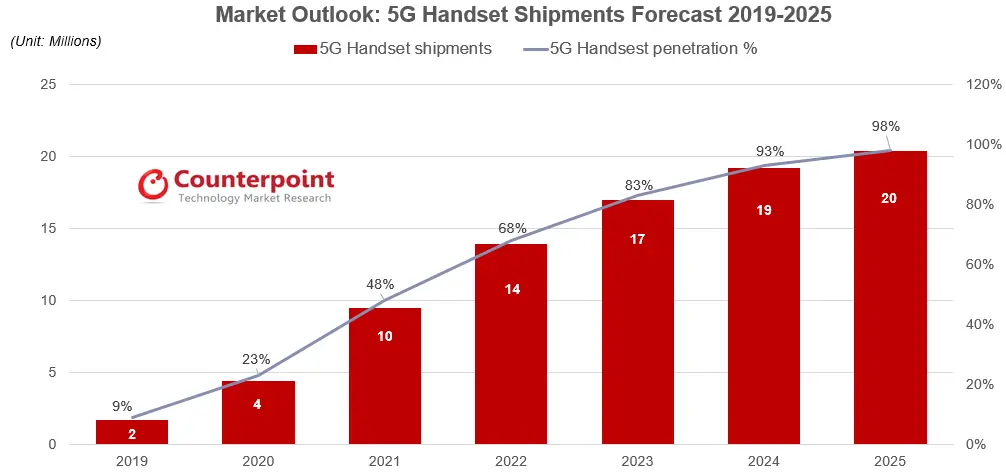
In 2019, the first year of 5G, we expect 5G smartphone shipments to be around 1.7 million and account for 9% of the total handset shipments. We estimate the market to pick up the pace when Apple releases 5G iPhones next year. The decline in 5G smartphone price coupled with a drop in 5G component prices, expansion of product lineup, and securing related content will be important factors for market growth.
Please click here to get access to the full report “5G Rollout in Korea - The First 20 Days of 5G” found under our Emerging Tech category.
