The Canadian Satellite Connectivity Ecosystem: Transitioning to Low Earth Orbit Satellite and Direct-to-Cell (D2C) Integration
- LEO satellites are changing connectivity in Canada by delivering low-latency and high-speed internet across rural and northern Canada.
- Rogers, Bell, and TELUS are partnering with LEO and GEO providers to offer D2C services, mixing satellite and terrestrial networks for messaging, voice, data, and emergency coverage.
- Federal and provincial programs, including the Universal Broadband Fund and the SMCS framework, are important for overcoming affordability and capacity challenges, ensuring high-speed satellite internet is accessible and sustainable nationwide.
Canada’s satellite connectivity landscape is undergoing structural transformation, transitioning from traditional Geostationary Earth Orbit (GEO) systems toward Low Earth Orbit (LEO) constellations for connectivity. This shift reflects both technological advancement and policy direction, driven by the federal government’s objective to achieve universal broadband access of 50 Mbps download and 10 Mbps upload for all Canadians by 2030. The transition is supported by a combination of private investment, proactive regulation, and an evolving partnership model between satellite operators and telecommunications carriers.
The Structure of Canada’s Satellite Market
Satellite Technology in Use
MEO satellites, operating between 2,000 and 35,000 km, offer a balance of coverage and performance and are primarily used for navigation and specialized broadband.
LEO satellites, orbiting between 160 and 2,000 km, can deliver high-speed, low-latency connectivity (as low as ~50 ms) and can support real-time data, streaming, and direct-to-device communication.
Market Composition
Canada’s satellite market is composed of domestic and foreign players. Domestic leaders include Telesat, which is developing the Lightspeed LEO constellation; MDA, a key supplier of satellite robotics and subsystems; Xplore, which uses GEO satellites to serve rural communities; and Kepler Communications and TerreStar, which focus on IoT and mobile satellite services.
On the foreign side, SpaceX’s Starlink currently leading the consumer broadband LEO service, while OneWeb, HughesNet, Viasat, and AST SpaceMobile maintain active service footprints through partnerships with Canadian telecoms.
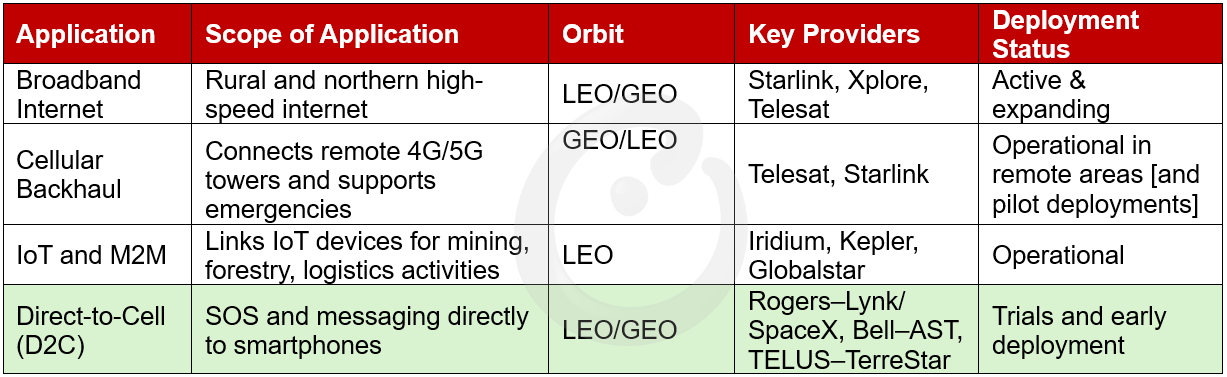
The most significant strategic development has been the integration of satellite infrastructure with terrestrial mobile networks under the Supplemental Mobile Coverage by Satellite (SMCS) framework. Introduced by Innovation, Science and Economic Development Canada (ISED) in 2025, this framework authorizes telecom operators to extend their licensed spectrum into space, allowing standard smartphones to connect directly to satellites for text, voice, and data services. The policy is designed to eliminate connectivity gaps in unserved areas and enhance emergency coverage through satellite-enabled 911 access. Importantly, ISED’s framework ensures compatibility with existing consumer devices, removing technical barriers to adoption.
All three major telecom carriers have entered partnerships to deliver Direct-to-Cell (D2C) services.
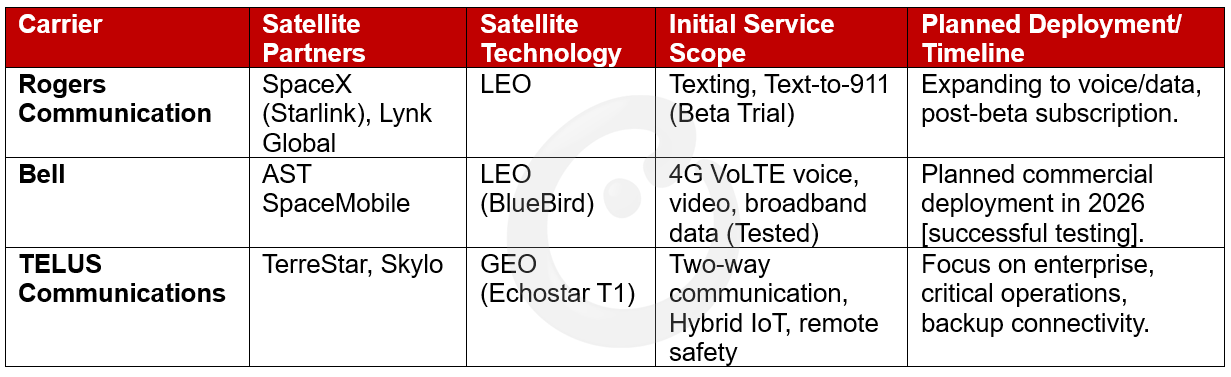
- Rogers, in collaboration with Starlink and Lynk Global, launched early commercial trails for satellite-to-mobile messaging across much of Canada, with nationwide trials allowing any user to send text messages and access emergency services.
- Bell has conducted end-to-end direct-to-cell tests, working with AST SpaceMobile to demonstrate full 4G Voice-over-LTE and broadband data directly to smartphones by 2026.
- TELUS, meanwhile, has adopted a GEO-based strategy with TerreStar and Skylo Technologies, focusing on IoT, remote workforce safety, and backup communications for enterprise and emergency operations. These three models collectively illustrate a market where satellite capacity is increasingly no longer separate from telecom networks but integrated into Canada’s national communications fabric.
By 2025, over 90.0% of the national population had broadband access, but rural penetration lagged around 80.0%. Satellite connectivity remains the primary mechanism for reaching the remaining unserved Canadians, given the cost-prohibitive nature of fiber deployment across the country’s vast terrain.
LEO satellite systems, particularly Starlink, have redefined remote connectivity in Canada by consistently delivering speeds that can meet the federal 50/10 Mbps benchmark with far lower latency than GEO satellites. However, as subscriber numbers surge—reaching over ~400,000 by mid-2024—regional capacity pressures have begun to impact performance, with some areas reporting slower average speeds. This emerging “capacity divide” highlights that while LEO has effectively closed the access gap, sustaining quality amid growing demand remains a challenge.
At the same time, affordability continues to limit adoption: residential Starlink service costs around $110 per month plus upfront hardware fees, making it pricier than many terrestrial or GEO-based alternatives. Federal and provincial governments have integrated LEO into national broadband programs, including Ontario’s announcement of a $100 million partnership with Starlink (later cancelled), to pilot rural connectivity and explore subsidy models.
Regulatory Framework and Policy Direction
Canada’s federal broadband policy is defined by the Connectivity Strategy and the Universal Broadband Fund (UBF), valued at approximately $3.2 billion, which aims to connect 98% of Canadians by 2026 and 100% by 2030. The Universal Service Objective (USO) mandates a minimum of 50 Mbps download and 10 Mbps upload with unlimited data — a target that LEO systems can now meet in many deployments. The CRTC Broadband Fund, valued at $752 million, further supports this effort, with direct satellite allocations exceeding $35 million, primarily for northern and Arctic regions such as Nunavut and Northern Ontario.
In parallel, ISED’s SMCS Framework (2025) establishes the regulatory basis for mobile-satellite integration, ensuring that D2C services can legally operate using terrestrial spectrum and existing handsets. Beyond access, the framework is intended to enhance national resiliency — enabling backup networks for emergency and disaster response.
Conclusion
Canada’s satellite connectivity market has evolved from niche service to national necessity. The combination of strong consumer adoption, telecom–satellite partnerships, and forward-looking policy frameworks has positioned Canada as one of the major markets in LEO integration globally. However, sustaining this progress will require addressing bandwidth capacity, affordability, and long-term service quality. The next stage of growth will depend on the development of hybrid models that combine LEO speed, GEO resilience, and terrestrial 5G offload capacity.
Category
Industry
IoT
Service
Standard
Report Type
Report
Time Period
Other
Receive our insightful weekly newsletter and stay ahead of the competition.
Author
Team Counterpoint
Counterpoint research is a young and fast growing research firm covering analysis of the tech industry. Coverage areas are connected devices, digital consumer goods, software & applications and other adjacent topics. We provide syndicated research report as well as tailored. Our seminars and workshops for companies and institutions are popular and available on demand. Consulting and customer