Robotaxis Have Proved They Can Drive. Can They Scale?
- The global robotaxi market is moving from technology validation to commercial deployment, with China and the US still leading the market.
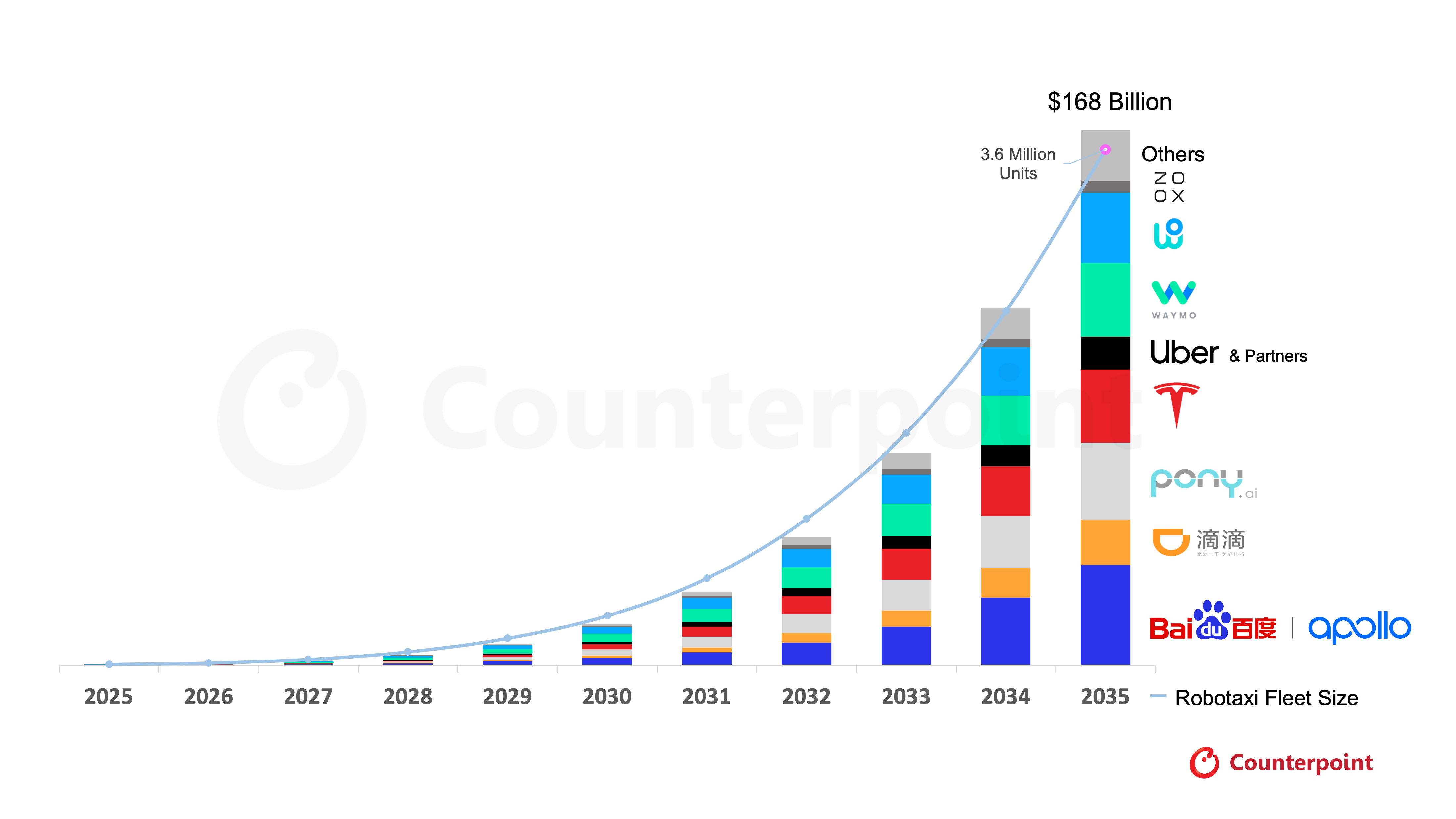
- The global robotaxi fleet is expected to reach 3.6 million vehicles, while the robotaxi services market is projected to reach $168 billion by 2035, according to Counterpoint Research.
- Waymo, Apollo Go, WeRide and Pony.ai are at the center of the current competitive landscape, but each is taking a different path to scale.
- The market is shifting beyond fleet size and autonomous miles, with utilization, safety, regulation, partnerships and unit economics becoming increasingly important.
- The next phase will be about turning autonomous-driving experience into scalable, high-utilization and economically sustainable mobility services.
The global robotaxi market is transitioning from technology validation to commercial deployment. Years of pilots and controlled testing have given way to expansions by major operators, increasing volumes of paid rides and expansions into new cities and markets. Waymo, Apollo Go, Pony.ai and WeRide are emerging as the key players in this transition, supported by growing real-world driving experience, strategic alliances, and expanding commercial operations.
The competitive environment continues to be increasingly global. China and the US are still the two most advanced robotaxi markets, but operators are pushing into Europe, the Middle East and Southeast Asia. The meaning of progress, too, is shifting. While fleet sizes and autonomous miles are still important, paid rides, vehicle utilization, geographic coverage, operational reliability and unit economics are emerging as equally important indicators of maturity.
There are challenges that accompany this transition. Scale remains a big hurdle, with regulatory scrutiny, safety validation, operational complexity and the ability to keep reliable performance across different cities still important considerations. As robotaxi fleets move from hundreds of vehicles to thousands, the industry is entering a new phase where the ability to scale safely, efficiently and economically will increasingly determine the market leaders.
Market outlook: How big can it get?
The market is now large enough to move robotaxis from being an autonomous-driving experiment to a meaningful mobility service.
That growth is reflected in the global robotaxi fleet, which is expected to reach 3.6 million vehicles, while the global robotaxi services market is expected to reach $168 billion by 2035, according to Counterpoint Research’s Global Robotaxi Vehicle Sales and Services Market Forecast. China and the US are expected to remain the two largest robotaxi markets, while Europe is emerging as a key growth region. The Middle East currently has a more mature commercial footprint, led by the UAE and Saudi Arabia, with Asia-Pacific markets such as Singapore, Japan and South Korea adding further growth.
The growth outlook indicates a broader shift across the industry. Robotaxis are moving from small pilot fleets to commercial networks, creating opportunities not just for autonomous-driving companies, but also for automakers, mobility platforms, infrastructure providers and insurers.
But the opportunity in the long term is much bigger than fleet deployments. The economics of each vehicle will increasingly depend on utilization; paid-ride demand; vehicle and autonomous-driving system costs; charging and fleet operations; safety performance; and ability to replicate deployments across markets.
The next stage of the robotaxi market will be determined not only by the number of cars companies deploy but by their ability to translate that autonomous driving experience into high-utilisation, scalable and economically sustainable mobility services.
Global Robotaxi Fleet and Services Market Size
Global leaderboard
Waymo, Apollo Go, WeRide, Pony.ai
Four companies are now at the center of the global robotaxi race, but they have reached there by following different strategies.
Waymo has had the most time to develop and validate driverless operations, creating a solid foundation of real-world experience and commercial learning. Apollo Go utilized the large urban markets in China to achieve operating scale and ride volumes. WeRide has taken a broader L4 approach, combining robotaxis with other autonomous driving applications and using partnerships to enter new markets. Pony.ai has been increasingly focusing on turning its autonomous-driving technology into a scalable mobility business through fleet expansion, lower-cost vehicles and strategic alliances.
What makes the competition interesting is that there is no single measure of leadership. A company can lead on autonomous driving experience but have a smaller international footprint, while another can operate across more countries without yet having the same level of commercial utilization. The table below brings these different dimensions together.
Robotaxi Leaders: Scale and Expansion
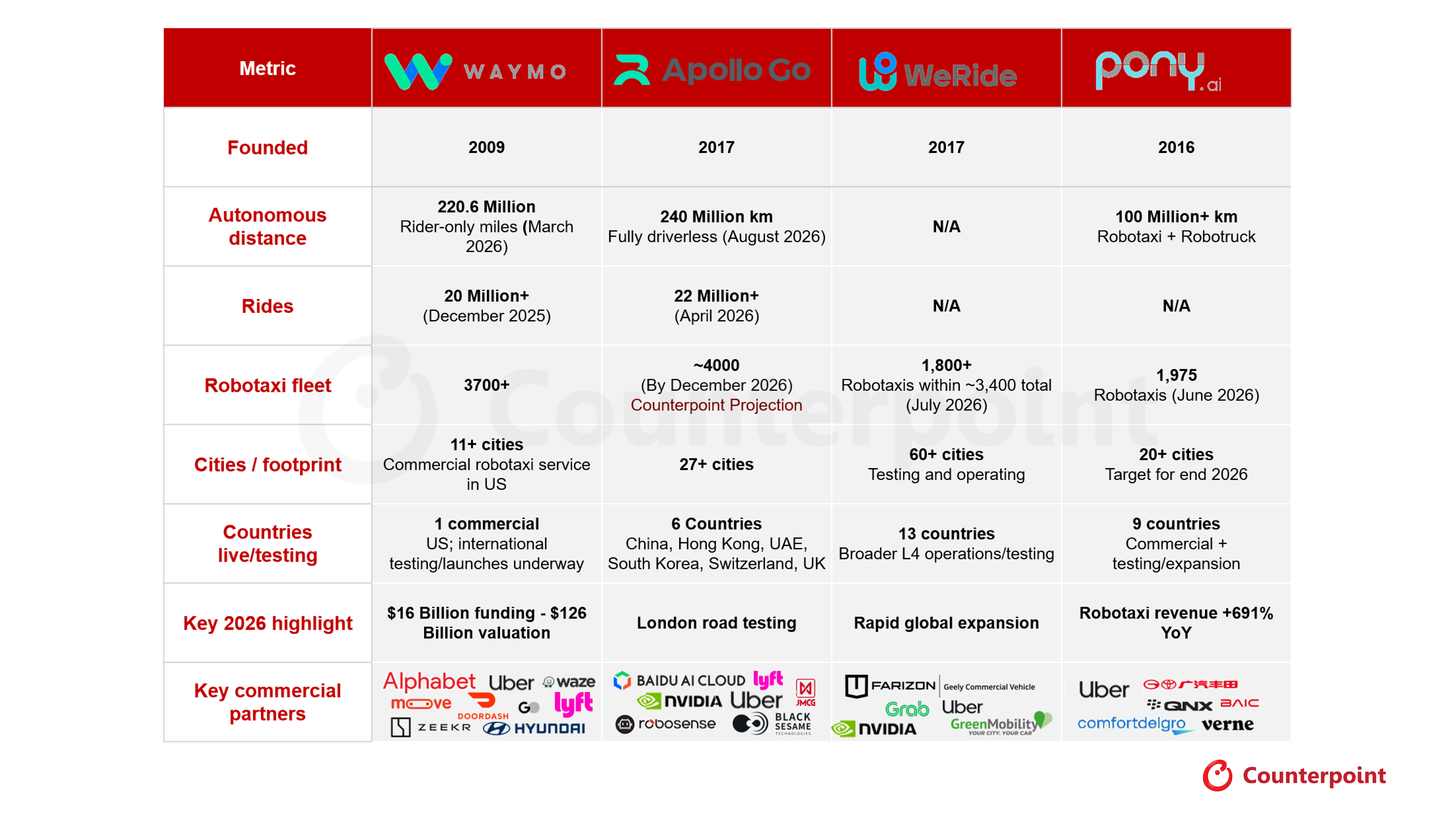
Note: Figures use different company definitions and reporting dates.
From early deployments to the next phase
The evolution of these four players shows how quickly the robotaxi market has changed. The early years were largely about technology development, road testing and proving that vehicles could operate without a human driver. Today, the focus is shifting toward making those services reliable enough for everyday use and scalable enough to support a larger commercial network.
Waymo initially started life as Google’s self-driving project but has since evolved into a commercial driverless service and is now working on the next generation of the experience. It recently launched the Ojai vehicle, a new compute architecture for autonomous driving, and a Gemini integration for riders. Waymo claims its latest compute system has been optimised for low latency, redundancy and real-time processing, including a purpose-built 5nm ASIC.
Apollo Go is taking a different next step, testing whether its China-developed operating model will travel well beyond its home market. It is now active internationally in the Middle East and Europe, with London road testing a particularly important phase of the technology under a new regulatory and operating environment. Apollo Go has also been collaborating with local partners in Abu Dhabi to prepare for commercial deployment.
WeRide is using partnerships as well as an asset-light approach to expand its international presence. Its latest results show it is growing in Spain, Switzerland, Denmark, the UAE and Singapore, with overseas revenue growing faster than its domestic business in the first half of 2026. WeRide also reported that the average number of daily rides per robotaxi in China jumped to more than 21 in the second quarter of 2026, a sign that utilisation is becoming an increasingly important part of its growth story.
Pony.ai is combining fleet growth with a global partnership-driven model. In August, it broadened its deal with Uber to roll out more than 2,000 robotaxis in Europe. The first rollout is already happening in Zagreb, Croatia, where people can book Pony.ai autonomous rides through Uber.
This brings a new competitive dynamic. Technology is still the base, but it’s market access, partnerships, utilisation and economics that are becoming the differentiators. The companies that can successfully transition from deployments city-by-city to repeatable operations across multiple markets will have the best shot at the long-term robotaxi opportunity.
Others in the race: The four companies above are not the only ones shaping the robotaxi market.
Tesla is taking a scale-focused approach, using its large EV manufacturing base and existing vehicle ecosystem to support its robotaxi ambitions. Its service has so far relied largely on conventional Tesla vehicles, but the Cybercab, designed specifically for autonomous operation, could become the key vehicle for scaling the business. If Tesla can move the Cybercab into volume production, its manufacturing capabilities could give it an advantage on cost and fleet growth.
Zoox is approaching the market differently, with a vehicle designed specifically for autonomous driving rather than adapted from a conventional car. That could offer benefits at scale, although its rollout is likely to be more gradual.
Uber is taking a different position altogether. Instead of developing its own autonomous-driving system, it is building a network around companies such as Wayve, WeRide, Pony.ai, MOIA, Nuro, Motional and Avride. Uber brings the rider base and booking platform, while its partners provide the autonomous technology and, in some cases, the vehicles and fleet operations. If these partnerships continue to expand, Uber could become an important link between robotaxi operators and everyday passengers as the market moves into larger-scale deployment.
Counterpoint view: What comes next?
The robotaxi race is moving into a new phase. The technology has moved beyond controlled pilots, and the focus is now shifting toward commercial scale, market access and sustainable economics.
The key question is no longer simply who has driven the most autonomous miles, but who can turn that experience into a scalable and profitable mobility business.
Four factors will shape the next stage:
1. International expansion: Chinese operators are increasingly working with global mobility platforms and local operators to expand into Europe, the Middle East and Southeast Asia. This approach enables autonomous-driving companies to leverage existing rider demand, local operating capacity and regulatory expertise without having to develop every aspect of the service themselves.
Pony.ai’s expanded Uber partnership aims to roll out over 2,000 robotaxis across Europe, with Zagreb already providing an early example of the model. WeRide is following a similar partnership led approach to expand internationally, with overseas business becoming an increasingly important growth driver. But each new market brings its own regulatory, infrastructure and operational challenges.
2. Regulatory access: It takes more than technology to get a robotaxi service on the road. Before companies offer their rides to customers, they must prove their vehicles are safe and comply with local rules.
China is putting a formal framework around higher levels of autonomous driving. The mandatory standard GB 44721-2026, which was published in July 2026 and will come into force in July 2027, defines the regulatory framework for L3 and L4 market access. The distinction matters – L3 is primarily for personal vehicles, while L4 is for commercial services such as robotaxis, autonomous buses and driverless delivery. The standard also sets out requirements for autonomous-driving systems, safety management, validation testing and type approval, giving operators a clearer route from testing to commercial deployment.
The UK is also extending its framework through the Automated Vehicles Act, 2024, which defines the legal framework for authorizing self-driving vehicles and automated passenger services. The government is currently developing detailed safety principles for vehicle authorization. The UK approach could also serve as a useful benchmark for other markets as they develop their own AV rules.
Recent developments in London show how regulation can become a bottleneck, even when the technology is ready. Uber and Wayve have received approvals for supervised robotaxi operations, but the rollout of fully driverless services has been delayed as Transport for London (TfL) has yet to issue the operational guidance needed for companies to move forward. Waymo and Baidu are also working through the UK approval process.
Safety is critical for robotaxis. Waymo’s recent report titled ‘Not All Miles are Equal: Why Time and Location Matter When Benchmarking Autonomous Safety’ highlights the need for safety assessments to focus on when and where vehicles operate, rather than relying solely on broad crash averages. While Waymo’s analysis is self-assessed, it appears to be transparent. Being fully open with safety data will help all players improve their performance. In 1958, Volvo patented the three-point safety belts, which have now become universal. Volvo chose to make the patent available to all as it viewed lives as more important than commerce. While autonomous driving is substantially more complex than a seatbelt, the concept of universal safety should pervade the automotive industry.
As operators enter new markets, different roads, traffic patterns and operating conditions can change the safety picture. Demonstrating that the system is safe to operate in each new environment will be an important component for robotaxi companies as they expand beyond their current markets.
3. Unit economics: As fleets move toward thousands of vehicles, utilization and cost per ride will become increasingly important. Higher utilization can improve returns from each vehicle, but operators must also manage charging, maintenance, remote assistance and vehicle cost. Recent moves by Pony.ai and WeRide show that utilization and operating efficiency are becoming bigger priorities.
In the end, the winners may not be the companies with the biggest fleets, but the ones that can keep those fleets busy, safe and financially sustainable.
4. Purpose-built vehicles: One of the bigger changes in the robotaxi market is the move from retrofitting existing cars to designing vehicles specifically for autonomous driving. Zoox and Tesla are taking this approach with dedicated robotaxi designs, giving them more freedom to rethink the cabin, remove components that are no longer needed, and integrate the autonomous system into the vehicle on the production line. Pony.AI is on its Gen 7 vehicle with partner Toyota. This requires a limited amount of post-line work. Its Gen 8 will be fully line-manufactured and is expected to go into production in mid-2027.
A purpose-built vehicle can offer a better rider experience, with the interior designed around passengers rather than a human driver. As fleets grow, this could help lower vehicle costs and become a differentiator in an increasingly competitive market.
There are trade-offs, however. Developing a new vehicle requires significant investments in engineering, manufacturing and supply chains, alongside the autonomous-driving system itself. Vehicles without traditional controls can also face additional regulatory hurdles, while a slower manufacturing ramp can limit early deployments and data collection. The real test will be whether the benefits of purpose-built vehicles, particularly lower costs and a better passenger experience, outweigh the higher upfront investment and complexity.
Category
Industry
Automotive, AI
Service
ADAS and AD
Report Type
Report
Time Period
Other
Receive our insightful weekly newsletter and stay ahead of the competition.
Author
Saumya Negi

Saumya Negi is a Research Associate at Counterpoint Market Research based in Noida, India. She is part of Counterpoint’s Automotive Research team, where she focuses on emerging trends and innovations within the smart mobility ecosystem. Her core area of specialization is Advanced Driver Assistance Systems (ADAS), along with related technologies such as radar, LiDAR, and sensor integration in connected vehicles. She holds a PGDM in Finance and Digital Business from Doon Business School and brings strong analytical skills along with a deep interest in the future of automotive innovation.