Panel Makers’ Q2 2026 Earnings: JDI Posts Another Loss, Innolux Books Another Profit
The last two publicly traded panel makers outside of mainland China released their Q2 2026 earnings reports last week. Japan Display booked another loss and has negative stockholder equity but described its plan to regain compliance with the Tokyo Stock Exchange’s requirement for positive equity. Innolux booked an operating profit and an even larger net profit based on a tax refund.
Japan Display
Japan Display reported a net loss of JPY 3.5 billion ($22 million) on revenue of JPY 23.9 billion ($150 million). Revenues were down 33% QoQ and 33% YoY in US$ terms. The yen depreciated 2% QoQ and 9% YoY in Q2 2026. JDI's net loss compared with a Q1 2026 net loss of JPY 5.3 billion ($34 million) and with a Q2 2025 net loss of JPY 20.3 billion ($140 million).
Non-operating items represented a net loss of JPY 2.1 billion. This included interest expense of JPY 2.3 billion. For Q2 2026, JDI reported an operating loss of JPY 1.2 billion. JDI has now reported operating losses for 16 of the last 17 quarters.
Gross margin fell QoQ from 14% to 11%, and operating margin fell from 0% to -5%. Net margin improved from -15% to -14% but SBITDA margin worsened from 2% to -2%.
Japan Display Quarterly Income Statement Highlights
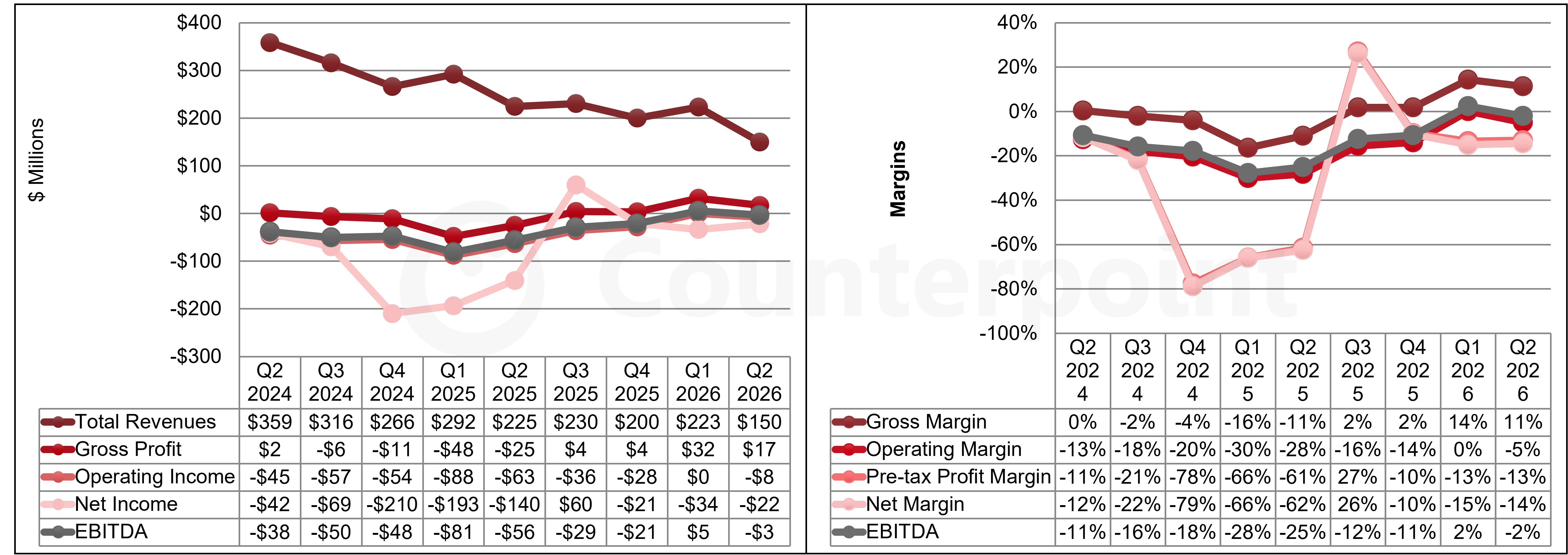
JDI inventory was down 10% QoQ and down 42% YoY in US$. Inventory days increased from 82 to 107 with lower sales. After a big restructuring in Q1'23 that left the company with zero debt, JDI took on JPY 65 billion in short-term debt during Q2 2023-Q2 2025. In Q2 2026, JDI repaid JPY 14.0 billion of debt, reducing it to JPY 51 billion ($320 million).
JDI reported negative equity of JPY 12.2 billion, making debt/equity calculations meaningless. JDI described its path to positive equity by the end of the fiscal year (March 31, 2027) to stay in compliance with the Tokyo Stock Exchange.
JDI reported negative cash flow from operations of JPY 7.4 billion ($47 million) and negative free cash flow of JPY 7.7 billion ($49 million). JDI reported capital expenditures of JPY 0.3 billion ($2 million).
JDI reported that it expects to return to positive equity through the sales of its Tottori and Mobara fabs and additional financing. JDI's cost reductions have lowered its break-even point for sales from JPY 308.5 billion in fiscal year 2025 to JPY 63.0 billion in the current fiscal year.
JDI ended production at its Mobara fab in November 2025 and is in ongoing negotiations with prospective buyers to repurpose the fab. JDI has signed a contract for the sale of its Tottori fab and expected a settlement by September 2026.
JDI reported that because its financial results may be significantly affected by its ongoing execution of structural reforms, as well as the possibility of the U.S. launch of JDI-operated advanced display manufacturing fabs, JDI is not disclosingan FY27/3 earnings forecast at this time
JDI will disclose the FY27/3 earnings forecast once visibility on key measures improves, including:
- Additional warrant exercises & other financial measures
- Mobara Fab sale to repay borrowings
- BEYOND DISPLAY growth strategy execution, including the U.S. display business
To reduce geopolitical risk, JDI is preparing back-end processes at its Nanox fab in the Phillippines. JSI stated that it has received multiple new orders for the Ishikawa / Nanox supply chain, including display mirrors and HUD displays.
Innolux
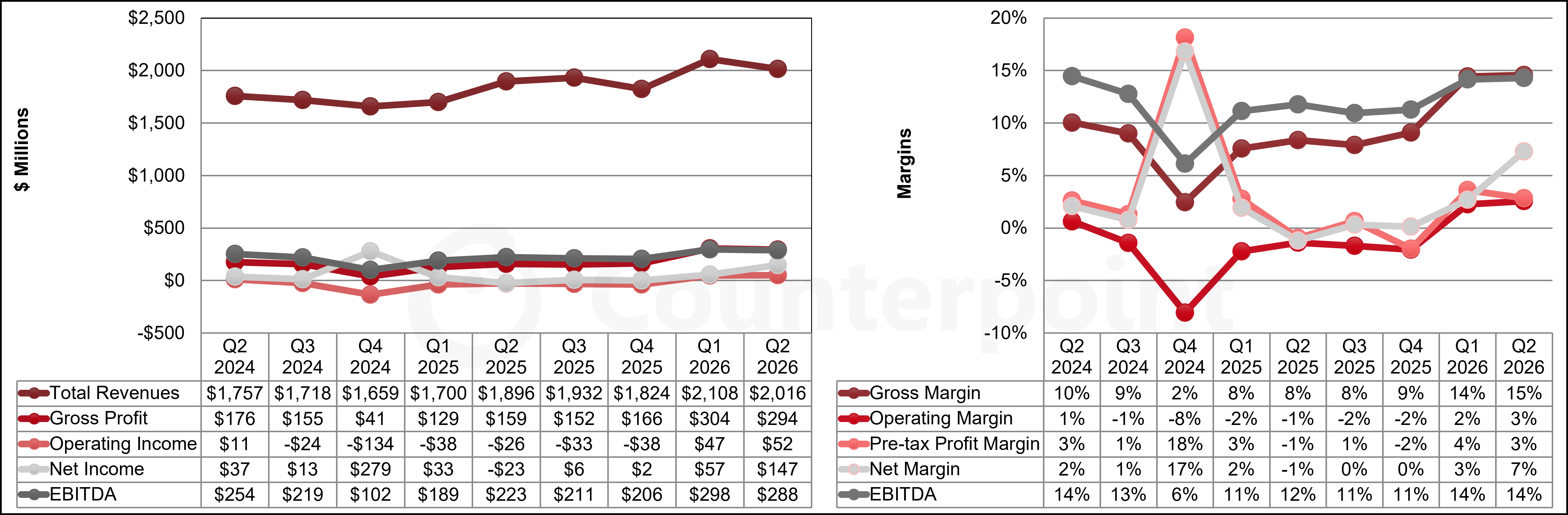
Innolux reported a net profit of NT$ 4.65 billion ($147 million) on revenues of NT$ 63.7 billion ($2.0 billion) for the second quarter of 2026. Innolux revenues decreased by 4% QoQ but increased by 6% YoY in US$. The NT$ was flat QoQ but depreciated by 7% YoY. Revenues were 5% lower than consensus analyst expectations of NT$ 66.9 billion and net income fell far short of analyst expectations of a profit of NT$11.6 billion.
Innolux reported an operating profit of NT$ 1.63 billion ($52 million), beating analysts' expectations of a profit of NT$1.46 billion, and EBITDA of NT$ 9.1 billion ($898 million) was in line with analysts' expectations of NT$9.1 billion.
Innolux noted that pull-in momentum moderated, with revenues down QoQ, but the company enhanced its product mix and expanded high margin businesses.
Net profit was NT$ 4.65 billion but profit before tax was only NT$1.8 billion, implying a net negative tax (or tax refund) of NT$2.8 billion. Gross and operating margins increased QoQ by 1% but EBITDA margin was flat QoQ and net margin increased QoQ from 3% to 7%.
Innolux Quarterly Income Statement Highlights
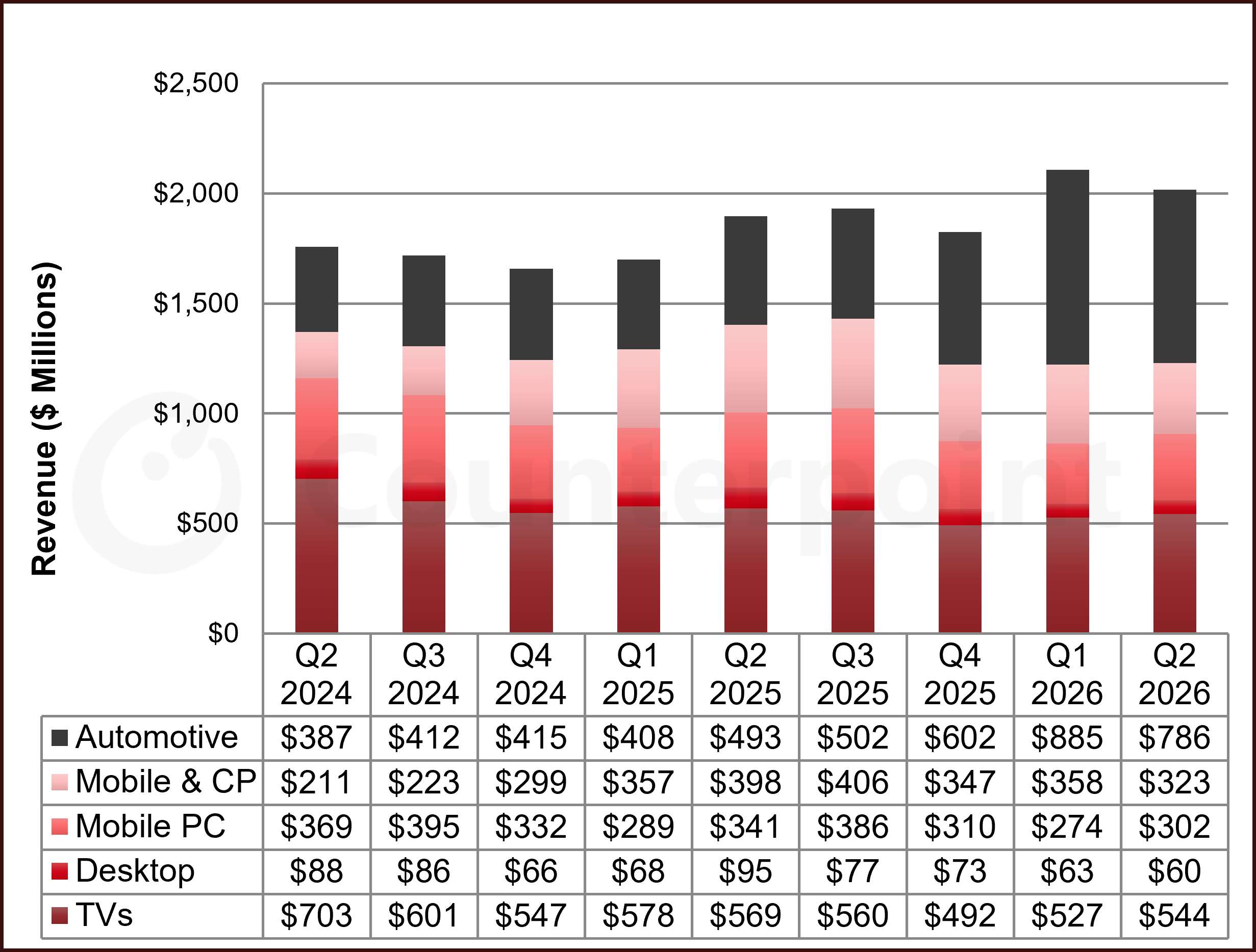
- Auto display revenues decreased 11% QoQ but increased 59% YoY. Auto displays represented 39% of revenues in Q2 2026, down from 42% in Q1 2026.
- Revenues from desktop displays decreased 4% QoQ and 36% YoY and the share of revenues remained at 3%.
- Revenues from TV increased 3% QoQ but decreased 4% YoY and TV represented 27% of total revenues.
- Revenues from mobile PC increased 10% QoQ but decreased 11% YoY and revenue share increased sequentially from 13% to 15%.
- Revenues from mobile phones and commercial products decreased 10% QoQ and 19% YoY and revenue share decreased sequentially to 16%.
Innolux Quarterly Revenue by Application
- Non-display sector: Flat QoQ
- Non-commodity sector (commercial display): Flat QoQ
- Commodity sector (consumer display): Up high single digit % QoQ
Panel demand is expected to level off after front-loaded buildup of inventory in the first half.
Innolux reported capital expenditure of NT$ 2.3 billion ($73 million) and depreciation expense of NT$ 7.5 billion ($237 million) in Q2 2026. Innolux did not release a balance sheet or cash flow statement. These will likely follow in 7-10 days.
Category
Industry
Display
Service
Display Market Trends
Report Type
Report
Time Period
Weekly
Receive our insightful weekly newsletter and stay ahead of the competition.
Author
Bob Obrien
Robert J (Bob) O’Brien joined Counterpoint Research as part of its acquisition of DSCC, where he was Co-Founder, Principal and CFO of DSCC. Bob has decades of experience turning market and business analysis into strategic insights in the display and electronics industries. At DSCC, Bob takes the lead role in analysis of display materials, including glass and AMOLED materials, and covers developments in TV and other large-screen display applications. He is the principal author of DSCC’s AMOLED Material Report, the Advanced TV Shipment Report, and the Display Glass Report, and Bob contributes regularly to the DSCC Weekly Review.