Event Report: MG Launches India’s First Multi-NEV Platform ADAPT
- MG is promoting its approach to NEVs rather than a specific model, underscoring the importance of its new platform to its product strategy.
- The company has taken a page out of Chinese OEMs’ playbooks, adopting an advanced series-parallel hybrid architecture for its upcoming PHEV models.
- MG’s approach to electrification is indicative of the broader industry trend and need for flexible platforms that can address market uncertainty.
Automobile maker JSW MG Motor India (MG) revealed its new vehicle platform, called Advance Drive Architecture Platform Technology (ADAPT), at the DRIVE.NEV event held in Gurugram on July 16, 2026. Claimed as India's first multi-NEV platform, ADAPT is a single modular architecture engineered to underpin battery-electric, strong hybrid, plug-in hybrid, and range-extender vehicles. The company, which is a joint venture between China's SAIC Motor and India's steel-to-cement JSW Group, has chosen to anchor its next phase in India on an architecture rather than a vehicle. This sequencing decision says more about MG’s competitive position than any model reveal would have.
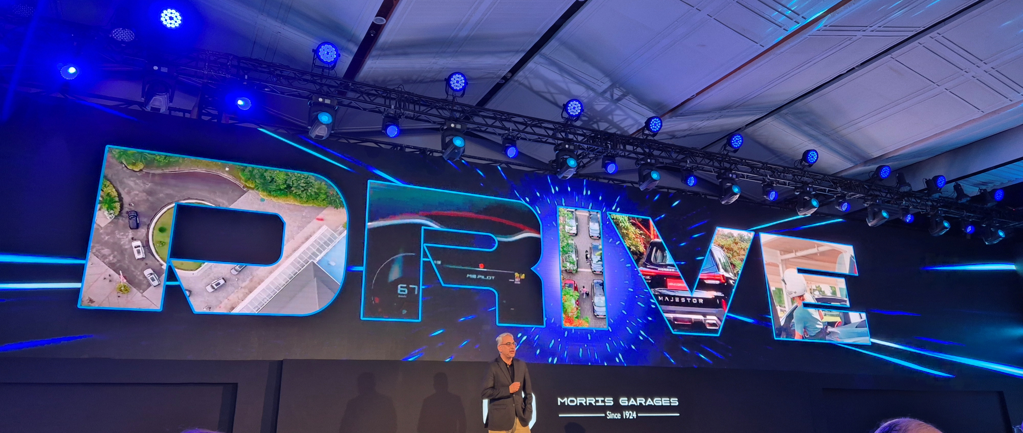
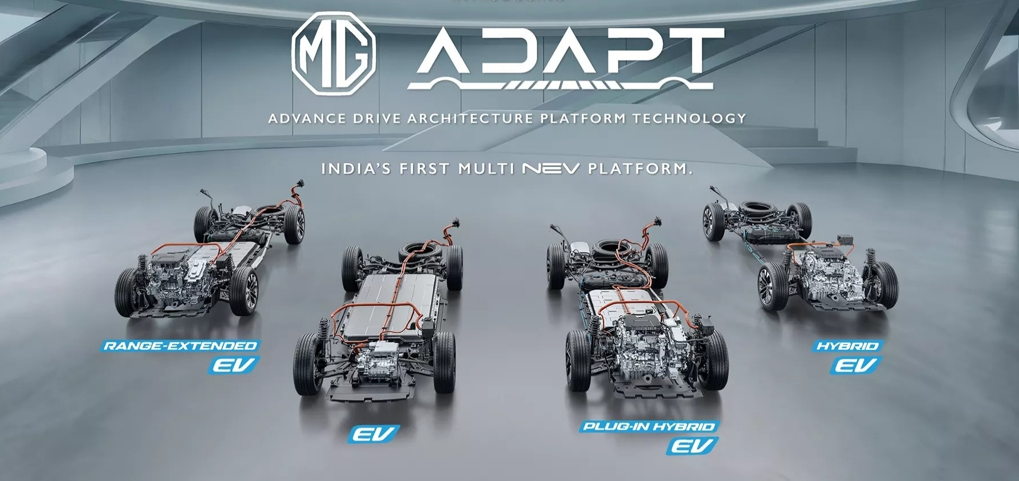
MG confirmed its first ADAPT-based EV and PHEV models for FY2026-27, which are widely expected to draw from SAIC's Starlight family. The company’s officials have since indicated a Diwali holiday launch window, when roughly a fifth to a quarter of India's annual car sales are booked. However, no production model was shown, no price quoted, no car named. Having spent the day on the event floor, we came away convinced that the company’s restraint was the message: MG wants India talking about its architecture before anyone has a vehicle to judge it.
What MG Showed
The vehicle hardware shown on stage was a stripped skateboard chassis. On the exhibition floor, MG broke the platform into three named building blocks, each in its own display case: an Electric Drive Unit (EDU), a Dedicated Hybrid Engine (DHE), and a Dedicated Hybrid Transmission (DHT).
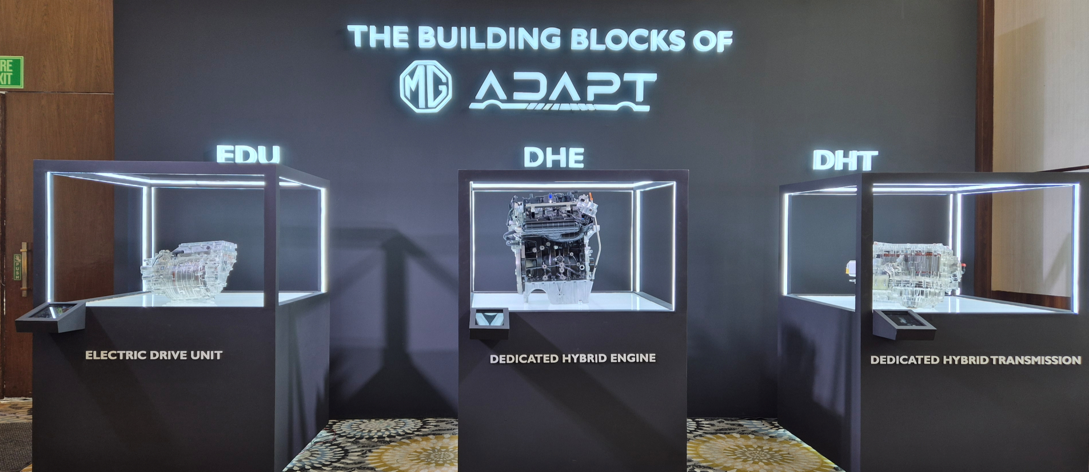
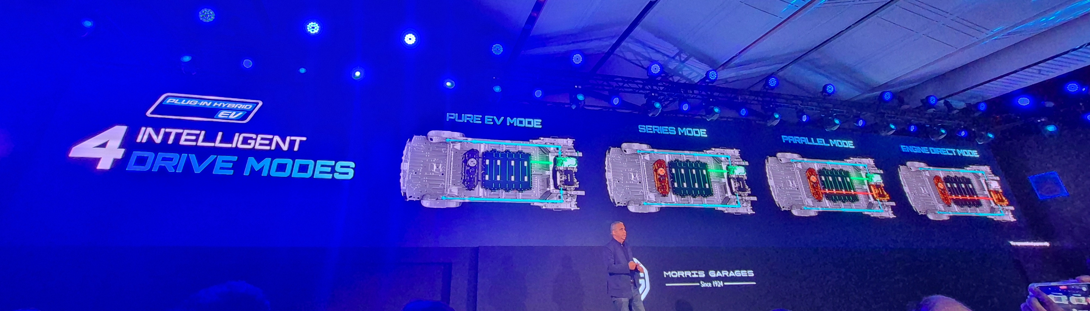
The claims are aggressive with the DHE quoted at 43.2% thermal efficiency. Typical production petrol engines convert 20% to 35% of fuel energy into motion, so if the figure holds, it will sit alongside the best dedicated-hybrid engines out of China and Japan. The DHT also carries a claimed world first: an electromagnetic e-clutch that MG says responds up to four times faster than conventional units, switching drive modes in 0.1 seconds. The EDU is a 10-in-1 integrated unit, and the platform supports both 400V and 800V architectures. The PHEV configuration runs four drive modes: pure EV, series, parallel, and engine direct.
The Strategic Read
The sequencing of announcements is the first signal. India's conventional launch playbook puts the car first and treats the platform as an engineering footnote. MG inverted it, much as BYD built the DM-i name in China before individual models carried it, which suggests ADAPT is being positioned as a franchise rather than a spec-sheet line.
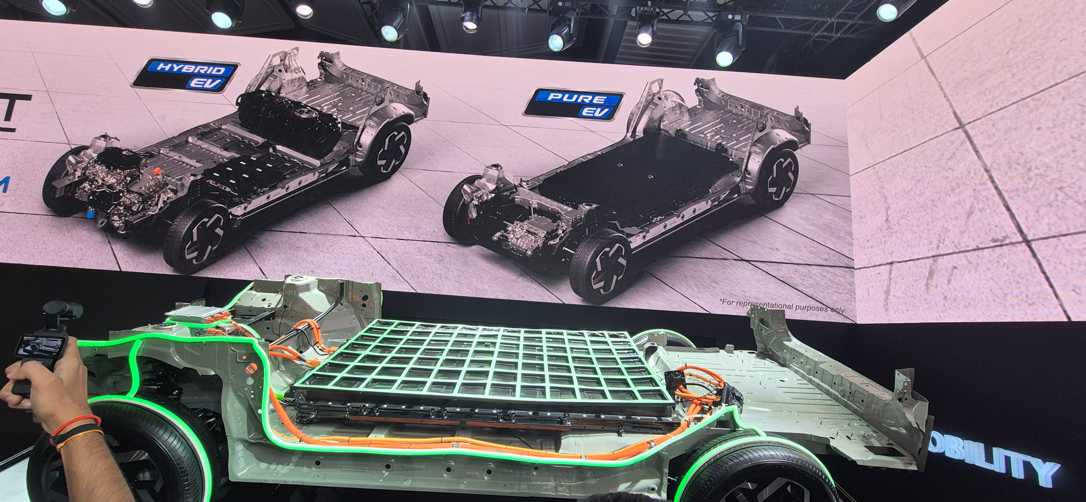
Managing Director Anurag Mehrotra mentioned on stage that over 70% of MG's sales already come from new energy vehicles and argued that India's ambition to hit 30% NEV by 2030 cannot be met by a single technology alone, as consumer cohorts will electrify at different speeds.
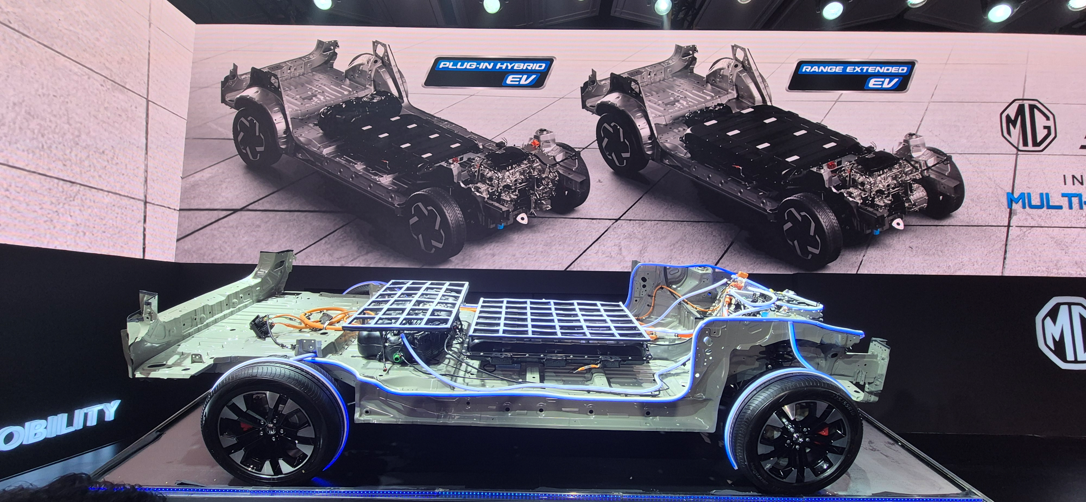
Seen that way, the four-powertrain flexibility is less a technology showcase than a cushion against India's uncertain energy transition. Battery-electric adoption remains concentrated and infrastructure-constrained, strong hybrids are gaining policy attention, and plug-in hybrids do not exist at mass-market prices. An OEM that can flex the same line between HEV, PHEV, REEV, and BEV as demand shifts carries significantly less product-planning risk than one locked into a single bet. The absence of a pure-ICE path is itself a statement: MG is hedging within electrification, not against it.
The timing is also important. The mass-market PHEV segment is about to get crowded, with BYD's Seal U and JSW-linked Jetour products expected to be revealed around the same late-2026 horizon. Moving first at the platform level lets MG define the vocabulary and gain the mindshare before rivals reveal their models.
What to Watch
If the Diwali timing holds, the first ADAPT products are roughly four months out, and three checkpoints will matter most:
- India specification: The internationally sold Starlight-family PHEV pairs a 1.5-litre petrol engine with a front motor for roughly 194 bhp and 230 Nm combined, and MG has said India products will be significantly tuned for local conditions.
- Price positioning: A dedicated-hybrid architecture is only disruptive if it lands at mass-market money.
- Localization: Platform economics depend on volume, volume depends on local content, and MG said nothing about where ADAPT's engines, transmissions, or cells will be built.
A quieter dimension of the company’s strategy deserves attention alongside these elements. Platform consolidation does not stop at powertrains: a single architecture implies a common electrical backbone. That backbone will shape multiple capabilities. For example, ADAPT's support for both 400V and 800V systems will shape charging behavior. It will also shape over-the-air update capability and the connectivity stack across every model built on it. MG, which brought India its first internet car in 2019, said little on Thursday about how ADAPT handles the software and connectivity layer. For a platform meant to carry the brand's next generation, that layer will matter as much as thermal efficiency, and it is where we will focus as the first products approach launch.
Analyst Take
MG has made a considered bet. Having watched it presented in person, we would rate the engineering as credible and the sequencing as genuinely novel for India. But the market proof is absent, and we need to see more of what its vehicles are capable of.
The hardware story holds together: DHE, DHT, and EDU form a coherent, dedicated-hybrid architecture of the kind that has already reshaped China's market, and the headline numbers, while unverified, are the right ones to claim. The strategic story is stronger still. MG needed a broader answer than pure BEV and selling the architecture before the car gives them the narrative ground.
India's mass market has no reference point for a dedicated-hybrid platform at accessible prices, and thermal-efficiency claims do not sell cars; low fuel bills, refinement, and competitive pricing do. The Diwali launches will compress spec, price, and localization into a single verdict window. Until then, ADAPT is a well-constructed argument awaiting evidence. We expect the PHEV, not the EV, to decide whether it lands.
Category
Industry
Automotive
Service
Standard
Report Type
Report
Time Period
Other
Receive our insightful weekly newsletter and stay ahead of the competition.
Author
Abhilash Gupta


Dr. Abhilash Gupta is a Senior Research Analyst at Counterpoint Technology Market Research, specializing in the rapidly evolving automotive sector and its surrounding ecosystem. With over 9 years of experience spanning industry, research, and academia, he possesses deep expertise in market research, data analytics, and the integration of emerging technologies such as 5G and AI into the automotive industry. His extensive research background allows him to offer strategic insights that drive the future of connected vehicles and smart mobility solutions. Dr. Gupta holds a Ph.D. in Electrical Engineering from Malaviya National Institute of Technology Jaipur, a Master’s degree in Control Systems from the National Institute of Technology Patna, and a Bachelor’s degree in Electrical Engineering from Rajasthan Technical University.