Insight
Digital Contact Tracing Effective Shield Against Pandemic
0
December 18, 2020
History tells us pandemics like COVID-19 can recur in some form or other. Their basic characteristics of mutating and spreading quickly among large populations are the biggest challenge to controlling them. Vaccines are effective in checking the spread but take time to get developed. In such a scenario, effective contact tracing plays a big role. Fortunately, technological tools are now available to ensure quick and effective contact tracing.
The traditional form of contact tracing is a labor-intensive process that depends on interviews and investigation. However, currently available technologies can improve the process by reducing the reliance on an individual’s ability to recall all those she/he met in the previous two weeks.
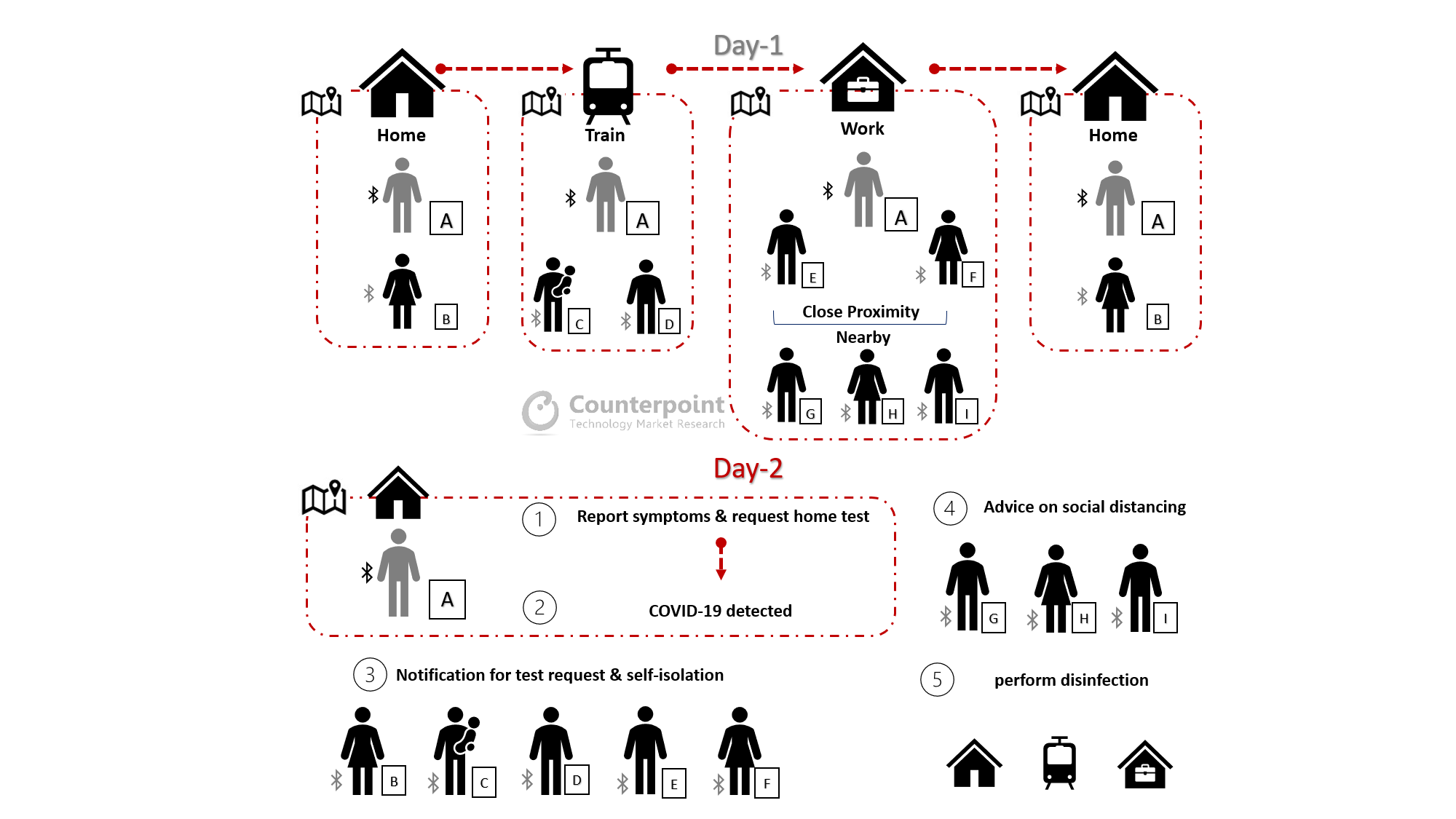
In the age of the connected world, where we carry smart devices with us almost everywhere, it is possible to enable the track-and-trace option embedded in smart devices such as smartphones, smartwatches, and smart bands.
Key technologies enabling digital contact tracing
 A few real-life implementations:
- Bluetooth Proximity Tracing: This is the most popular technology being used for the purpose. Bluetooth, or Bluetooth Low Energy, is used here to track the encounters between two smart devices while maintaining the anonymity of the identifiers of nearby devices. As soon as the user gets identified, an alarm notification is transmitted to other identified users based on the locally stored contact history log in an app. This solution has been implemented by Google and Apple for their contact-tracing app.
- Location Tracking: This can be achieved by cellular triangulation of network towers or GNSS embedded in smart devices. The network tower-based tracking has the advantage of eliminating the need to download an app. However, it raises privacy concerns.
- GEO-QR Code Tagging: This requires assigning a venue or a place to a QR code and asking people to scan the QR code using smartphones to tag their visit. No app is needed here to register the voluntary check-in and check-out from the location, hence enabling users to control their privacy. However, it increases the error margin in the tracking and tracing process. This method has been implemented by a few private sector entities in Malaysia, Australia, and New Zealand.
- Ultrasound: Smartphones emit ultrasound signals which are detected by other smartphones. NOVID and SONAR-X are two digital contact tracing apps with sub-meter contact tracing capabilities that implement ultrasound.
A few real-life implementations:
- India implemented Bluetooth proximity tracing with the Aarogya Setu app, which is now being used by almost 166 million of its citizens.
- Italian company IK Multimedia has come up with a smart band, called Safe Spacer, with built-in memory to trace contacts, and time stamp collection to ensure social distancing.
- Apart from IK Multimedia, brands like Fitbit and Samsung are also working for a similar purpose.
- Some US military Academy cadets are donning smartwatches to evaluate their effectiveness in contact tracing. Since these devices contain no GNSS data, they will not hinder the cadets’ privacy.
- Bluetooth proximity tracing is designed to log a person’s contacts and send them to a centralized/decentralized database to work with apps developed by public health authorities. This raises privacy concerns over documentation of the time and date of your encounter along with the identity of another person. However, app developers and companies like Google and Apple want such data to be kept anonymous.
- Location tracking creates a timeline of a person’s movement throughout the day. Such data can be misutilized in the wrong hands.
Receive our insightful weekly newsletter and stay ahead of the competition.
Author
Arushi Chawla
Arushi Chawla is a Research Analyst with Counterpoint Research, based out of Gurgaon (near New Delhi). Currently, she is dedicated to primary research of emerging technology like mobile phone device, consumer IoT, and other technology-associated segments. She also has a keen interest in researching the impact of mobile phone technology and the digital payment ecosystem on the economy. Arushi holds a Post Graduate Degree in Economics from Amity School of Economics and is a graduate in Economics from Delhi University.