Memory Solutions for Gen AI Part 33: Samsung Shock
The memory chip industry is transitioning into an unprecedented structural super-cycle, signaling a profound paradigm shift rather than a temporary cyclical upturn, fundamentally altering the balance of power across the global technology ecosystem. As the entire electronics industry advances into a stage of structural disruption, traditional strategy such as the passive "wait and see" approach will inevitably prove fatal.
Samsung Shock. Goldman Sachs has recently projected that Samsung Electronics’ operating profit alone in 2028 will exceed the combined total of the top 100 highest-earning listed companies in Japan. The paramount issue is that an unprecedented transformation is unfolding, as it was in 1st Samsung Shock in 2004 with internet, and we must not dismiss it as merely a passing storm that will eventually blow over.
The Myth of the Perpetual Boom. While market optimists argue that "this time is different," memory remains a commodity business with viable substitutes. Once capital expenditures culminate in global capacity expansion, fierce competition and pricing pressures will return. Capitalizing on global supply shortage, Chinese firms are rapidly expanding their export footprints. Paradoxically, the threat of stricter equipment and material sanctions will likely accelerate international supply chain realignment as well.
Customer-Centric Execution as the Ultimate Differentiator. Survival hinges entirely on deploying irreplaceable innovations. While leading manufacturers are diverging in their technical roadmaps, such as 1D process adoption timelines, Vertical Channel Transistor (VCT) or 3D DRAM implementation, and High Bandwidth Flash (HBF) architectures, the ultimate battleground will not be technological novelty for its own sake. True market leadership will be determined by maximizing customer value metrics including speed, power, capacity, and cost, driven by flawless, relentless operational execution.
2nd Samsung Shock
The memory industry is entering an unprecedented super-cycle. This is not a mere cyclical upturn, but a phase where the market's very structure is undergoing a transformation. Comparing this trend to the past, the current situation has more than enough potential to trigger a "2nd Samsung Shock."
- In early 2004, a Japanese economic weekly first uses the term "Samsung Shock," highlighting that Samsung Electronics' net profit of $10.3 billion surpassed the combined net profits of Japan's top ten electronics corporations. In response, the Japanese tech sector scrambled to analyze Samsung’s core strengths and devise countermeasures.
- Fast forward more than two decades, and Goldman Sachs has recently projected that Samsung Electronics’ operating profit alone will exceed the combined total of the top 100 highest earning listed companies in Japan.
Stunning upside in ASP. This lines up with the Q1 2026 most stunning metric: the industry's DRAM operating profit margins. Approaching an unprecedented 80%, these margins comfortably beats the high 60% range estimated for SK’s HBM, previously regarded as the absolute example of high value memory chips. This surge is driven by commodity DRAM prices skyrocketing, while HBM prices remained fixed under annual contracts.
- By 2027, the average selling price (ASP) of DRAM is projected to approach $2 per gigabit. Given that the previous peak during the 2018 cloud boom was $1 per gigabit, the DRAM industry stands to reap double the pricing power on top of a decade's worth of cost-reduction efforts. An ASP at the $2 level has not been seen since the cyclical peak of 2010.
LTA provides longer visibility. What makes this extraordinary pricing power truly remarkable is that it is being locked in through Long-Term Agreements (LTAs). Locked in fierce competition over performance and market share, Cloud Service Providers (CSPs) appear determined to sustain aggressive capital expenditures regardless of the massive costs. This is a logical choice considering that Amazon and Google, survivors of the colossal internet investment wars, reaped massive returns on capital from what is now deemed the greatest technological revolution since the internet itself.
The critical variable here is the massive scale of advance payments. Unlike historical LTAs, where contractual binding power remained weak if a buyer failed to take delivery, upfront deposits now reaching massive scales, exceeding $10 billion for instance, create tight enforcement. As the revenue share of LTAs climbs from 20–30% this year to over half the market next year, 2nd Samsung Shock scenario gains significant credibility.
Naturally, certain players will push back. Supply chain participants like Qualcomm and Nvidia may prove reluctant to accept such binding constraints. Meanwhile, consumer facing downstream segments such as smartphones where spiking memory costs trigger operating losses and supply shortages are already experiencing meaningful pullbacks in order volumes.
Ecosystem moving into a stage of disruption. What we must focus on now is neither Samsung’s staggering profits, nor the scale of advance payments, nor the order cuts from loss-making companies. The paramount issue is that an unprecedented transformation is unfolding, and we must not dismiss it as merely a passing storm that will eventually blow over. This shift is a clear signal that the entire electronics industry ecosystem is moving into a stage of disruption, rather than a simple market upswing. Therefore, the "wait and see strategy" often chosen by downstream players will inevitably prove to be the worst choice this time around. Aggressive structural responses and strategic pivots are imperative.
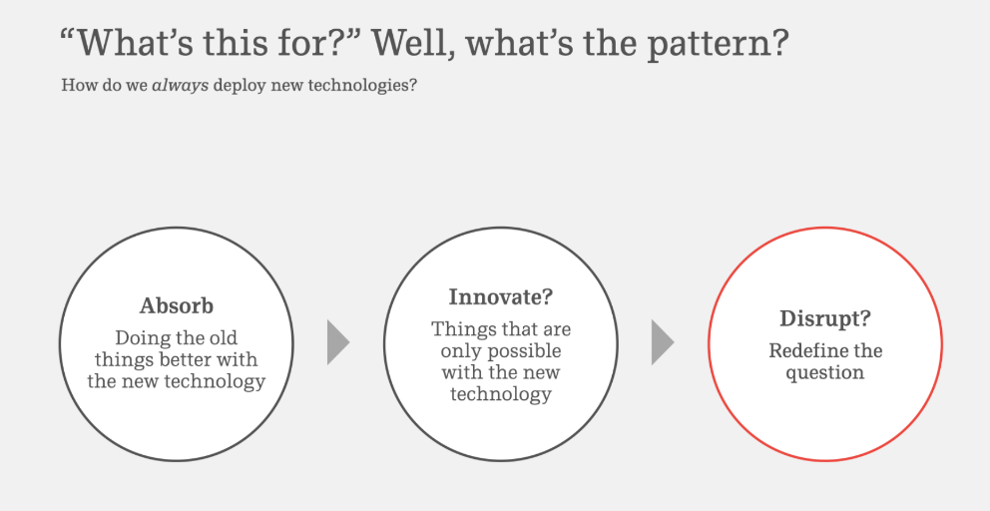
According to a slide in the latest tech analysis presentation by Benedict Evans, titled AI eats the world (May 2026), the deployment of new technology follows a distinct three-stage pattern: Absorb, Innovate, and Disrupt.
Three-stage pattern of new technology deployment: Absorb, Innovate, and Disrupt
Source: X.com
The advancement of AI, which is completely altering the memory industry, will similarly undergo a process of entirely dismantling and restructuring the current electronics ecosystem.
- For example, a conventional fire alarm in an apartment complex. It serves a simple function: detecting smoke or temperature changes via sensors and triggering a warning signal. In this paradigm, buyers favor products that are cheaper, durable and accurate. However, when integrated with AI, the fire alarm becomes part of an overarching fire-prevention system. Beyond just sounding an alarm, it must notify relevant authorities, coordinate automated robots to swiftly suppress the fire, and dynamically broadcast evacuation instructions for residents. Without being part of new ecosystem, the existing players may go out of business.
We must remember that the 2004 "Samsung Shock" heralded the rise and fall of industries alongside the growth of the internet. Waiting things out has proven to be the worst possible strategy when facing innovation, and this time will be no different. For downstream players facing a harsh winter and their connected supply chain partners, an exceptionally aggressive response to this ecosystem restructuring is absolutely vital.
The Myth of the Perpetual Boom
While some argue that "this time is different," we do not share that view. Memory is ultimately a commodity business with existing substitutes; once supply expands, competition and pricing pressure are bound to follow. On top of this, the explosive growth of Chinese competitors is emerging as both the biggest wild card and a major beneficiary in this cycle. Simultaneously, the potential risks of equipment and material shortages could, paradoxically, accelerate supply chain realignment of China's domestic supply chain.
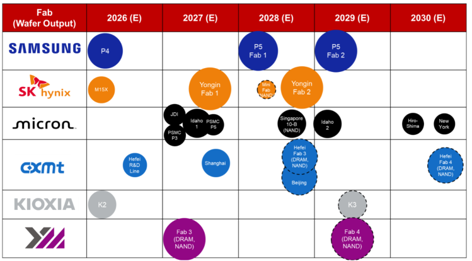
Rapid growth in supply capacity. Recently, the supply industry has been expanding new manufacturing fabs at an unprecedented pace to keep up with surging demand. Nonetheless, the prevailing consensus is that capacity additions will still fall short of demand, leading many to predict that this market strength will persist beyond 2030. Despite these projections, our rationale for why cycles will inevitably endure is simple: memory chips have substitutes, at least for the products developed thus far.
Unless a company is the sole producer of a standard commodity product, selling all increased capacity becomes an absolute necessity in the semiconductor industry due to its fixed costs. Should capacity expand across the board for everyone, this competitive pressure will only accelerate. This is particularly true for the consumer facing segments that have been struggling; reducing prices to a certain degree will be necessary to stimulate demand growth. No matter how much artificial intelligence advances, consumer demand naturally exhibits greater price elasticity than enterprise demand.
New fab expansion pipeline by suppliers
Source: Counterpoint Research Memory Tracker
Chinese firms have clear goals: maximizing profits while building their own domestic ecosystems.
- We believe there is an increasing level of pressure from China authorities to the memory suppliers in China to ease the pricing condition as well as supply shortage. In other words, once they achieve a certain profit margin through high prices, they are expected to lower prices to stabilize their ecosystems.
- Notably, starting this year, the Chinese government has begun allowing overlapping development of similar next generation technologies among companies. Until now, DRAM centered on CXMT and NAND on YMTC, with a focus on business sustainability. This explains why, despite rapid growth, Chinese companies prioritized nurturing profitability through subsidies rather than discount sales.
- However, China is now encouraging competition in next generation products such as VCT, 3D DRAM, and HBF to drive industry innovation. This signals a shift toward massive expansion of mass production facilities and strategies aimed at cost innovation and market share growth through intense competition.
- CXMT’s IPO review documents suggest the company’s Q1 2026 revenue exceeded previous market expectations. The revenue reached a 700% surge from the same period last year compared to the DRAM market’s 260% growth. YMTC is no different. Its Q1 2026 revenue growth was outpacing the market’s growth.
- Of course, the biggest obstacle to China’s continued growth remains import restrictions on advanced equipment. In particular, as Korean companies such as Samsung and SK embark on large scale capacity expansions, there is a high likelihood that resources for producing large volumes of equipment will be insufficient. If equipment is lacking, China’s planned mass production of commodity products or introduction of next generation products may be delayed or scaled back.
- However, supply chain disruptions may lead to other outcomes. Equipment shortages affect not only Chinese companies but the entire industry, and to resolve this, the industry may increasingly rely on China’s supply chain. A year ago, we predicted that memory shortages could push Chinese memory companies to expand exports rather than remain confined to the domestic market and this is now becoming reality. The same logic applies to equipment and materials.
Customer-centric Execution as the Ultimate Differentiator
If a standard commodity cycle is structurally unavoidable, introducing new technologies through innovation becomes a prerequisite for survival. While individual corporate strategies differ subtly in this regard, they share a common thread: each is heavily built upon their respective recent market successes.
Strategy built upon recent success. SK hynix, which captured the leading position in DRAM and overall memory revenue during the first half of last year, is now pivoting its strategy to gain volume leadership. Concurrently, Samsung Electronics is projected to successfully capture the leading market share in HBM4 by leveraging its advanced logic foundry for the base dies and 1c DRAM process. This milestone highlights Samsung’s potential to introduce groundbreaking technologies by accelerating the heterogeneous integration of logic and memory. Consequently, the development and rollout of architectures previously constrained by cost burdens such as FinFET, VCT, 3D DRAM, and HBF are highly likely to accelerate.
Yet, even in the midst of this intense technological arms race, prioritizing traditional value metrics like speed, power, capacity, and cost for the end customer remains far more critical.
- This historical pattern is well evidenced by recent industry cycles. Over the past decade, excluding Chinese players, Micron Technology achieved the fastest technological catch-up in the industry. Despite adopting a highly conservative stance toward Extreme Ultraviolet (EUV) lithography, a tool long deemed indispensable for next-generation breakthroughs, Micron delivered some of the strongest operational results in the sector.
- Given this track record, the industry must consider the distinct possibility that Micron may bypass VCT post 1d DRAM node which it has started sampling recently, choosing instead to transition directly into 3D DRAM. The ultimate metric of success remains achieving peak transition efficiency to maximize cost reduction.
Memory increasingly relying on material innovation and advanced packaging than traditional scaling. Recently, Huawei unveiled an architectural innovation that bypasses the need for EUV lithography altogether, relying instead on so called “logic folding” technologies.
- A similar paradigm shift occurred in 2018 when YMTC, suffered by physical scaling limitations, introduced its Xtacking architecture using a dual wafer bonding method. At the time, industry competitors dismissed the breakthrough, citing excessive cost burdens and yield degradation. Paradoxically, however, this very architecture provided the structural flexibility needed for rapid logic circuitry modifications and accelerated process deployment, lifting YMTC to a position where it is now poised to challenge for the second largest in NAND industry.
- Similarly, CXMT is aggressively pursuing VCT development and Wafer-on-Wafer (WoW) technologies utilized via hybrid bonding.
Ultimately, which of these competing technologies will prove definitive can only be validated through realized market performance, making it premature to declare definitive winners. Even the most sophisticated technology will fail to deliver economic value without flawless execution. Conversely, a theoretically common technology can yield extraordinary commercial returns if it is aligned with real world market dynamics and backed by faultless, precision execution.
Category
Industry
Semiconductors
Service
Premium
Report Type
Report
Time Period
Other
Receive our insightful weekly newsletter and stay ahead of the competition.
Author
MS Hwang
MS Hwang is a research director at Counterpoint, specializing in memory semiconductor research. MS Hwang brings over 30 years of experience from Samsung Electronics and sell-side brokerage research roles including ABN AMRO, Goldman Sachs, Credit Suisse and Samsung Securities.
Jeongku Choi

Jeongku Choi is a Research Analyst at Counterpoint Research based in Seoul, Korea. As an engineer in LG Electronics, she was responsible for commercializing the latest technologies for new products in mobile and automotive. Also analyzing and strategizing the latest Android technology was one of her roles. Her interests are mobile, mobility, AI, and emerging technologies.