Can Automotive and IoT Offset Qualcomm’s Declining Baseband Revenue from Apple?
Apple has started to reduce its dependency on external players for critical components of its SoC, with modem being one of the major components for which Apple was dependent on external sources. Apple bought Intel’s modem business in 2019 to begin developing its own modems and launched the C1 in 2025, integrated into the iPhone 16e. This marked the first in-house modem designed by Apple. Following the C1, Apple introduced the C1X with the iPhone Air and iPhone 17e and is now likely to expand its coverage into the forthcoming iPhone 18 series with its C2 modem.
Apple’s long-term objective is to vertically integrate one of the last major external components used in its products. The in-house modem strategy is aimed at reducing royalty and license fees, lowering long-term BoM costs, improving gross margins, and enabling tighter hardware-software optimization across Apple’s ecosystem. The move also followed years of legal and commercial disputes with Qualcomm, which has been its major partner for modems.
Apple’s transition to in-house modems will create a substantial revenue headwind for Qualcomm, as Qualcomm has been earning an estimated $4 billion-$5 billion annually from supplying modems to Apple plus the royalty per chip. To offset the revenue loss from Apple, Qualcomm has started diversifying its revenue streams to reduce its dependency on the handset segment and increase its exposure to the IoT and Automotive sectors. IoT and Automotive have become leading contributors to Qualcomm’s revenue stream which will help cushion the loss of Apple’s modem business.
Apple’s In-house Modem Transition
Apple initially used Qualcomm modems in the early versions of iPhones, due to the company’s leadership in 3G and LTE performance, and global telco network interoperability. To reduce reliance on single-vendor sourcing, Apple diversified its modem supply to include modems from Intel in some later iPhone models. However, due to below-par performance with Intel modems, Apple was forced to move back to single-vendor sourcing.
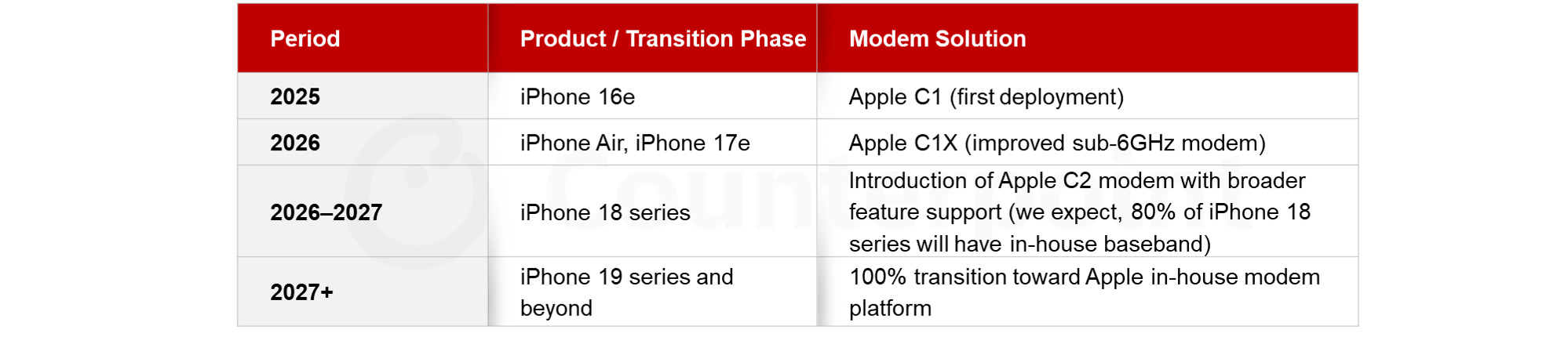
In further efforts to reduce reliance on Qualcomm, Apple acquired Intel’s modem business in 2019 and invested heavily in developing its own modems for future iPhones. This culminated in the 2025 launch of Apple’s C1 modem in 2025. Apple first introduced the C1 modem with the iPhone 16e; a lower risk option than aiming for the main iPhone 17 series. Following C1, Apple introduced C1X, which was also integrated into the lower volume iPhone Air and iPhone 17e. Having built confidence in its capabilities, Apple is expected to utilize its next-generation Apple C2 modem with major models in the iPhone 18 series and is likely to completely transition to its in-house modems with the iPhone 19 series.
This transition reduces Apple’s dependence on Qualcomm and gives Apple greater control over its silicon roadmap and supply chain. Currently, Apple is paying an estimated ~$4.8 billion annually to Qualcomm for modem chipsets, along with additional royalty/licensing fees Qualcomm receives from Apple on each iPhone sold. Moving to in-house modems would therefore reduce Qualcomm’s revenue exposure to Apple while helping improve iPhone margins, especially amid rising memory costs, by using its own in-house modem solutions.
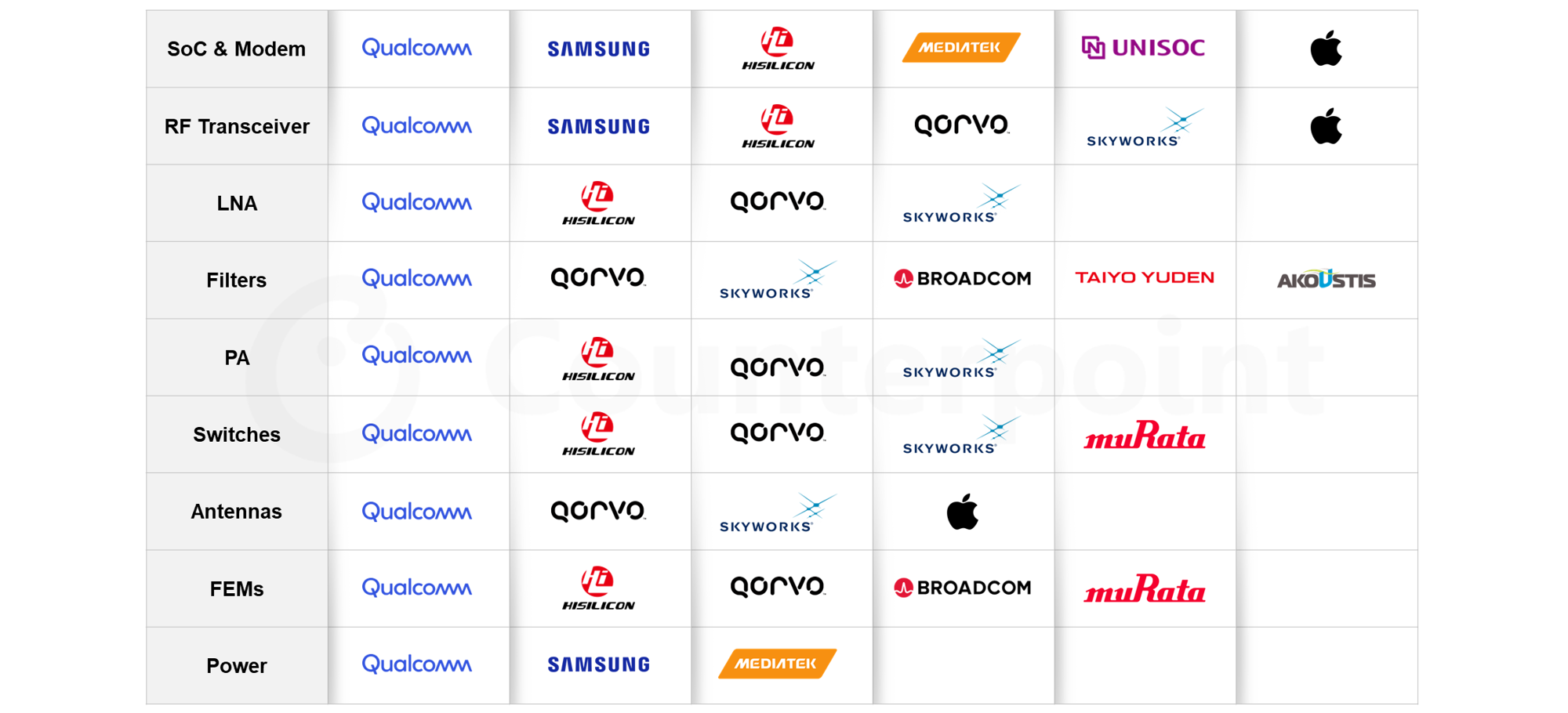
Apple Enters 5G Cellular Modem Ecosystem
Source: Counterpoint Research
Why In-house Baseband
Apple acquired Intel’s cellular modem business in 2019 for around $1 billion to develop its own 5G modem capabilities. Intel LTE modems had already been used in several pre-2020 iPhone models alongside Qualcomm solutions depending on region and carrier requirements.
Developing a competitive 5G modem proved challenging and took Apple several years. In 2025, Apple introduced its first in-house 5G modem, the C1, with the iPhone 16e, followed by an improved version, the C1X, with the iPhone Air.
Apple’s in-house baseband strategy supports greater cost control, tighter system integration, and reduced dependence on external suppliers.
- Tighter Integration: Apple’s in-house modem can improve connectivity between iPhones, Apple Watch, AirPods, and other Apple devices, enabling a smoother and more connected ecosystem experience.
- Reduced reliance on third party: Apple has been paying an estimated $4.4 billion annually to Qualcomm for 5G modem-related BoM costs, with Qualcomm serving as the sole supplier of 5G modems for iPhones. By developing its own modem, Apple can potentially save billions of dollars in component and licensing costs over time.
- Better Gross Margins
Developing semiconductors internally allows Apple to improve gross margins at the component level. Based on Counterpoint’s BoM Analysis for Apple iPhone Air report, Apple manufactures its A-series chipsets at a significantly lower cost than what most smartphone OEMs pay external suppliers such as Qualcomm and MediaTek.
We estimate the Apple A19 and A19 Pro cost around $80 and $90, respectively, which is substantially lower than competing flagship chipsets because Apple uses these chipsets internally rather than selling them, and the chipsets also lack an integrated modem.
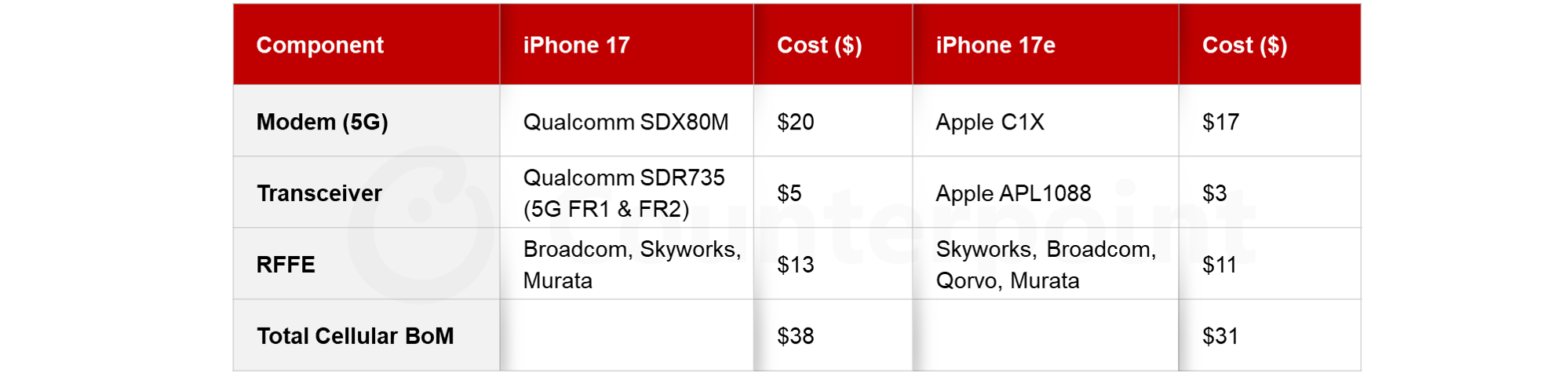
For modems, if Apple achieves gross margins of more than 45% on its in-house C1X modem manufactured on TSMC’s 3nm node, the economics become more attractive. We estimate that for the iPhone Air, the C1X modem costs Apple around $17, compared with about $20 previously paid for Qualcomm’s X80 modem used in iPhone 17 models. This also enables savings on other components such as transceivers and RFFE. Overall, this suggests a per-unit saving of roughly $6-$7, which can significantly improve margins at scale. The iPhone Air is currently estimated to have a gross margin of around 49%, which is the highest within the iPhone lineup. Overall, in-house development of both SoC and modems strengthens Apple’s cost control and long-term margin profile.
Source: Counterpoint Research
Baseband Transition Rollout Schedule
Source: Counterpoint Research
Apple’s Baseband Performance and Comparison
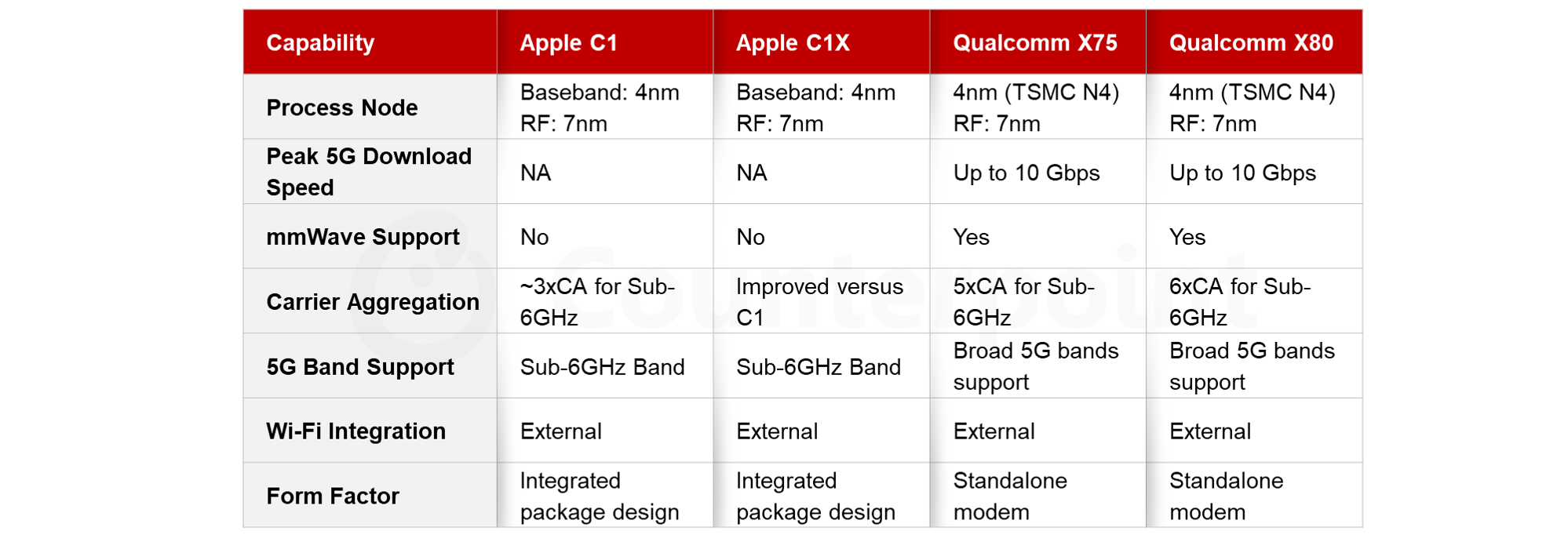
The first-generation Apple in-house modems, including C1 and C1X, have faced several limitations that highlight the gap with chipset players like Qualcomm. One of the limitation is lack of mmWave support, which restricts theoretical peak data speeds in dense urban environments where high-frequency 5G is important. However, mmWave adoption in telcos remains limited globally and most rely on Sub-6GHz frequency for connectivity.
In terms of performance, there was a gap compared to Qualcomm modems, particularly in uplink and downlink speeds as well as efficiency in congested networks. There have also been early-stage reliability concerns, such as instances of connectivity loss observed with the C1X modem. Beyond this, mmWave adds considerable system complexity, requiring advanced technologies like beamforming, multiple antenna modules, and precise RF calibration.
The improved C1X (used in iPhone 17e and iPhone Air) has narrowed the gap considerably. Apple has prioritized power efficiency and tight system-level integration over raw peak specifications delivering battery life advantages and better thermal performance, particularly important in thinner designs like the iPhone Air. However, Qualcomm still maintains an edge in certain premium capabilities such as mmWave support, advanced uplink carrier aggregation, and theoretical peak speeds.
Source: Counterpoint Research
RFFE Design Changes with C1 Introduction
Apple’s transition to its in-house baseband modem significantly reduces dependence on Qualcomm for the core cellular processor, but it does not eliminate the need for a complete RFFE system. The RFFE sits between the modem and the antenna and performs essential functions such as power amplification, signal filtering, switching, impedance tuning, and envelope tracking. This highly specialized domain demands deep expertise in RF analog design, acoustic wave filters (SAW/BAW), and advanced packaging, areas where Apple has not yet developed full in-house capabilities.
With the launches of the iPhone 17e and the iPhone Air, both equipped with Apple’s in-house modem, the company continues to rely heavily on external RFFE suppliers, primarily Skyworks, Qorvo, Murata, Broadcom, and to a lesser extent Qualcomm (for certain supporting components and modules). These vendors supply critical power amplifiers, filters, switches, impedance tuners, and integrated front-end modules that enable the in-house baseband to operate efficiently across global frequency bands, power levels, carrier aggregation scenarios, and varying network conditions.
Apple’s design decisions with the in-house modems will continue to shape future requirements for these RFFE partners, potentially through tighter co-design specifications, customized modules, or selective in-house development of certain active components. This ongoing dependence highlights that baseband independence is only one piece of the broader RF connectivity stack.
Financial Implications
Qualcomm has been the sole modem supplier for Apple since the iPhone 12 series. We estimate Apple paid Qualcomm around $4.8 billion annually for modem-related BoM costs. Since 2020, Apple has paid an estimated $25.6 billion for modem components, in addition to annual licensing payments of roughly $3 billion-$4 billion.
Apple’s transition to in-house modems is expected to reduce modem-related component costs and improve iPhone gross margins through greater vertical integration. We estimate Apple can achieve gross margins of around 50% on its in-house C1 modem, which is manufactured on TSMC’s 4nm node.
Beyond direct cost savings, tighter integration between Apple’s modem and A-series chipsets could improve power efficiency, optimize internal system design, and support broader ecosystem integration across devices. For Qualcomm, Apple’s modem transition represents a meaningful revenue headwind over the next several years as iPhone modem content gradually shifts in-house.
As per Counterpoint Research, the iPhone 18 series, along with Apple’s first foldable iPhone, is expected to follow a dual-modem strategy in 2026. Devices for the US market are likely to continue using Qualcomm basebands, while models for the rest of the world are expected to adopt Apple’s in-house C2 modem. However, mmWave support depends not only on the modem but also on the maturity of the broader RF ecosystem, including antenna modules, RF front-end components, and beamforming systems. Apple continues to rely on external vendors such as Qorvo and Skyworks Solutions for these RF components. If this ecosystem is not fully mature, mmWave support may be limited or deferred in early C2-based devices. This could result in a transitional dual-modem strategy, where Apple’s in-house modem is used in non-mmWave markets, while Qualcomm solutions are retained in regions such as the US.
Apple iPhone Baseband Shipments Share
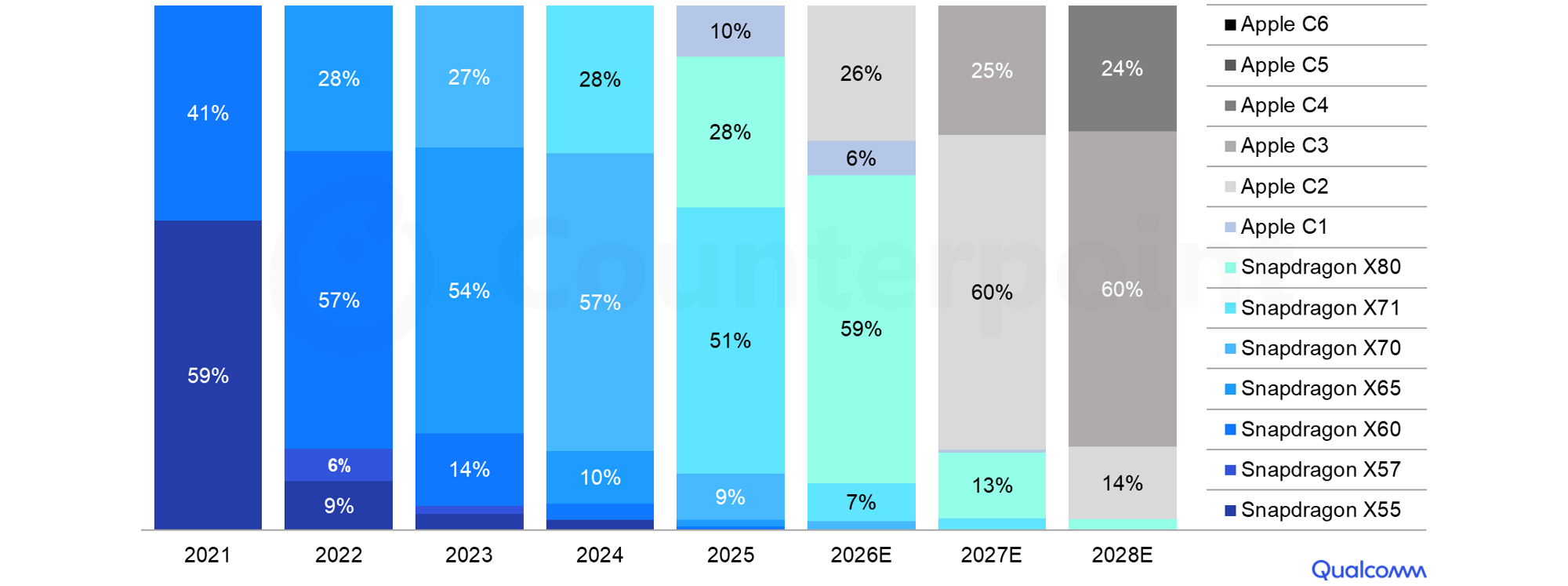
Source: Counterpoint Research
Qualcomm’s Diversification into Automotive, IoT and Data Centers
In response to high dependence on smartphones, Qualcomm has been expanding into adjacent markets, particularly Automotive and IoT. The Automotive segment, led by the Snapdragon Digital Chassis platform, has become an important long-term growth driver. The business includes infotainment, ADAS, and connectivity solutions. Compared with smartphones, automotive programs have longer design cycles, often spanning five to ten years, which provides stronger long-term revenue visibility once design wins enter production. Qualcomm has already disclosed a large automotive design pipeline, reflecting growing adoption across global automotive OEMs.
The IoT segment represents a broader but more fragmented opportunity across consumer, industrial, and enterprise markets, including wearables, XR, and edge AI devices. While IoT offers exposure to several high-growth categories, revenues remain more volatile due to a diverse customer base and changing demand patterns.
The Data Center segment is emerging as another long-term opportunity, driven by growing AI and cloud infrastructure demand. Qualcomm is developing custom ARM-based Oryon CPUs and AI inference accelerators targeting hyperscalers and enterprise AI workloads. The acquisition of Alphawave Semi further strengthens Qualcomm’s position in AI infrastructure and high-speed connectivity solutions, with meaningful revenue contribution expected from 2028 onward.
Can Automotive and IoT Offset Apple’s Revenue Loss?
In the near term, Automotive and IoT are unlikely to fully offset the loss of Apple’s modem business. Apple’s modem transition is expected to create a concentrated revenue impact between 2025 and 2027, while Automotive revenue ramps gradually because of long development cycles and IoT growth remains uneven.
This creates a timing mismatch, with Apple-related revenue declining faster than diversification revenues ramp.
Over the medium to long term, however, the outlook becomes more balanced. As automotive programs move into production and edge AI adoption expands across IoT categories, these businesses are expected to contribute a larger share of Qualcomm’s revenue mix.
While Atomotive and IoT may not fully replicate the scale and profitability of Apple’s modem business, their combined growth can partially offset the impact over time and reduce Qualcomm’s dependence on smartphones.
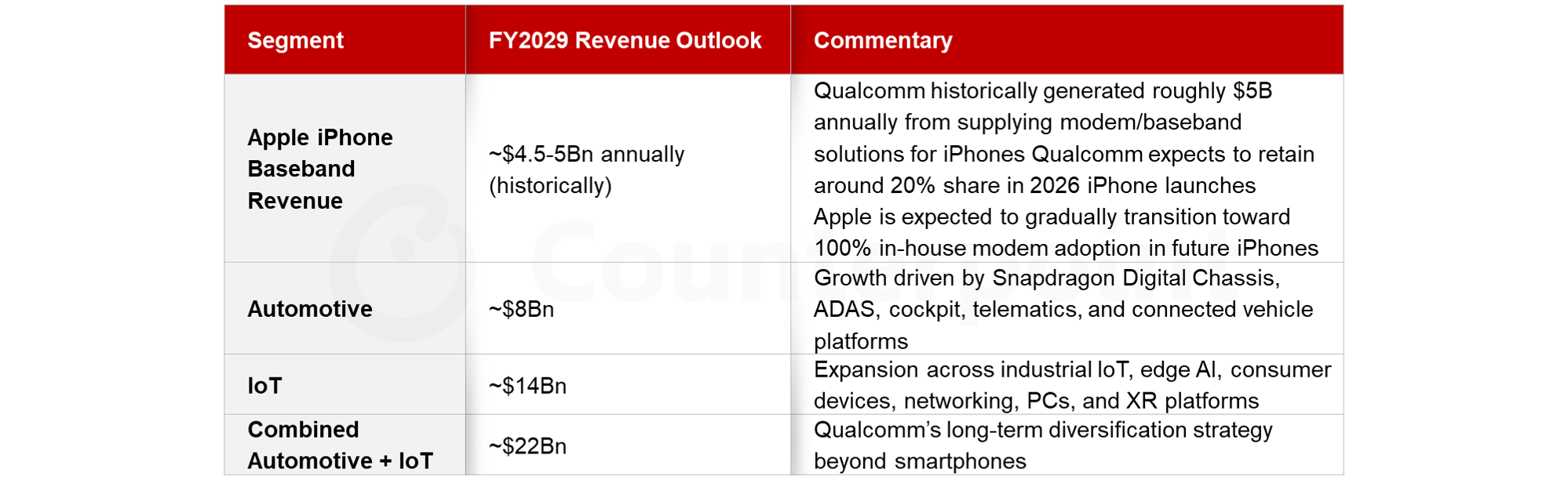
Source: Counterpoint Research
Conclusion
- Apple’s transition to in-house modems marks a major shift in the semi industry, supporting Apple broader vertical integration strategy through improved cost control, tighter hardware-software optimization, and greater product differentiation.
- For Qualcomm, the transition creates a meaningful long-term headwind as Apple gradually reduces modem sourcing, impacting a historical ~$4.8 billion annual iPhone baseband revenue opportunity and the royalty per chip. However, Qualcomm remains well positioned through its high-margin licensing business, continued leadership in premium Android smartphones, and expanding diversification across Automotive and IoT.
- Year over year, Qualcomm continues to see strong growth in its IoT and Automotive businesses, with revenues increasing 16% and 25% YoY, respectively, in 2025. In Automotive, the Snapdragon Digital Chassis platform spans infotainment, telematics, ADAS, and connectivity solutions. Through partnerships with BMW, GM, Mercedes-Benz, Li Auto, and others, Qualcomm has built a strong design-win pipeline, which we believe will support continued long-term growth.
- Qualcomm’s target of ~$14 billion in IoT revenue by FY2029, combined with Automotive growth, indicates a significantly larger ~$22 billion diversification opportunity, compared with ~$10.8 billion in 2025. The potential loss of approximately ~$4.8 billion in annual revenue, along with royalty revenues per chip from Apple’s modem related business, could be offset by growing Automotive and IoT revenues.
Category
Industry
Semiconductors, Smartphone
Service
Premium
Report Type
Report
Time Period
Other
Receive our insightful weekly newsletter and stay ahead of the competition.
Author
Shivani Parashar

Shivani is a market researcher with over 11 years of market research and consumer insights experience. She started her career with Northern Trust Corporation and has since worked with multiple other market research & consulting agencies in India. Shivani has worked across a wide variety of industries, including but not limited to, technology, automotive, and logistics. She has handled multiple end-to-end research project across industries & functions covering a wide variety of subjects. Within Counterpoint, she focuses on components, especially semiconductor foundries and chipsets. Shivani holds an MBA degree in Marketing and an Engineering Degree in Electronics & Instrumentation.