Global Smartphone Market Declined 10% YoY in Week 33, Samsung Achieved Meaningful Growth on Strong Fold8 Launch
- Global smartphone market declined 10% YoY, led by weak sales from Chinese brands
- Apple maintained sales at last year’s level. Strong demand in India partially offset weaker demand in the US, China and Europe.
- Samsung achieved 9% YoY growth, driven by strong initial demand for the Galaxy Z8 series
Global Smartphone Market Declined in Week 33, Led by Chinese Brands
According to Counterpoint Research’s Global Weekly Smartphone Tracker, the global smartphone sales declined 10% YoY in Week 33 (August 9–15), continuing its weak performance. Among major brands, only a few, including Samsung and Huawei, recorded YoY growth. Samsung, in particular, grew 9% YoY, supported by the launch of the Z8 series.
Meanwhile, major Chinese brands such as Xiaomi, OPPO and vivo continued to see declining sales across key markets, driving the overall market contraction. Despite some improvement in sales following new product launches, the broader recovery in smartphone demand remains limited, with performance differences between brands becoming more pronounced depending on product competitiveness and market-specific demand conditions.
Apple: Strong Demand in India Partially Offset Weakness in Major Markets
Apple’s global sales in Week 33 remained broadly in line with the previous year, showing relatively resilient performance. Although sales declined 3% WoW, strong demand in India partially offset weaker sales in major markets such as the US, China and Europe. Continued Independence Day promotions in India supported solid sales of both the iPhone 17 series and older models, helping sustain Apple’s global performance.
In the US, demand for the iPhone 17 Pro and Pro Max began to weaken ahead of the launch of the iPhone 18 series in September, while lower overall promotional value also contributed to softer sales. In Japan, sales began to normalize as the pull-forward demand ahead of the recent price increases gradually faded.
Global Smartphone Sales: W33 2026 vs. W33 2025
![[Global Smartphone Sales: W33 2026 vs. W33 2025]](https://admin.counterpointresearch.com/statics/images/admin/e005bc40-a75f-11f1-80d6-3f15a78e7327.png)
Source: Counterpoint Research Global Weekly Smartphone Tracker
Samsung, Strong New Product Demand Drives Growth Despite Weak Market
Samsung’s global smartphone sales increased 9% YoY in Week 33. In particular, the Fold8 had generated strong early interest even before launch, with pre-order inventory selling out quickly in some markets and deliveries being delayed. As a result, attention was focused on whether this strong initial response would translate into sustained demand following the actual launch.
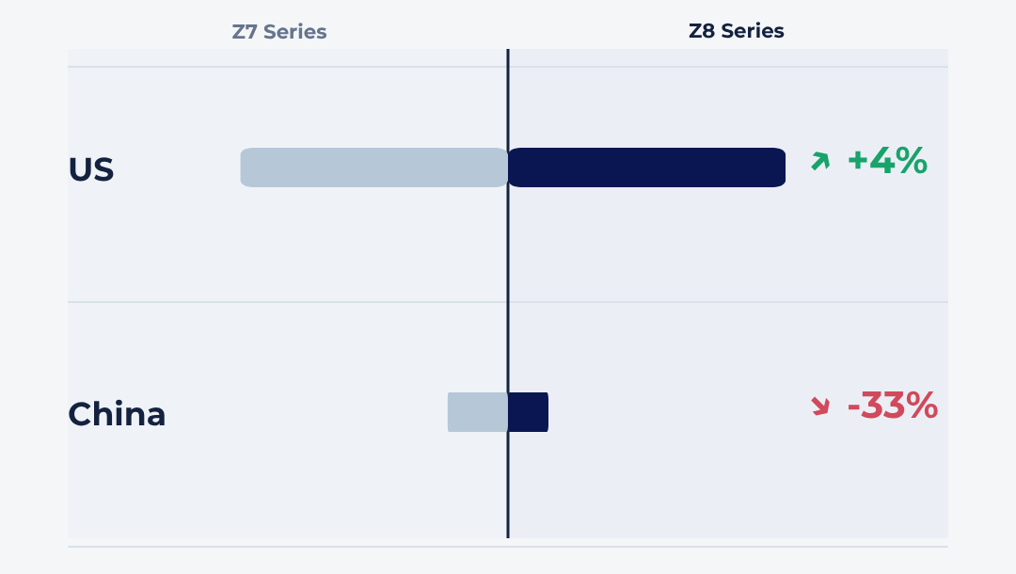
To assess the initial sales performance following the launch, we compared Z8 series sales in Weeks 32–33 with Z7 series sales in Weeks 30–31 last year. In the US, Z8 series sales increased 4% compared with the previous generation, with the Fold8 accounting for the largest share of sales. In contrast, sales in China declined 33% from the previous generation, highlighting a clear difference in performance across markets.
In China, Huawei had already introduced various foldable form factors through the Pura X and Pura X Max, while competing products were positioned at lower price points than the Fold8. As a result, the differentiated value offered by the Fold8’s form factor may have been relatively limited for local consumers. Overall, the initial sales performance of the Z8 series suggests that while demand for new products remains present, differentiated product experiences and the competitive environment in each market are becoming increasingly important factors determining sales performance.
Z8 First 2 Weeks Sales Comparison
Source: Counterpoint Research Global Weekly Smartphone Tracker
OPPO, YoY Decline Continued Despite India Promotions and New Product Launch in China
OPPO’s global sales declined 16% YoY in Week 33, but increased 14% WoW, showing a modest recovery. In India, OPPO saw improved demand driven by Independence Day promotions, while the launch of the A7 Pro Max contributed to higher sales in China. This week's recovery looks more like a temporary rebound driven by promotions in specific markets and new product launches rather than a broad-based improvement in underlying demand.
vivo, WoW Rebound Fails to Offset Persistent YoY Decline
vivo’s global sales increased 15% WoW in Week 33, but remained down 25% YoY, continuing its weak performance. Sales increased WoW in both India and China, but remained below last year’s level. In India, the S2 series and Y and V series drove sales with the support of promotions, while sales in China continued to be led mainly by the Y series, including the Y600 Pro. Thus, despite the recent WoW rebound, the gap versus last year remains significant, making it difficult to interpret the improvement as a meaningful recovery in underlying demand.
Xiaomi, Impact of Price Increases in China Becomes More Pronounced
Xiaomi's global sales increased 10% YoY and 21% WoW in Week 33. In China, price increases for the Xiaomi 17 series, K90 series and Turbo 5 lineup took effect on August 2, reflecting the pass-through of higher BOM costs from the sharp rise in memory spot prices — a sign that similar adjustments could become more widespread across the industry. Sales continued to decline after the price increases, raising concerns that demand may be more price-sensitive than previously expected.
Global Demand Recovery Remains Limited Despite New Product Effects
Week 33 demonstrated that while new product launches and promotions are supporting sales at some brands, underlying global demand remains weak. OPPO, vivo and Xiaomi saw WoW sales recover, but continued to record YoY declines, highlighting the gap between short-term sales improvements and a genuine recovery in underlying demand.
Samsung, by contrast, maintained relatively resilient sales momentum and achieved growth despite the challenging market environment. This suggests that when consumer demand is weak, simply launching new products is not sufficient. Brands increasingly need to offer strong product competitiveness and compelling reasons for consumers to justify additional spending. Going forward, differences in sales performance between brands are likely to widen further depending on how clearly, they can establish such competitive advantages.
Category
Industry
Smartphone
Service
Standard
Report Type
Report
Time Period
Weekly
Receive our insightful weekly newsletter and stay ahead of the competition.
Author
Steve Lee

Steve is a research analyst at Counterpoint Research, specializing in the Japanese smartphone market. He leads comprehensive analysis by integrating carrier-level promotions, weekly and monthly sell-through data, and regulatory changes to provide an accurate, real-time view of market dynamics. His expertise lies in identifying trends across operators and devices, helping clients navigate Japan’s unique mobile ecosystem. In addition to his work on Japan, he also contributes to research on the global TV market.