FCC’s Ban on Foreign-made Routers: What the Policy Means for the US Wi-Fi Router Market
- The FCC has banned the entry of new foreign-produced consumer routers into the US market unless they obtain conditional approval.
- Existing routers and previously authorized models are not affected by the policy.
- The definition of “foreign produced” is broad, covering major stages of production such as manufacturing, assembly, design, and development.
- The policy will increase costs, slow the introduction of new Wi-Fi technologies, and encourage longer use of existing approved models
- Much remains unclear, and the ultimate effect of the policy will depend on how the FCC applies and enforces the new approval framework.
The Federal Communications Commission (FCC) has announced a new restriction on the entry of foreign-produced consumer routers into the US market unless they are specifically cleared through a conditional approval process. This marks a significant shift in how Wi-Fi routers are being treated by regulators. They are no longer positioned as simple consumer technology and are viewed as critical infrastructure devices with implications for cybersecurity, supply chain resilience and broader national security.
Conditional approval for new foreign manufactured router models can be granted by the Department of War or the Department of Homeland Security. In practice, that means regulators now have a direct gatekeeping role over which new router models can enter the US market. However, the decision does not affect routers already in use and it does not block the continued sale or import of router models that were previously authorized.
The approval process also makes clear that this is not just a security restriction. Applicants must disclose where the router and its components, firmware, and design originate, and they must submit a time-bound plan for expanding manufacturing and assembly in the US. That suggests the policy is designed not only to screen out risk, but also to encourage a gradual shift of router production toward the US.
Where are US routers and gateways manufactured?
The FCC uses a broad definition of what counts as “foreign produced”. According to the agency production includes “any major stage of the process through which the device is made, including manufacturing, assembly, design and development”. This means the ruling is not limited to routers that are simply assembled outside the US, but also applies where major stages of the router’s design, development or production takes place abroad. This broad of a definition will impact essentially all major broadband CPE vendors, operating through both the service provider or retail channels.
According to Counterpoint Research’s Broadband 360 service, North America accounted for over 32 million broadband CPE shipments in 2025 through the ISP channel. These devices were procured from a globally diverse group of vendors with large parts or all of the manufacturing process occuring overseas. While models already with FCC approval can continue being sold, new models from these vendors will now face delays. It also remains to be seen how readily these vendors will be able to transition manufacturing to the US.
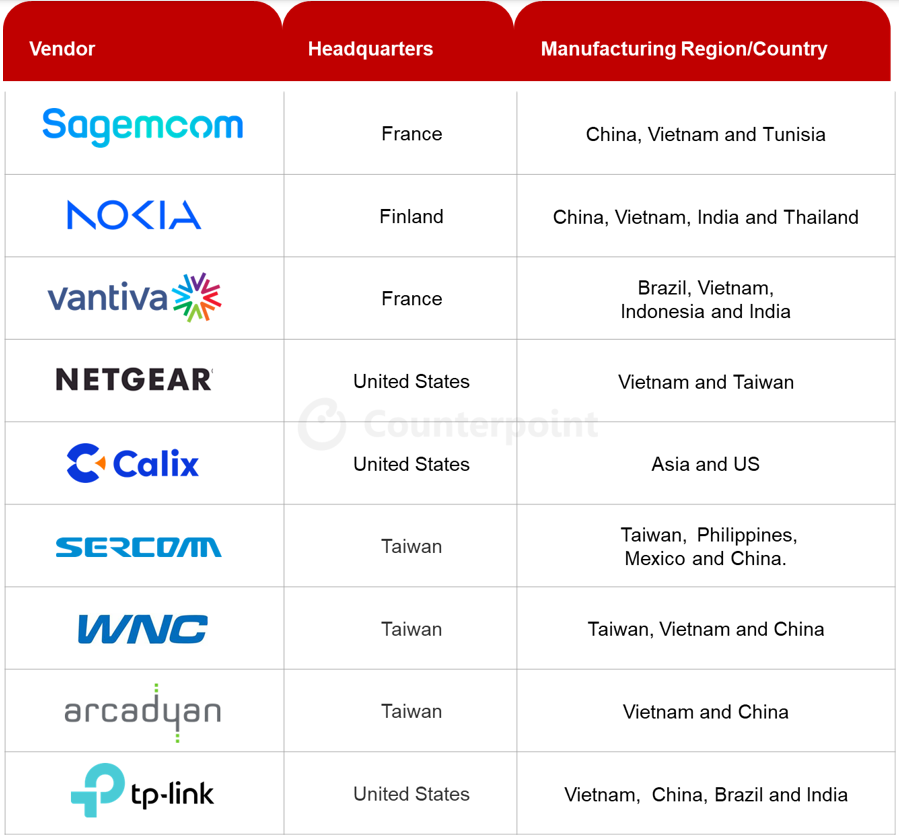
Leading vendors in the US broadband CPE market are all heavily reliant on foreign production, with China, Vietnam and Taiwan being key centres of broadband CPE manufacturing. US-headquartered companies such as Calix, Netgear and TP-Link are also manufacturing most of their CPE in Asia and will be negatively impacted by this restriction. European and Taiwanese vendors will face similar challenges, with a similar geographical manufacturing footprint. Some vendors did shift manufacturing to the US to comply with requirements for the Broadband Equity, Access and Deployment (BEAD) program. However, this was primarily focused broadband infrastructure hardware and not Wi-Fi gateways. Some of Calix’s ONT production shifted to the US and Nokia is also producing a rugged outdoor ONT in Wisconsin. Beyond these small numbers, the US broadband CPE market remains heavily reliant on Asian manufacturing. Interestingly Starlink’s new Wi-Fi router claims to be made in Texas, seemingly avoiding these new restrictions.
The Impact
The immediate and obvious impact will be on pricing. Vendors seeking conditional approval will face new compliance, legal, and supply-chain restructuring costs, including detailed disclosure requirements and pressure to invest in US-based manufacturing. Actually moving router manufacturing to the US would also raise vendor costs. Building or expanding domestic production capacity requires major upfront investment in facilities, equipment, labor, and supplier networks. Even after factories are established, operating costs in the US will remain higher than in existing manufacturing hubs in Asia, this means the policy will increase production costs over both the short and long term.
These higher costs are likely to be passed on to consumers rather than absorbed entirely by vendors or service providers. In retail channels, the most visible effect would be direct increases to router prices, as manufacturers and distributors adjust pricing to reflect higher manufacturing costs. In ISP channels, the effect may be less visible but no less significant. If internet service providers face higher costs for broadband CPE, they will respond by raising monthly router rental fees or spreading those costs more broadly through higher broadband subscription prices. As a result, even consumers who do not purchase routers directly will still face the economic effects of the policy through the cost of their internet service.
Beyond higher prices, the policy may also delay access to the latest Wi-Fi technology. Additional approval requirements and pressure to shift production could slow product launches and make vendors more cautious about introducing new models. In the near term, both vendors and operators may prefer to rely on older CPE that has already received FCC approval, extending the life of existing models rather than taking on the cost and uncertainty of new product approvals. Over time, this could slow upgrade cycles and make firms less willing to adopt the newest technologies, especially where margins are already under pressure from higher compliance and manufacturing costs.
The policy may improve supply chain trust, but its cybersecurity benefits are likely to be more mixed than the headline suggests. While the FCC argues that foreign-produced routers create serious supply chain and national security risks, manufacturing location alone does not determine whether a router is secure. Firmware quality, software updates and long term vendor support play a major role. In that sense, the policy may be more effective at reducing strategic dependence on foreign production rather than solving every underlying source of router insecurity.
In conclusion, the full impact of the FCC’s decision remains uncertain. While the announcement marks a significant shift in how router market access may be regulated, much will depend on how key terms are defined and how the conditional approval process is applied in practice. How strictly “foreign produced” is defined, the standards to evaluate conditional approval requests and the willingness of regulators to allow exceptions will all shape whether this becomes a strict barrier, a managed approval process or something in between. For that reason, the policy’s long-term significance lies not only in what was announced, but in how it is ultimately implemented.
Category
Industry
IoT
Service
Standard
Report Type
Report
Time Period
Other
Receive our insightful weekly newsletter and stay ahead of the competition.
Author
Taimur Zafar

Taimur specializes in Home and Residential Networks, Wi-Fi CPE, Broadband Infrastructure, IoT and Wi-Fi Module research. He focuses on uncovering trends and insights in these areas, using his industry experience and knowledge to provide value to clients. Prior to joining Counterpoint, Taimur led the Home Networks research at Omdia, where he developed his subject matter expertise. He holds a Master of Science in Bioinformatics from Queen Mary, University of London and is based out of London, UK.