- The global Foundry 2.0 market’s revenue grew 25% YoY to a record $96.6 billion in Q2 2026, accelerating from 24% in Q1 2026, driven by AI GPUs, custom AI ASICs and the broader AI infrastructure build-out, including server CPUs, networking chips and power management ICs.
- TSMC remained the primary beneficiary of the AI cycle, with revenue up 34% YoY to $40.2 billion, lifting its share of the Foundry 2.0 market to about 42%. We expect AI-driven demand to support around 43% YoY revenue growth for TSMC in full year 2026.
- Non-TSMC pure-play foundry revenue growth doubled to 18% YoY from 9% YoY in Q1 2026, led by SMIC (+36% YoY) and Nexchip (+21% YoY) on local AI chip demand, localization and structural wafer price increases.
- OSAT revenue rose 22% YoY to $12.6 billion, with ASE and Amkor up 24% and 26% YoY, respectively, as accelerating advanced packaging and testing demand moves OSAT vendors to the core of the AI value chain.
-
Looking beyond 2026, packaging is becoming the main competitive battleground: more than 130 million GPUs and AI ASICs are expected to ship with advanced-packaged on-compute memory over the next five years, generating almost $2 trillion in compute revenue.
Seoul, Beijing, Berlin, Buenos Aires, Fort Collins, Hong Kong, London, New Delhi, Taipei, Tokyo – September 29, 2026
The global foundry 2.0 market revenue climbed 25% YoY and 11% QoQ in Q2 2026 to reach $96.6 billion, according to Counterpoint Research’s latest Foundry Market Supply Tracker. The growth has accelerated compared with the last quarter and was largely driven by the continuous demand for AI GPUs and the expansion of AI infrastructure. This includes custom ASICs, server CPUs, networking chips and power management ICs.
Associate Director, Brady Wang, highlights. “With pure-play foundries, non-memory IDMs and OSATs all posting double-digit growth, the AI investment cycle has broadened across every segment of the value chain. TSMC remains the central beneficiary, but there are more opportunities emerging for mature-node foundries, non-memory-IDM and OSAT vendors.”
Mr. Wang, added, “Advanced packaging is still a major constraint since AI processors have become larger in size and more complex in design.”
We estimate TSMC’s CoWoS supply-demand gap remains around 20% in 2026, narrowing to roughly 10% in 2027 as its in-house capacity scales toward 185 KWPM. Longer test times and additional test steps are gradually turning OSAT vendors into strategic second sources in the AI semiconductor ecosystem.
Pure Play Foundries Revenue Growth Broadened Beyond TSMC
The whole sector revenue increased 29% YoY in Q2 2026 to $54.9 billion with TSMC’s revenue rising 34% YoY and 12% QoQ to $40.2 billion, or about 42% of the total Foundry 2.0 market, up from 38% in 2025. Although its YoY growth moderated from 41% in Q1 2026 due to a higher comparison base, we still see strong sequential momentum and expect it to deliver about 43% revenue growth for full year 2026. This implies H2 2026 revenue growth of close to 50% YoY, which depends on the N2 ramp, wafer price increases and CoWoS capacity additions landing on schedule.
Tight CoWoS capacity limits shipments of AI products, hence TSMC increased backend investment while customers are building alternative packaging options simultaneously. Although this is not going to affect TSMC’s leading position in customers’ advanced products, there’s a structural reallocation of manufacturing capacity in both advanced/mature nodes and packaging.
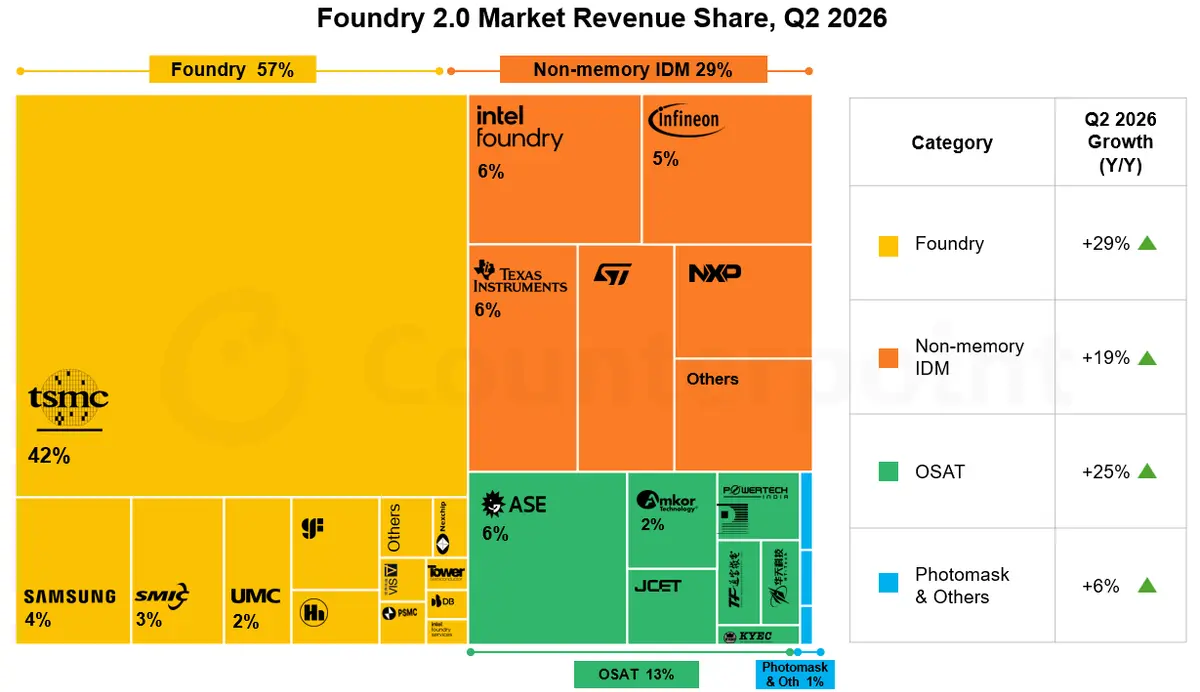
Source: Counterpoint Research Foundry Market Supply Tracker, Q2 2026
Non-TSMC pure play foundry revenue grew 18% YoY, up from 9% YoY in Q1 2026, with SMIC posting strong growth of 36% YoY. SMIC benefited from strong demand for local AI chips, which we expect to keep its N+2 capacity tight throughout 2026, as well as higher utilization, while Hua Hong and Nexchip grew 17% and 21% YoY, respectively. Taiwanese second-tier foundries posted mixed results. UMC/Vanguard grew 9%/20% YoY and 13%/9% QoQ respectively, driven by demand for PMICs, MCUs, and other peripheral chips, which lifted utilization rates. However, mature-node tightness is concentrated in AI-related applications such as PMICs and interposers rather than reflecting an industry-wide shortage, as consumer demand remains soft.
While TSMC continues to optimize its capacity by allocating advanced nodes, Vanguard appears to be capturing interposer demand, while UMC is benefiting from improving exposure to PMICs and silicon photonics. GlobalFoundries grew at a more modest pace, as weaker automotive and smartphone demand offset strong growth in its communications infrastructure and data center business, driven by silicon photonics and silicon germanium demand for AI optical networking.
Senior Analyst, William Li, notes, “Samsung and Intel Foundry also benefit as customers look for additional sources. Samsung held the No. 2 foundry position with around 4% share in Q2 2026, supported by SF4/SF5 demand and higher wafer prices, while Intel’s EMIB-T packaging has been adopted for Google’s next-generation TPU. But neither supplier currently serves as a perfect alternative to TSMC’s combination of advanced-node scale, yield and packaging execution”.
Non-Memory IDMs Benefited from Industrial Recovery and AI Power Demand
The non-memory IDM group recorded 19% YoY revenue growth in Q2 2026 led by Intel Foundry at 31% YoY, followed by STMicroelectronics at 26%, Texas Instruments at 23%, NXP at 19%, and Infineon at 15%. Part of this rebound reflects a low base, as the group was still working through inventory corrections in H1 2025.
We expect the non-memory IDM recovery to continue into H2 2026, supported by rising rack-level power density and the shift to higher-voltage power delivery architectures in AI data centers. The demand for PMICs, MOSFETs, and SiC/GaN-based components is therefore boosted. However, rising foundry and packaging costs could pressure IDM margins if they cannot be passed on to customers.
Advanced Packaging Pushes OSAT to the Center of the AI Supply Chain
The OSAT sector maintained solid momentum in Q2 2026 with revenue rising 22% YoY and 12% QoQ to $12.6 billion. Growth was driven primarily by advanced packaging, wafer probing and testing demands of AI processors. ASE reported 24% YoY revenue growth, while Amkor grew 26%. Other OSAT vendors also reported 20%+ YoY growth in Q2.
ASE, the second-largest company in the Foundry 2.0 market after TSMC, emerged as the second source following TSMC on advanced packaging and its full-process solutions also grew. Amkor is expanding its 2.5D packaging capacity, while Powertech is securing additional opportunities in CPU packaging and developing panel-level technologies. Despite this back-end diversification, most leading-edge AI compute wafers are still made by TSMC, so its leading position remains intact.
Final test and burn-in test gained more importance as chips become more complex. However, testing requirements vary by architecture, meaning that testing cycle time will not increase uniformly for each product and the suppliers should customize and optimize by architecture. Therefore, besides installed capacity, yield consistency and process integration are becoming competitive advantages for OSAT vendors.
Outlook: Back-End Capacity and Compute Diversity Set the Pace for H2 2026
We expect the Foundry 2.0 market to sustain double-digit YoY growth through H2 2026 as AI demand broadens from GPUs to custom ASICs, server CPUs and power components. Advanced packaging, substrates and test capacity will remain the key gating factors for AI deployment. The rise of agentic AI workloads is also lifting CPU demand per AI rack, adding to leading-edge wafer and CPU packaging requirements. Key risks include CoWoS and substrate bottlenecks, the pass-through of higher wafer and packaging costs, persistently soft consumer demand and trade-policy uncertainty.
Mr. Li further added,“AI demand is no longer a single-product story. GPUs, custom ASICs, server CPUs and power chips are all competing for the same wafer, packaging and test capacity, which is why growth has broadened from TSMC to mature-node foundries, IDMs and OSATs. In H2 2026, vendors that can guarantee packaging and test capacity at scale will capture the largest share of incremental AI spending.”
Beyond 2026: The $Trillion Packaging Bottleneck Redraws the Foundry 2.0 Map
Looking further ahead, packaging rather than logic scaling is becoming the main competitive battleground. Counterpoint expects more than 130 million GPUs and AI ASICs to ship with advanced-packaged on-compute memory over the next five years, generating almost $2 trillion in compute revenue. Getting there requires breaking through three converging limits – the Memory Wall, the Performance Wall and the Copper Wall. HBM’s reliance on CoWoS silicon interposers, with the cost, yield and capacity constraints that come with it, is opening the door to credible alternatives.
Our $Trillion Bottleneck series tracks how these alternatives are taking shape. Intel is pairing its EMIB bridge packaging with its ZAM and XBM memory architectures as an alternative to TSMC’s CoWoS. Qualcomm’s High Bandwidth Compute (HBC) stacks LPDDR memory on a logic die to avoid the 2.5D interposer, with first products targeted for mid-2027. NVIDIA’s NVHBM moves the memory controller into a custom HBM base die that NVIDIA designs and memory makers build to order, extending its reach into custom accelerator programs. For the Foundry 2.0 ecosystem, value is shifting toward logic base dies, bridges and substrates. This creates opportunities for foundries that combine advanced logic with packaging capacity, and for OSATs and substrate suppliers that can qualify these new architectures at scale.
“The next phase of the AI build-out will be decided as much in the package as on the wafer,” said Neil Shah, Vice President of Research at Counterpoint Research. “As memory moves closer to compute, the Foundry 2.0 model of integrated manufacturing, packaging and test is no longer a concept but the operating reality. The foundries and OSATs that secure base-die, bridge and substrate capacity for 2027–2028 architectures today will determine who captures the almost $2 trillion AI compute opportunity.”
Related research:
- Foundry Market Supply Tracker - For vendor-, node- and segment-level wafer data
- Foundry Monthly Intelligence Report
- Global Cloud AI CPU, GPU and Compute ASIC Tracker
- For our forward view on AI packaging and memory architecture, read the $Trillion Bottleneck series:
- “Intel Bets EMIB, ZAM and XBM Against TSMC’s CoWoS”
- “Inside Qualcomm’s High Bandwidth Compute (HBC) Bet”
- “NVIDIA’s NVHBM and the Fight for the Base Die”
- "d-Matrix Raptor, AlChip and the Case Against Custom HBM" and
- "TSMC OIP 2026 – AI Design Kit, Packaging Innovations, 3D DRAM Timeline", with full reports available to clients.
- Webinar: “Cloud AI – Trillion-Dollar Infrastructure, Companies & Compute Trends”.
What is Foundry 2.0?
The traditional “Foundry 1.0” definition – focused solely on chip manufacturing – is no longer sufficient to capture current sector dynamics. Counterpoint’s “Foundry 2.0” definition expands the scope to include pure-play foundries, non-memory Integrated Device Manufacturers (IDMs), Outsourced Semiconductor Assembly and Test (OSAT) companies and photomask suppliers. The transition to Foundry 2.0 reflects a gradual shift away from the traditional pure-play model toward a more integrated ecosystem. In practice, this means closer alignment across design, manufacturing, and packaging, ultimately improving system-level efficiency and total cost of ownership (TCO).
About Counterpoint Research
Counterpoint Research is a global market research firm specializing in products across the technology ecosystem. We advise a diverse range of clients – from smartphone OEMs to chipmakers and channel players to Big Tech – through our offices located in the world's major innovation hubs, manufacturing clusters and commercial centers. Our analyst team, led by seasoned experts, engages with stakeholders across the enterprise – from the C-suite to professionals in strategy, analyst relations (AR), market intelligence (MI), business intelligence (BI), product and marketing – to deliver services spanning market data, industry thought leadership and consulting. Our core areas of coverage include AI, Automotive, Consumer Electronics, Displays, eSIM, IoT, Location Platforms, Macroeconomics, Manufacturing, Networks and Infrastructure, Semiconductors, Smartphones and Wearables. Visit our Insights page to explore our publicly available market data, insights and thought leadership, and to understand our focus, meet our analysts and start a conversation.
Follow Counterpoint Research
ENG
Insight


