Asia & Oceania Spearheads 2025 Global FWA CPE Shipment Growth with Strong 19.8% YoY Rise
- Global FWA CPE shipments climbed 10.8% YoY in 2025 to reach 37.8 million units as the market continued to expand, marking the fifth consecutive year of shipment growth.
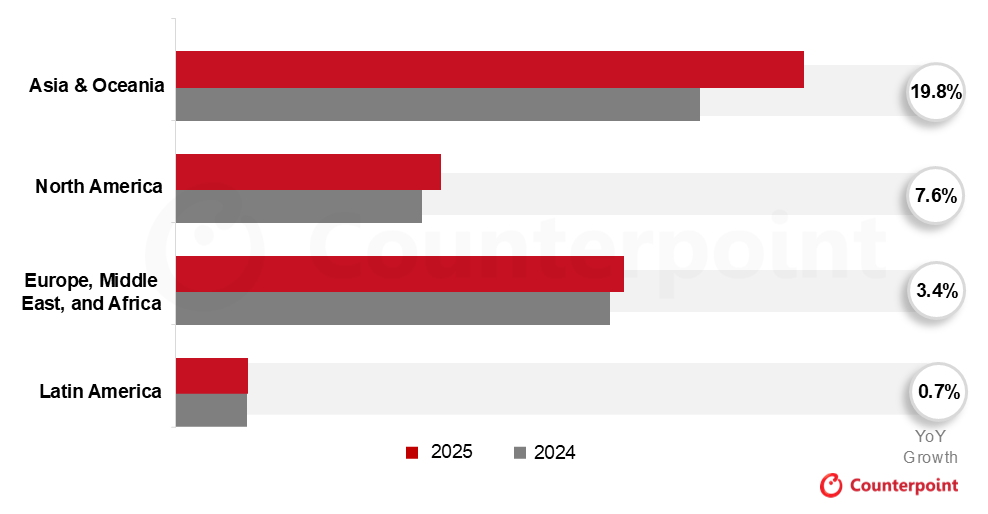
- Asia & Oceania shipments climbed 19.8% YoY, emerging as the strongest-performing region globally, with India leading this momentum by driving primary demand across the region.
- North America and EMEA followed with 7.6% YoY and 3.4% YoY growth, respectively, supported by rural broadband connectivity programs and the increasing competitiveness of FWA offerings.
- FWA adoption faced headwinds in Latin America and Africa as operators favored fiber-based deployments.
- FWA market dynamics remained divergent across and within regions. Asia led growth in FWA shipments, but this was concentrated in key markets such as India. Other parts of Asia with high FTTH penetration such as China or South Korea will not see demand for FWA.
- The global FWA CPE market is expected to face pricing-related challenges in 2026 due to the ongoing memory crisis.
Global FWA CPE shipments climbed 10.8% YoY in 2025 to reach 37.8 million units, marking the fifth consecutive year of shipment growth. The substantial annual growth was due to CPE cost reductions, several rural broadband coverage programs, and operator efforts to expand subscriber base while avoiding the heavy CAPEX spends associated with FTTH deployments. However, global shipment growth was varied among regions. Asia & Oceania and North America saw strong growth, while EMEA’s shipment increase was comparatively modest. LATAM struggled to maintain pace with other markets as shipments remained flat due to limited and relatively higher cost deployment opportunities for operators in comparison to FTTH.
Globally, the FWA CPE shipment numbers remained positive and highlighted the growing traction of the access technology. However, the regional shipment data provided a different angle on how FWA is maturing locally and whether the growth remains even across geographies. For context, Asia & Oceania grew 19.8% YoY in volumes, while the other three regions saw below 8% growth. The data point highlighted a stronger deployment trend among Asian economies such as India, which increasingly trusted FWA to achieve maximum subscriber reach as well as cover the rural-urban coverage gaps. India was the primary growth engine within Asia, wherein operators such as Jio and Airtel adopted focused strategies to target underdeveloped FTTH areas for market penetration. Alongside this, these operators also offered competitive or bundled FWA plans to attract migrating consumers, which worked well in the region due to consumer price sensitivity. Indonesian operators were observed to implement a similar strategy which gained them substantial FWA subscribers. Additionally, Japan also became one of the contributing markets for regional shipment growth. Mostly, the regional operators made a strategic shift to prioritise FWA over legacy access technologies to mitigate investment risks, resulting in historical deployment milestones for the region. Indonesia is rapidly becoming the next key market for FWA deployment in Asia, with a large, underserved broadband population and similar market dynamics to India.
FWA CPE Shipments YoY Growth by Region, 2024 vs 2025
Source: Counterpoint's FWA CPE Tracker
North America mirrored the global growth trajectory by exhibiting 7.6% YoY growth. This growth was partly driven by rural broadband initiatives in the US via the BEAD program, while declining FWA CPE costs also played a catalytic role in driving operator demand. The US remained a key market, with operators such as T-Mobile and Verizon reporting rapidly increasing demand for FWA subscriptions. The strong presence of cable as the access technology of choice in the US market has enabled FWA to remain a viable alternative in suburban and rural areas. FTTH deployment has been limited in these areas due to high cost of deployment. Operators are utilizing FWA to gain market share in areas beyond the limits of their physical fixed access networks. EMEA also maintained relatively modest growth of 3.4% from 2024, as the region had a mixed year, with countries such as Italy pushing broadband initiatives, while the Middle East drove a portion of demand through its efforts to develop a future-proof broadband ecosystem. In contrast, Africa diverged from the regional trend due to the challenging environment created by high FWA CPE costs and limited 5G infrastructure, which hampered adoption. Lastly, LATAM’s local market constraints, such as an established FTTH market and lack of adequate 5G infrastructure, made FWA deployment unviable for operators, resulting in just 0.7% shipment growth YoY.
Despite a record year for global FWA CPE demand, the market is expected to face pricing-related challenges in 2026 due to the ongoing memory crisis. Component scarcity, which previously impacted broadband CPE OEM margins, is now likely to drive higher costs for service providers, as OEMs may no longer be able to absorb the full extent of price increases. This trend will have similar impacts on other access technology, slowing growth of the global broadband CPE market. Increased spending on CPE may limit operators’ fiber rollout plans, keeping FWA a relevant technology for longer.
Receive our insightful weekly newsletter and stay ahead of the competition.
Author
Team Counterpoint


Counterpoint Research is a global industry and market research firm providing market data, intelligence, thought leadership and consulting across the technology ecosystem. We advise a diverse range of global clients spanning the supply chain – from chipmakers, component suppliers, manufacturers and software and application developers to service providers, channel players and investors. Our veteran team of analysts serve these clients through our offices located across the key innovation hubs, manufacturing clusters and commercial centers globally. Our analysts consistently engage with C-suite through to strategy, market intelligence, supply chain, R&D, product management, marketing, sales and others across the organization. Counterpoint’s key coverage areas: AI, Automotive, Cloud, Connectivity, Consumer Electronics, Displays, eSIM, IoT, Location Platforms, Macroeconomics, Manufacturing, Networks & Infra, Semiconductors, Smartphones and Wearables.