Those Who HONOR the Mid-Range: What HONOR 400 Reveals About AI Phones
- HONOR 400 has consistently outsold the 400 Pro in Western Europe, even though both devices sit within the same AI smartphone family.
- This performance gap suggests that AI alone is not enough to pull consumers into higher smartphone price tiers.
- Consumers appear to be rewarding a balanced package of AI features, camera capabilities, software longevity, and value, rather than pursuing the most feature-rich device available.
AI has quickly become the smartphone industry’s next growth narrative. As hardware innovation becomes increasingly incremental and cost pressures continue to build, OEMs are turning to AI not only as a new user experience, but also as a potential justification for higher device prices. Western Europe has emerged as one of the key testing grounds for this strategy: AI capabilities are rapidly expanding beyond flagship devices, while vendors are increasingly positioning AI as a reason for consumers to upgrade and spend more. The underlying assumption is straightforward: better AI should support higher‑priced smartphones.
Yet whether consumers are actually willing to pay materially more for AI remains an open question. As AI features spread across price tiers, the burden of proof is shifting: vendors must now explain why one “AI phone” deserves a meaningful premium over another that appears to offer many of the same capabilities. The risk is that AI becomes part of the baseline smartphone experience rather than a clear reason to move up a price band.
The sustained performance of the HONOR 400 series offers a useful perspective on how consumers are responding to AI smartphones. While both the HONOR 400 and HONOR 400 Pro offer AI-powered experiences, buyers have shown a clear preference for the more affordable model. The trend raises a broader question for the industry: if AI is becoming a must-have feature, does it still justify a premium price?
Demand Concentrates Around the Base Model
The HONOR 400 has emerged as the clear volume driver within the brand's mid-to-premium portfolio in Western Europe. Since its launch, it has consistently outsold the HONOR 400 Pro, with monthly sell-through volumes typically running at roughly two to three times the level of its higher-priced sibling.
The scale of the gap is notable, but its persistence is even more striking. Rather than being limited to the launch period, the HONOR 400 maintained its advantage across successive months after release. While smartphone demand naturally fluctuates over time, the relative relationship between the two models remained remarkably stable, with the base model repeatedly attracting the larger share of demand.
Monthly Sales Mix of HONOR 400 and 400 Pro (May 2025–Apr 2026)
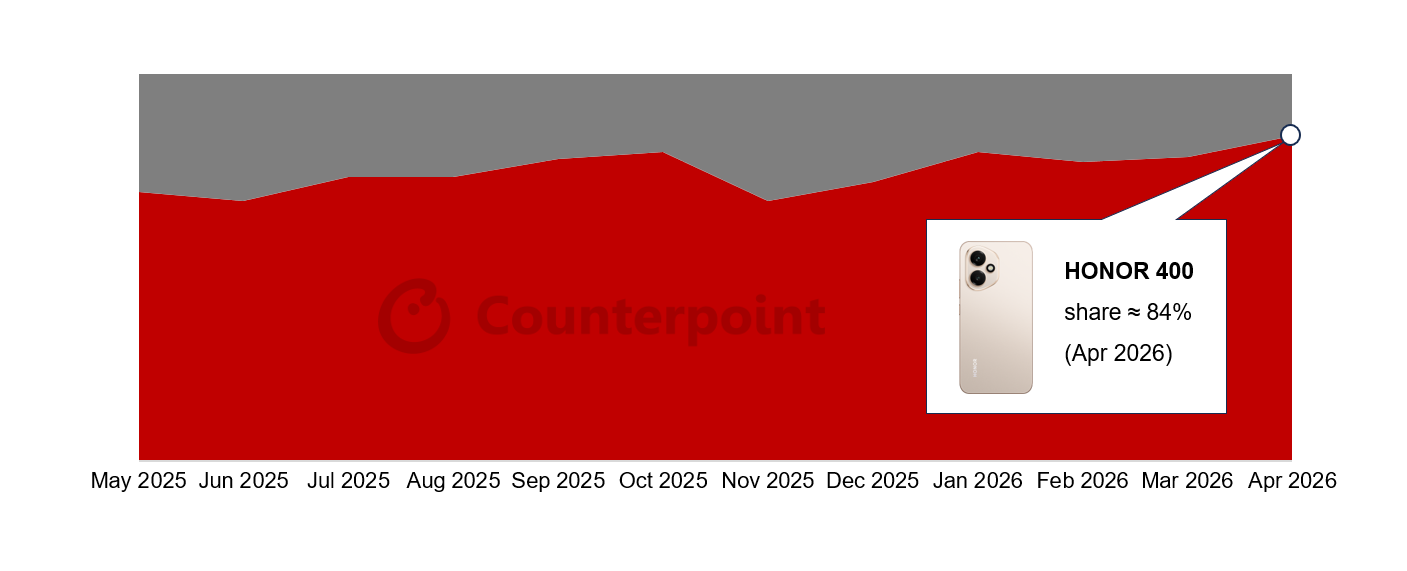
The persistence of this gap suggests that consumers are expressing a structural preference rather than reacting to a short-lived launch cycle. Although both devices belong to the same product family and share many of the same headline AI experiences, buyers have consistently gravitated toward the standard model. The result points to a broader industry question: if consumers are repeatedly choosing the base model over the Pro variant, what exactly are they willing to pay a premium for?
AI Is Expected, Not Exclusive
The performance gap between the HONOR 400 and 400 Pro highlights a broader shift in how consumers perceive AI smartphones. While vendors increasingly position AI as a key differentiator, many of the most visible AI experiences are no longer confined to premium devices. Features such as AI-assisted photography, image editing, productivity tools and generative AI services are rapidly becoming available across multiple price tiers.
The HONOR 400 series provides an illustration of this dynamic. Both devices are marketed as part of the same AI smartphone family, featuring AI-powered photography, image editing, productivity tools and Google Gemini-powered experiences that have become central to the brand's positioning strategy. Yet Western European consumers appear to be favoring the more affordable model. The standard HONOR 400 sits in a price band that remains accessible to a broad range of buyers, while the 400 Pro competes not only against upper-mid-tier Android devices but also against discounted flagship models. Although the Pro variant offers additional hardware advantages and a more premium package, the regular 400 appears to deliver enough AI experience that many consumers are seeking.
As AI capabilities become more widely available, the value of AI itself may also be changing. For consumers, the question is increasingly shifting from whether a smartphone offers AI to whether those AI experiences are meaningfully better than what is already available at a lower price point. Once a baseline level of AI functionality is established, simply offering more AI features does not automatically justify a substantial move up the pricing ladder.
This does not suggest that AI has become less important. Rather, AI is becoming a baseline expectation rather than an exclusive premium feature. For smartphone vendors, the challenge is no longer simply adding AI to devices, but creating experiences that consumers perceive as distinct enough to justify paying more.
More Than Just AI
HONOR 400’s performance suggests that its appeal cannot be explained by AI alone. The device sits in one of the market's most competitive price bands – premium enough to feel aspirational, yet affordable enough to remain accessible to a broad base of consumers.
Part of that value lies in the balance of the package. HONOR 400 combines a high-resolution camera system, a large battery with fast charging, a bright display and a relatively slim, premium-looking design with a price that remains meaningfully below more expensive Pro-tier alternatives. Just as importantly, HONOR’s six-year Android OS and security support give the device a stronger long-term ownership story than many buyers might expect in this segment. For users planning to keep a phone for several years, that kind of software support can matter as much as AI branding.
In that sense, consumers may not be choosing HONOR 400 simply because it is an “AI phone.” They appear to be choosing a phone that offers enough of the latest AI experiences while also delivering the practical features that shape everyday value: camera quality, battery life, software longevity and a more accessible price band. The broader lesson is that AI may help get a device onto a shortlist, but it still needs to be supported by a compelling overall package if it is to drive sustained volume.
Will Users HONOR the Next Generation?
HONOR’s next product cycle will offer an important test of whether this pattern can hold. With the newer 600 series, the brand is pushing further on the same broad formula introduced with the 400 – layering more advanced AI features, newer silicon and a more premium overall package on top of the mid-range foundation. The strategic ambition is clear: to move users up the price curve without losing the appeal that made the 400 resonate in the first place.
Whether consumers will follow is a more open question. If the HONOR 400 story suggests that buyers increasingly treat AI as a baseline expectation rather than a premium feature, then the next challenge is not simply offering more AI, but offering a version of it that feels meaningfully worth paying for. In that sense, the next HONOR generation will be more than just another product launch; it may become an important test of how far AI alone can support premiumization in the smartphone market.
Category
Industry
Smartphone
Service
Standard
Report Type
Report
Time Period
Other
Receive our insightful weekly newsletter and stay ahead of the competition.
Author
Sanghoon Kim

Sanghoon Kim is a Research Analyst at Counterpoint Research based in Seoul, Korea. At Gallup Korea, he gained hands-on experience conducting primary research surveys, mainly for government and public sector clients. After three years of research experience, he joined Counterpoint to focus on expanding his expertise in the fast-evolving IT sector. He graduated from Yonsei University with a Bachelor of Arts in Political Science.