Pricing and Spec Strategies are Impacting Smartphone Sales in Western Europe, For Better or For Worse
- OEMs are using different strategies to mitigate the impact of the memory price rises. Most involve a delicate balance of pricing and specifications.
- It comes as no surprise that the most successful of the major launches so far have been a result of significant spec upgrades and no price rise over the previous generation. The Samsung Galaxy S26 Ultra and Apple iPhone 17e are prime examples.
- But just how damaging can an increase in price or minimal spec upgrades be to sales? The Google Pixel 10A and Samsung Galaxy A37/57 suggest that consumers are not fans.
- The deteriorating macro environment needs to be taken into account of course, but that only makes the strategies OEMs choose going forward even more critical.
2026 is proving a challenging year to launch a new smartphone. There have been around 20 significant smartphone launches so far in Europe this year, and each has posed a difficult choice for their respective OEMs as they try to mitigate the impact of the memory price rises. Most strategies involve a delicate balance of pricing and specifications, and some have done better than others.
One of the first major launches of the year was the Samsung Galaxy S26 series, and the Ultra variant was the most successful, with sales growing by 22% in Western Europe its first five weeks of availability compared to the S25 Ultra. This was largely thanks to no price increase, faster charging, and the introduction of the impressive Privacy Display.
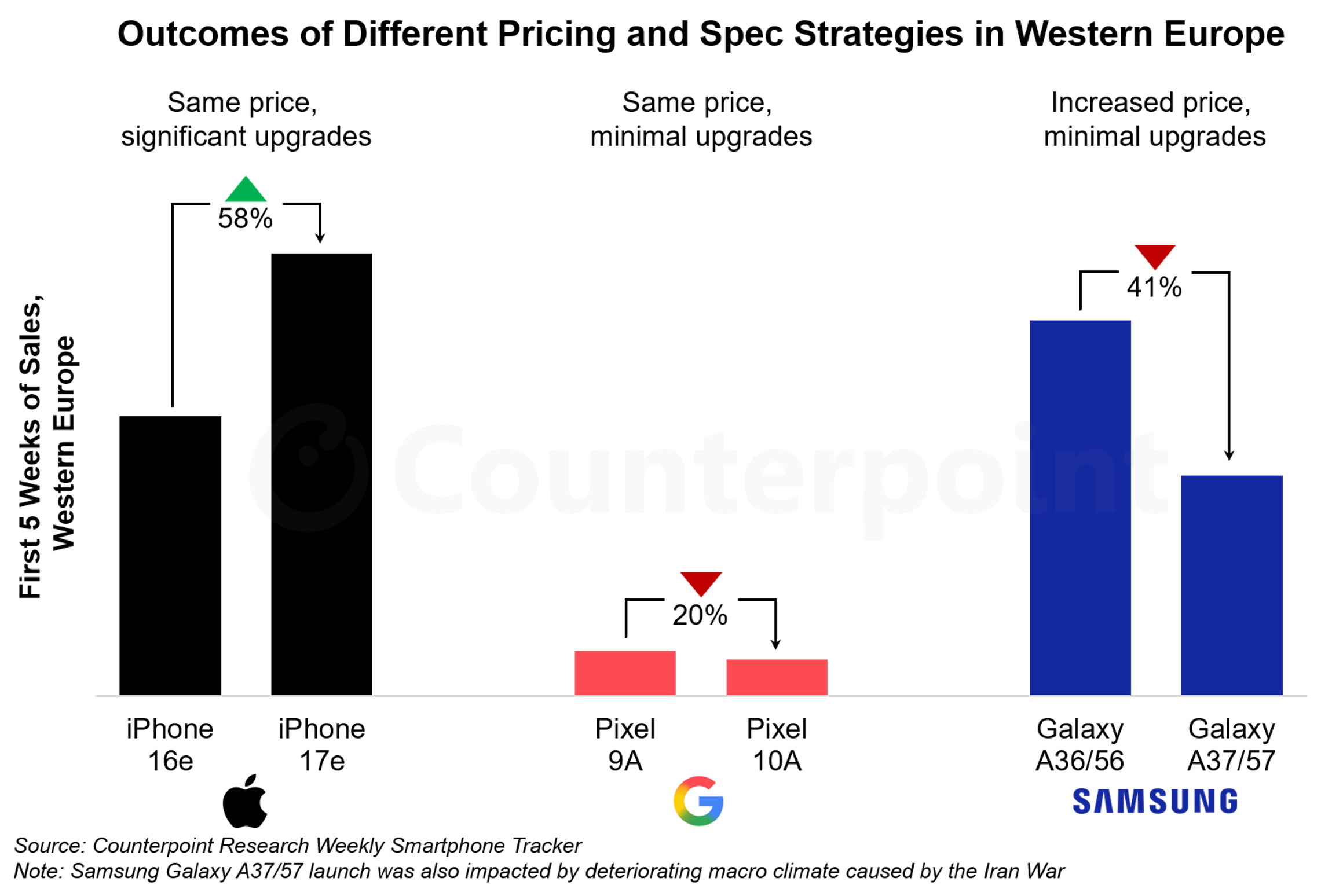
To illustrate this further, we have taken three examples of recently launched smartphones, each of which took a different approach when compared to the previous generation:
- Same price, significant upgrades: the Apple iPhone 17e was launched at the same price as the iPhone 16e (around €700) but added MagSafe technology and doubled the storage compared to the 16e.
- Same price, minimal upgrades: the Google Pixel 10A was the same price as the Pixel 9A (around €549) but featured almost identical hardware to the 9A.
- Increased price, minimal upgrades: the Samsung Galaxy A37/57 were 10-13% more expensive than the A36/56, but with only slight tweaks in performance and camera.
So, how has each device fared? The results reveal no major surprises.
The Apple iPhone 17e did very well, with sales in its first five weeks of availability up by 58% in Western Europe compared to the iPhone 16e. It should be noted that Apple was buoyed by a record breaking Q4 2025, so could more easily absorb the additional costs of upgrades while maintaining the price.
The Google Pixel 10A, meanwhile, struggled due to the perception that it was basically the same as the Pixel 9A. Sales in the first five weeks were therefore down by 20% in Western Europe, while we actually saw a small spike in sales of the 9A during the same period (which was available at a lower price).
Finally, sales of the Galaxy A37/57 plummeted by 41% in Western Europe in the first five weeks compared to the A36/56. Yes, Samsung launched these devices amid a low point in consumer confidence due to the economic impacts of the Iran War. And also, these mid-range devices are more likely to be purchased outright instead of on a contract that can soften the impact of price rises by spreading them out over a period of time. So while the decline might not be completely because of the inflated price, it does nevertheless suggest that consumers do not like paying extra for minimal upgrades, particularly when times are tough.
There is one more permutation of the price and spec strategy to discuss: raising the price while also significantly upgrading the specifications. This is the approach taken by HONOR with its recently launched 600 series. The HONOR 600 Pro launched in April at €999, a significant step up from the HONOR 400 Pro which was priced at €799, but featuring a faster processor, a larger battery, a sharper and brighter display, and an upgraded periscope telephoto lens. The price places the 600 Pro into flagship territory, while the 400 Pro sat more in the upper-mid range, but the improved specifications go some way in justifying that shift. In addition, there are some early-bird discounts available that bring the price down to €799, and that makes the hardware seem even better value for money.
It is too early to say how well the HONOR 600 Pro is doing, but it has been very well reviewed in the media. We will know more in a few weeks to see whether the strategy of raising both the price and specs will be a success. But what is clear is that consumers are not responding well to having to pay more for the same hardware. At that point, just buying the previous generation, or even a refurbished device, at a lower price makes more sense, particularly in this challenging economic environment.
More flagships will be coming over the next few months, most notably the Samsung Galaxy Z Fold/Flip refresh and the Apple iPhone 18 series (possibly even the iPhone Fold). We will have to wait and see what the pricing and spec strategies will be, but we expect the respective OEMs will have seen what has worked or not worked so far this year, and will act accordingly.
Category
Industry
Smartphone
Service
Standard
Report Type
Report
Time Period
Other
Receive our insightful weekly newsletter and stay ahead of the competition.
Author
Jan Stryjak


Jan is an Associate Director with Counterpoint Research, based in London, and leads the company’s European and Sustainability research. He is a seasoned analyst with over 17 years’ experience in the TMT sector, previously with GSMA Intelligence where he led a team of analysts producing highly impactful regional insights. Before that, Jan held strategy and analyst positions at Vodafone UK and Qualcomm respectively, and started his career with research firm TNS (now Kantar).