

- Google will include AAOS SDV in the Android Open-Source Project later in 2026.
- Google is building a partner ecosystem for this platform, which can run vehicle compute, body control, and cluster domains.
- By providing a common foundation for more in-vehicle functions, Google can simultaneously create a broader base for its own paid solutions and enable automotive software providers to develop new, compatible solutions of their own.
With Google’s announcement that it plans to open-source its Android Automotive Operating System for Software Defined Vehicles (AAOS SDV) came additional details for this new platform. AAOS SDV is an Android-based software stack that supports a broader range of automotive-specific functions than ever before. It is separate from AAOS IVI, which is what Google is now calling the infotainment-focused version of AAOS that the automotive industry is familiar with and commonly uses.
Automaker Renault announced its partnership with Google for next-generation vehicles in 2022, noting that Android would be the “Car OS”. Over the last several years, Google has continued to develop AAOS SDV into a more full-fledged framework capable of running systems beyond the cockpit.
AAOS SDV, according to Google, can manage “core compute, body controls, and cluster domains”. The company describes it as a “lightweight Android-based operating system incorporating low-level automotive-specific frameworks for communications, diagnostics, software updates, and more”. Other functions supported by AAOS SDV include climate control, seat actuators, mirrors, cameras, lighting, and vehicle telemetry. As part of AAOS SDV, Google provides the Display Safety framework for implementing instrument cluster functions. It includes a safety design toolchain and a reference safety monitor to enable automakers to meet functional safety requirements.
Google’s stated goal with AAOS SDV and its decision to open-source it is to address industry challenges, such as fragmented software across different systems, poor portability across different E/E architectures, and to reduce development costs.
AAOS SDV does not support advanced driver assistance systems (ADAS) and autonomous driving functions. The company stated in its announcement that AAOS SDV is for “non-safety” functions.
Automaker Renault plans to deploy AAOS SDV in its upcoming Renault Traffic e-Tech mid-size van, which uses the SDV architecture developed by Renault subsidiary Ampere.
Google plans to formally incorporate AAOS SDV into the Android Open-Source Project (AOSP) later this year.
Google focuses on next-generation E/E architectures with AAOS SDV
Google’s approach with Android OS for the automotive industry has been to steadily add support for more types of in-vehicle systems. AAOS originally only supported infotainment functions, as it was an extension of Android for mobile devices to infotainment systems. Now, with AAOS SDV, the company is formally extending Android so that it can function across multiple automotive domains, beyond the cockpit.
This was an expected move on Google’s part, given the company’s long relationship with automakers and suppliers, with Google having announced AAOS in March 2017. Based on the announcement, though, there are still certain aspects of AAOS SDV that the company hasn’t fully detailed. One example would be its support for AUTOSAR-based ECUs. Also, in the infographic (shown below) it has provided, it depicts the different elements of AAOS SDV running on SoCs, which are primarily used in more powerful ECUs in vehicles.
Android Automotive Operating System Frameworks
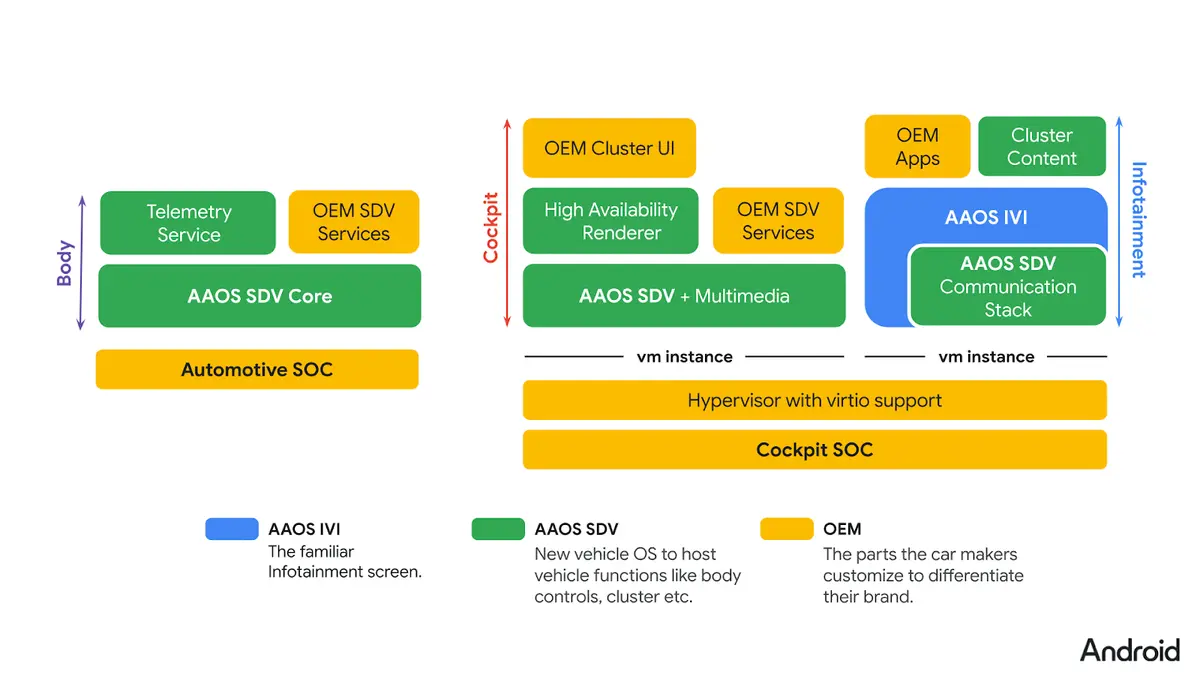
Source: Google
Google is intentionally designing AAOS to support next-generation E/E architectures, which typically have a smaller number of more powerful ECUs that support functions (and increasingly cross-domain functions). Centralized and zonal compute architectures generally have ECUs that have an SoC as the main processor. Google designed AAOS SDV with a modular structure and a topology-agnostic communication layer. The company also designed it to support granular software updates.
Some of the features AAOS SDV provides include a standard signal catalog, extended VirtIO support (for more types of virtual devices), and integration with Google Cloud services, such as Google Cloud Horizon, which can enable an automaker to run a digital twin of a vehicle. In addition, Google designed AAOS SDV as a service-oriented architecture capable of being updated. As an example of how an automaker works with AAOS SDV, Renault’s Ampere subsidiary uses Google Cloud Workstations, which are synced with AAOS-related repositories. The company also uses Gemini Code Assist for development.
To streamline software development, Google has said, AAOS SDV is cloud-native and runs on Android Virtual Device (Cuttlefish). This allows it to develop software without access to development hardware. Also, in a January 2026 blog post by Qualcomm (during CES), the company noted its Snapdragon vSoC (virtual SoC) can run in Google Cloud, specifically on Axion C4A metal instances. Google also stated in its agreement with Qualcomm that it would pre-integrate AAOS SDV with Qualcomm’s Snapdragon Digital Chassis solutions.
Analyst takes
For Google, this expands its already significant presence in the automotive industry. This also mirrors its approach with the original version of AAOS, where the company offers Android OS to suppliers and OEMs for free and then generates revenue from its suite of applications that run on top of AAOS, Google Built-in (also known as Google Automotive Services). As Google Cloud solutions work with AAOS (both IVI and SDV), this is an example of how the company can generate indirect revenue by open-sourcing AAOS SDV. The more companies use AAOS SDV, the more likely they are to use Google Cloud solutions.
Other companies in the automotive software market have been moving toward offering open-source versions of their software, such as Elektrobit’s EB corbos Linux for Safety Applications and QNX making the OS open source for non-commercial use. Both companies have offered solutions for automotive cockpits for many years and have adapted their product portfolios as Android has been widely used by automakers.
Since this will be an open-source version of Android that supports a wider range of vehicle functions, industry suppliers and automakers can take advantage of AAOS SDV and build solutions for it. Elektrobit and QNX, for example, already offer solutions that support or are designed to work with Android OS, such as Elektrobit’s Virtual IVI Development for Android and EB corbos Link solutions, and QNX Cabin, which can support Android and Linux.
Looking at AAOS SDV from a competitive perspective, despite the new functionality provided by AAOS SDV, it will not be a solution for every in-vehicle system. Google has not stated that AAOS SDV will run on microcontrollers (MCUs), for example, and this is not a solution for automotive safety systems. This won’t compete with ASIL-D-certified solutions from other companies. Open-source AAOS SDV will expand Google’s presence in the market, but it won’t eliminate the need for safety-critical software from other companies and organizations nor a large partner ecosystem.
In addition, the development of different SDV software frameworks, reference architectures and coordination efforts, such as Eclipse S-CORE, SOAFEE’s architecture, Automotive Grade Linux’s (AGL) SoDev framework, AUTOSAR Adaptive and its Common Adaptive Platform Implementation (CAPI) effort, will also need to determine how their solutions will work either alongside or with Google’s SDV framework, especially since automakers are already starting to use it (such as Renault).


