

- Qualcomm has partnered with Google to develop an AI framework to bring personalized, conversational AI agents to vehicles.
- The framework is designed to speed up automakers’ development of in-car AI agents and time to market when bringing next-generation user experiences to cars.
- These AI agents will be able to control infotainment features, such as media and navigation, and different vehicle functions.
At IAA Mobility 2025, Qualcomm announced that it had partnered with Google to develop an AI framework to bring personalized, conversational AI agents to vehicles. Automakers can use this solution to create new types of in-vehicle user experiences, combining the framework with their own in-vehicle HMI (Human-Machine Interface) and branding. The framework is designed to speed up automakers’ development of in-car AI agents and time to market when bringing next-generation user experiences to cars.
These AI agents will be able to control infotainment features, such as media and navigation, and different vehicle functions (rolling down a window, changing the temperature, etc.). They will also tell a driver or passenger about vehicle features and how they work (an AI-enabled “car manual”), and handle requests for general information. The solution includes a reference architecture for use cases such as conversational navigation, media and entertainment, and controlling vehicle functions. Qualcomm also noted that the AI agents are designed to be multimodal and multilingual.
The solution combines Google Cloud’s Automotive AI agent SDK and framework with Qualcomm’s Snapdragon Digital Chassis platform. Google Cloud’s Automotive AI Agent enables OEMs to customize their in-vehicle digital assistants, especially when paired with Qualcomm’s on-device inferencing capabilities. In addition, Qualcomm is integrating a voice front-end that includes echo cancellation and noise reduction (ECNR), zonal voice, and custom wake words. The company has also integrated its on-device retrieval augmented generation (RAG) capability and its toolchain with Google Cloud’s Automotive AI Agent solution. The framework also enables automakers to select their own AI models in addition to Google’s Gemini models.
The solution is a hybrid framework that can send users’ queries to the in-car system and cloud-based AI models as needed, depending on the request. For example, if a user asks the in-vehicle digital assistant to control an in-vehicle function, an on-board model is best positioned to handle that request. If the user asks for general information, such as the results of a football game, a cloud-based model would be the better choice, and the orchestrator software client installed in the vehicle’s infotainment system would route the request accordingly.
Automotive AI Agent SDK with Qualcomm’s Snapdragon Digital Chassis Platform Diagram
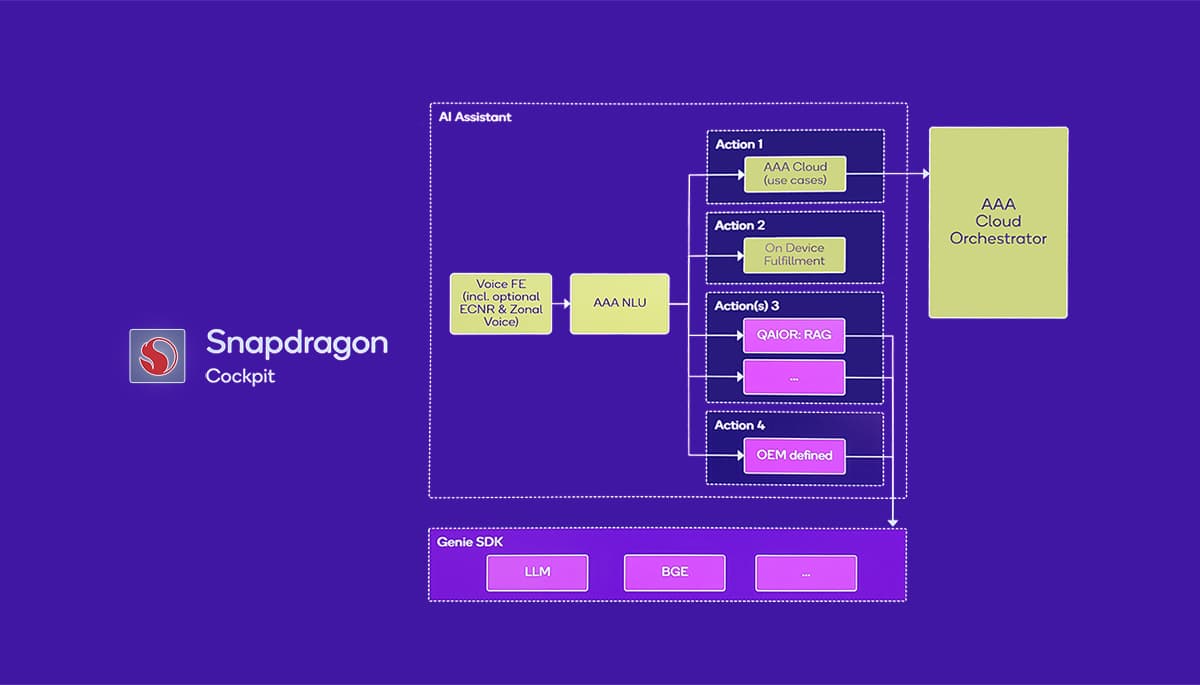
Qualcomm representatives noted the company has worked closely with Google to enable full on-device inference using Snapdragon Digital Chassis solutions' heterogeneous compute cores, ensuring it functions even when wireless connectivity is unavailable.
During the announcement, Qualcomm representatives noted that several automakers were already piloting this new framework to create new, AI agent-enhanced in-car user experiences. The solution supports the Model Context Protocol (MCP) and Agent-to-Agent (A2A) AI agent communication protocols, which help ensure automakers can use a wide range of AI agents.
Qualcomm and Google’s partnership goes back many years, to 2016 when they first integrated Android with Qualcomm’s Snapdragon solutions. They later expanded their collaboration to in-car AI experiences, showcased in 2021 and 2022, prior to generative AI becoming widely available. The companies plan to jointly offer this new solution to automakers.
Analyst takes
Google announced that its Automotive AI Agent solution would debut in 2025 in models from Mercedes-Benz. Since then, Mercedes has announced it will incorporate AI capabilities from Google and Microsoft in 2026 model CLA, enhancing the OEM’s MBUX Virtual Assistant. This is an example of the type of solution that automakers are beginning to deploy, where the solution utilizes multiple AI models to provide the best user experience.
Google and Qualcomm have partnered to expand their efforts to enable automakers to flexibly integrate their solutions while maintaining greater control over branding. For Qualcomm, the partnership aligns with the company’s goal of enabling edge AI through its semiconductor products and software solutions while simultaneously building its ecosystem of partners and solutions.
Earlier this year, Qualcomm announced its efforts related to “compound AI” that can manage not only infotainment and other in-cabin functions but eventually also act as a co-pilot. The company’s efforts related to agentic AI align with its focus on helping automakers enable compound AI in their vehicles and transform the driving experience. For Google, the company is giving automakers the flexibility to create their own in-car AI agents, and by partnering with Qualcomm, it is making it easier for OEMs to integrate AI agents into vehicles.