• NXP unveils new S32N7 super-integration processor series for SDVs
• Mercedes-Benz taps QNX and Vector’s Alloy Kore to power next-gen digital architecture
• Elektrobit unveils EB civion to fast-track SDV cockpit development
• Sonatus showcases AI-powered SDV innovations and partners
• ETAS collaborates with Microsoft to accelerate automotive software development with cloud-based calibration tools
• Sibros launches SDV app marketplace
• Cerence xUI, leveraging NVIDIA AI enterprise and running on Microsoft Azure, drives strong traction with automakers
• AMD showcases next-gen automotive innovations and partners with StradVision and Seyond
• Ambarella launches powerful edge AI 8K vision SoC with industry-leading AI and multi-sensor perception performance
• Mercedes-Benz unveils new MBUX Hyperscreen and AI-powered in-car entertainment
• Geely redefines next-gen smart vehicle tech with full-domain AI 2.0 and G-ASD
• Leapmotor and Qualcomm debut world's first automotive central computer powered by Snapdragon Cockpit Elite and Snapdragon Ride Elite platforms
• AUMOVIO focuses on UX + ADAS + SDV scale-up
• Valeo unveils safety-enhancing advanced monitoring applications powered by Seeing Machines
• Qualcomm, Google solidify partnership to power next-Gen AI in software-defined vehicles
• TomTom Orbis Maps to power CARIAD’s automated driving systems
• Arbe combines market-leading radar solution with powerful NVIDIA AI computing, creating advanced platform for AI-based driving
On Day 1 of CES 2026, automotive announcements moved quickly from high-level positioning to practical execution as the show floor opened after Media Days. It was established on the first day of the event that the industry conversation has shifted beyond individual features to the foundations of software-defined vehicles (SDVs). OEMs and suppliers focused on centralized computing, scalable platforms, and software that can be deployed, updated and maintained throughout a vehicle’s lifecycle. Across the show floor, AI, sensing, connectivity and compute were increasingly presented as tightly integrated building blocks spanning cockpit, ADAS, body, and vehicle control systems. Semiconductor and software players, including NXP, Qualcomm, AMD, QNX, Google, Sonatus and Elektrobit, highlighted how architecture upgrades are enabling ECU consolidation and reducing complexity. OEMs, including Mercedes-Benz, Geely and Leapmotor, reinforced that long-term competitiveness will depend on software agility, AI strength and strong ecosystem partnerships, not solely on hardware.
• NXP unveils new S32N7 super-integration processor series for SDVs
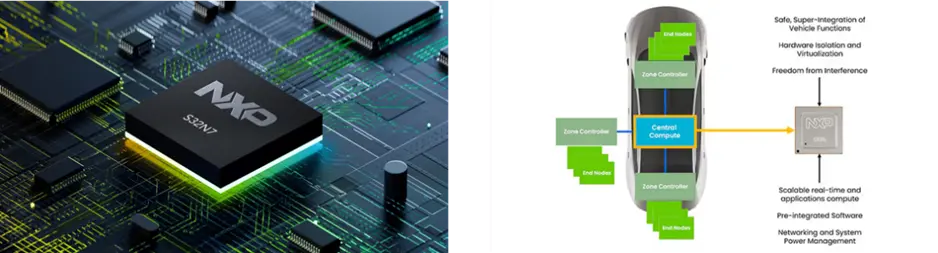
During the event, NXP Semiconductors unveiled the S32N7 super-integration processor series, building on the same 5nm foundation as in the S32N55 and designed specifically for SDVs. The S32N7 brings together functions that are traditionally spread across multiple electronic control units (ECUs) – from propulsion and vehicle dynamics to body control, gateway functions and safety domains, among others – into a single, centralised hub. This consolidation helps reduce complexity, wiring and electronics costs by up to 20% while enabling OEMs to scale AI-driven innovation across entire vehicle fleets. The S32N7 architecture supports high-performance networking, hardware-enforced safety partitions, integrated AI/data accelerators and modular expansion, all under automotive safety and security requirements. This series offers a scalable portfolio with 32 compatible variants, delivering application and real-time compute with high-performance networking, hardware isolation technology, AI and data acceleration on a system-on-chip (SoC), while meeting the strict timing, safety and security requirements of the vehicle core. It is a key element of NXP's S32 automotive processing platform, designed to accelerate the shift toward intelligent, next-generation vehicles. Bosch was the first company to deploy the S32N7 in its vehicle integration platform. Together, they have co-developed reference designs, safety frameworks, hardware integration and an expert enablement program, accelerating system deployment and reducing integration effort for early adopters.
• Mercedes-Benz taps QNX and Vector’s Alloy Kore to power next-gen digital architecture
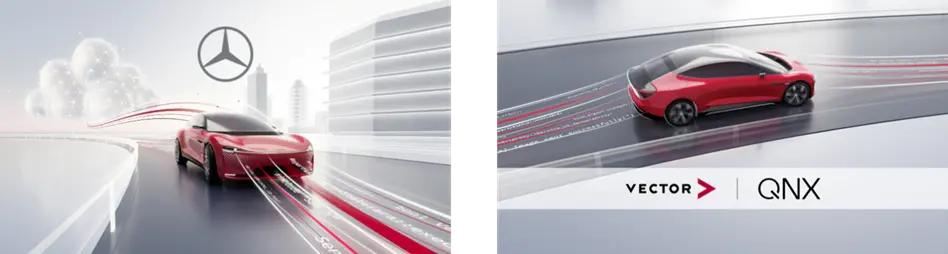
At CES 2026, QNX and Vector unveiled Alloy Kore, a jointly developed “Foundational Vehicle Software Platform” aimed at accelerating the transition to SDVs by simplifying complex digital architectures. The platform integrates QNX’s safety-certified operating system and virtualization with Vector’s middleware to create a standardized “base-layer” that handles essential infrastructure, allowing automakers like Mercedes-Benz, which is already exploring the platform for its next-generation centralized control units, to focus on brand-specific innovations such as AI-driven cockpits and automated driving. By decoupling hardware from software and meeting the highest safety (ASIL D) and cybersecurity standards for the industry, Alloy Kore aims to reduce development costs and enable faster, fleet-wide over-the-air (OTA) updates, with a full certified release targeted for late 2026.
• Elektrobit unveils EB civion to fast-track SDV cockpit development
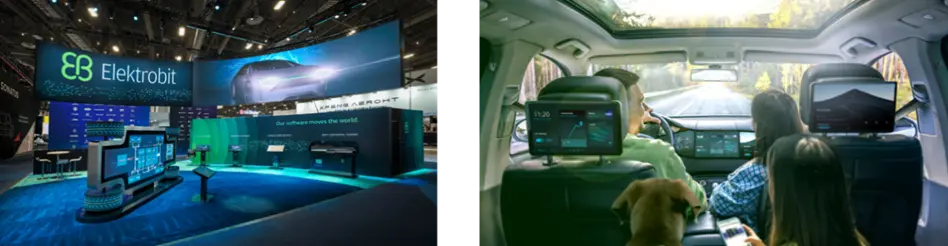
Elektrobit took the stage at CES 2026 to announce the launch of EB civion, a new software suite aimed at accelerating digital cockpit and application development for SDVs, while giving automotive OEMs greater control over their supply chains. EB civion consolidates Elektrobit’s core expertise in cockpit systems and automotive software into a single, integrated ecosystem built around three key components: EB civion Creator is a cloud-native, virtual cockpit development environment that enables rapid HMI design and application prototyping in simulated environments. EB civion Core provides hardware-agnostic, modular software assets optimized for cockpit domain controllers, supporting high-performance and real-time infotainment functions. EB civion Cockpit offers build-to-print cockpit domain controller solutions, combining system software and reference designs tailored for specific SoCs. Together, these elements help OEMs reduce development complexity, shorten time-to-market and lower cost of ownership by enabling reusable software, hardware-independent development, and pre-integrated solutions. The suite is backed by a strong ecosystem of cloud and semiconductor partners, supporting scalable, cloud-native workflows and future-ready SDV architectures. According to Elektrobit CEO Maria Anhalt, EB civion will transform cockpit development by turning complexity into opportunity through off-the-shelf, integration-ready software.
• Sonatus showcases AI-powered SDV innovations and partners
Sonatus showcased a broad set of SDV capabilities at CES 2026, with a clear focus on making connected vehicles easier to build, operate and scale. One key theme was accelerating SOP through intelligent test and validation, demonstrated on a 2026 Nissan Leaf in collaboration with Nissan Technical Centre Europe, allowing OEMs to identify issues earlier and reduce delays using software-based testing tools. Sonatus also highlighted how automakers can deliver in-vehicle edge AI at scale, with ecosystem partners, including Michelin, NXP, Renesas, MOTER, COMPREDICT, Qnovo and VicOne, enabling remote monitoring, personalisation and system optimisation without heavy reliance on the cloud. Another important area was unlocking vehicle data using GenAI, shown through a live connected vehicle demo with Hyundai, which helps OEMs and fleets turn large volumes of vehicle data into actionable insights. On the fleet side, smart diagnostics were demonstrated with Kenworth, showing how remote fault detection and predictive maintenance can improve uptime. Looking ahead, Sonatus is positioning its platform to support a future where continuous connectivity, data-driven decisions, and software updates define the full vehicle lifecycle.

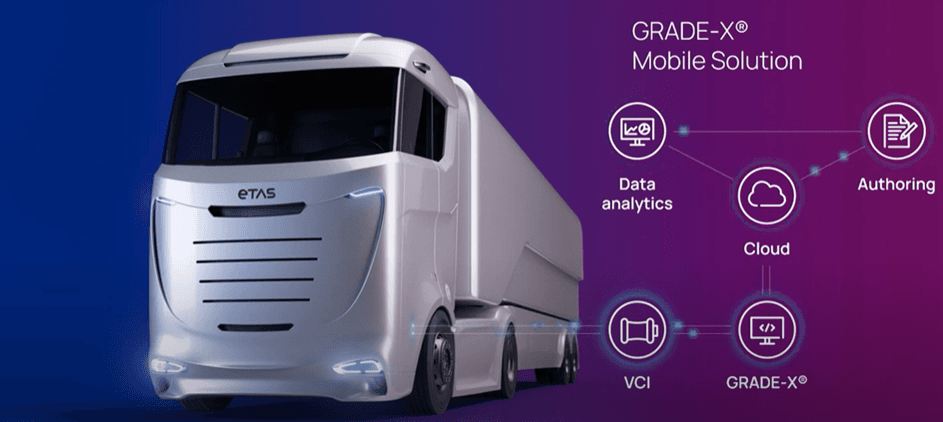
• ETAS collaborates with Microsoft to accelerate automotive software development with cloud-based calibration tools
ETAS has partnered with Microsoft to bring cloud-based calibration and development tools to Microsoft Azure, with the goal of speeding up automotive software development. By running ETAS calibration and data tools in the cloud, OEMs and suppliers can test, calibrate and validate software much earlier in the development cycle. This reduces dependence on local hardware, improves collaboration across engineering teams and shortens development timelines. This also directly supports the shift toward SDVs and connected vehicles, where software complexity and data volumes are growing rapidly. Cloud-based calibration enables earlier testing, faster iterations and better use of vehicle and simulation data across global engineering teams. It also helps reduce development bottlenecks and shortens the time to SOP by allowing teams to scale resources on demand. This partnership supports more connected development workflows, easier software updates, and closer links between vehicle data, cloud systems and in-vehicle software, which will be important as OTA updates and full software lifecycle management become common in modern vehicles.
• Sibros launches SDV app marketplace
Sibros has launched the SDV app marketplace, helping automakers and fleet operators to quickly add and modify connected car services for their vehicles. The platform includes over 50 pre-built and ready-to-deploy applications for battery management, diagnostics, compliance, fleet operations, safety and customer features. Built on Sibros’ Deep Connected Platform, the apps can be deployed over-the-air without complex custom development. This reduces time-to-market and enables faster rollout of SDV services while improving vehicle performance, efficiency and customer experience.
• Cerence xUI, leveraging NVIDIA AI enterprise and running on Microsoft Azure, drives strong traction with automakers
Cerence xUI is being widely adopted by global automakers for 2026 vehicle launches, as its agentic AI architecture is built on NVIDIA AI Enterprise and Microsoft Azure, which enables more advanced and natural voice-based in-car assistants. Running on Azure’s secure cloud and optimized with NVIDIA tools like NIM microservices, xUI offers higher performance, low latency and faster production cycles. This will help OEMs gain confidence in AI-powered automotive experiences and increase industry partnerships. Recently, Geely Auto partnered with Cerence xUI to power its next-generation LLM-based in-car AI experience. The platform will enable natural, conversational voice interaction, multi-intent commands and personalized assistance for different occupants, including “say-what-you-see” UI control. Built on a hybrid technology having both on-device and cloud architecture, the system will leverage advanced AI capabilities to enhance infotainment, vehicle control and user experience. Initial deployment is planned from 2026 across select Geely models.

• AMD showcases next-gen automotive innovations and partners with StradVision and Seyond
AMD demonstrated AI-driven ADAS capabilities through its collaboration with StradVision and leveraging AMD’s Versal AI Edge Series Gen 2 device to enable vision-based driver assistance with surround-view visualization. The company also highlighted Seyond's integration of Zynq UltraScale+ MPSoC in long-range forward LiDAR sensors, supporting advanced point-cloud processing, calibration, and RX/TX control for enhanced ADAS performance. The Vehicle Experience Platform combines Ryzen Embedded processors and Versal AI Edge for seamless digital cockpit operation with intelligent workload distribution, complemented by a cloud-native development workflow powered by Radeon Pro GPUs and EPYC Embedded CPUs to streamline SDV validation. These advancements highlight AMD's dual focus on elevating ADAS autonomy while redefining software-defined vehicle experiences.
• Ambarella launches powerful edge AI 8K vision SoC with industry-leading AI and multi-sensor perception performance
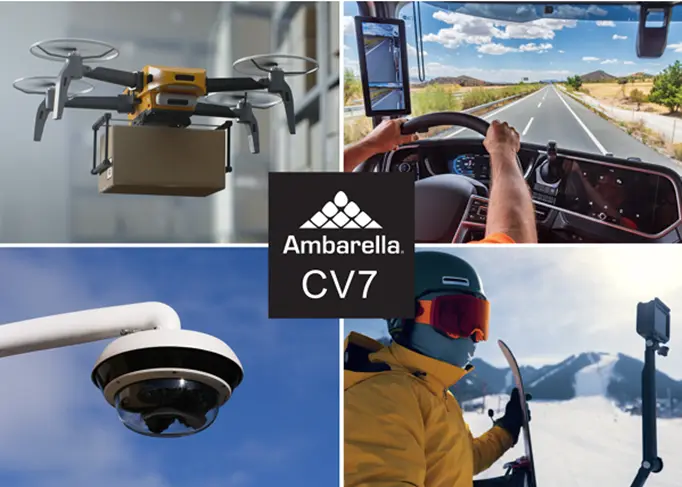
Ambarella has launched its powerful CV7 edge AI 8K vision SoC, marking a standout moment at CES with cutting-edge on-device AI and multi-sensor perception capabilities. The new 4nm CV7 SoC is designed to handle simultaneous multi-stream videos of up to 8K p60 while delivering high-performance edge AI with about 20% lower power consumption than its predecessor, making it ideal for advanced consumer cameras, enterprise security systems, robotics, industrial automation, and automotive AI vision applications like telematics, 360° surround view, and ADAS. By tightly integrating its proprietary AI accelerator, image signal processor, video encoding and CPU cores into a single efficient chip, Ambarella enables developers to push next-generation, high-quality imaging and analytics into a wide range of smart edge products with better performance per watt and reduced system cost. The CV7’s debut at CES reinforces Ambarella’s leadership in edge AI silicon and underscores its commitment to pushing the boundaries of intelligent vision processing.
• Mercedes-Benz unveils new MBUX Hyperscreen and AI-powered in-car entertainment
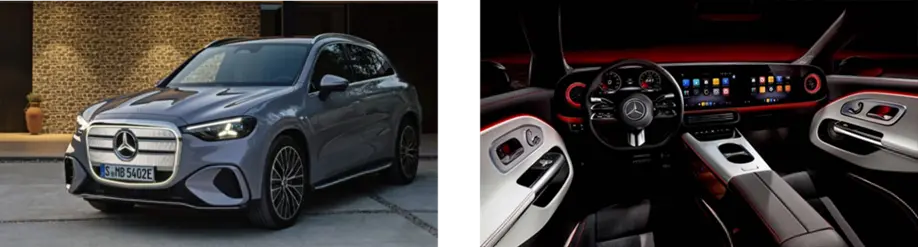
At CES 2026, Mercedes-Benz spotlighted its shift toward software-defined electric vehicles with the US premiere of the all-new electric GLC. Reimagined as a fully electric SUV, the GLC highlights the brand’s focus on digital experiences, connectivity and advanced driver assistance for one of its most important US nameplates. Central to the showcase is the AI-powered MB.OS and fourth-generation MBUX system, including the optional 39.1-inch Hyperscreen, alongside features such as intelligent air suspension and 800-volt charging. Mercedes also emphasized immersive in-car entertainment through partnerships with Dolby and Sony Pictures Entertainment, bringing Spatial Audio, IMAX Enhanced video and premium sound into its vehicles. On the driving side, MB.DRIVE technologies developed with NVIDIA demonstrate SAE Level 2 capabilities. Overall, the presentation signals Mercedes-Benz’s strategy of pairing EVs with software, AI and content ecosystems ahead of its US rollout later in 2026. As the US has rolled back EV incentives, these features are likely to be available in ICE and hybrids alongside EV powertrains as well.
• Geely redefines next-gen smart vehicle tech with full-domain AI 2.0 and G-ASD
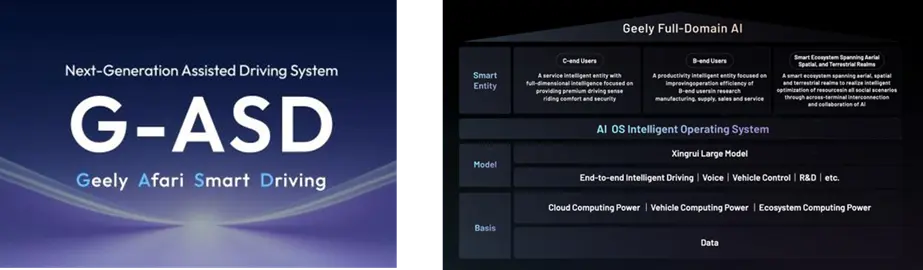
Geely Auto Group returned for the third consecutive year, unveiling two major innovations –Full-Domain AI 2.0 and G-ASD (Geely Afari Smart Driving) – to strengthen its leadership in intelligent mobility. Full-Domain AI 2.0 represents a major evolution from Geely’s earlier AI architecture, shifting from siloed, module-based intelligence to a unified, vehicle-wide AI system. By deeply integrating computing power, data and AI models, Geely has created a central “super AI brain” that enables real-time collaboration across cockpit, chassis, safety and driving domains. Complementing this, G-ASD marks a significant step toward high-level autonomous driving, combining advanced AI algorithms, large-scale real-world driving data, and high-performance sensing and computing hardware to improve safety and confidence in complex traffic scenarios. According to Geely CEO Jerry Gan and CTO Li Chuanhai, these technologies lay the foundation for future vehicles to evolve into emotionally aware, proactive, and continuously learning “super intelligent” mobility systems by 2030. This new-gen smart vehicle system will put Geely at the forefront of AI-based software defined vehicle, proving a strong competitor to BYD Auto, Tesla, Volkswagen and other pioneers in the segment.
• Leapmotor and Qualcomm debut world’s first automotive central computer powered by Snapdragon Cockpit Elite and Snapdragon Ride Elite platforms
At CES 2026, Leapmotor and Qualcomm unveiled the world’s first cross-domain integrated vehicle compute platform powered by dual Snapdragon Elite (SA8797P) chips, merging cockpit, ADAS, body and connectivity functions into one high-performance controller advancing centralized, software-defined vehicle design. The upcoming Leapmotor D19 will be the first car to use this setup, featuring Oryon CPU, Adreno GPU and Hexagon NPU for full-vehicle AI and personalized in-car experiences. The platform supports 8 high-res displays, 13 sensors (with LiDAR and radar) and over 30 ADAS functions, including Parking-to-Parking (P2P) autonomous driving. Built on a service-oriented architecture (SOA) with OTA, diagnostics and intelligent control, it cuts system cost and complexity while boosting performance.
• AUMOVIO focuses on UX + ADAS + SDV scale-up
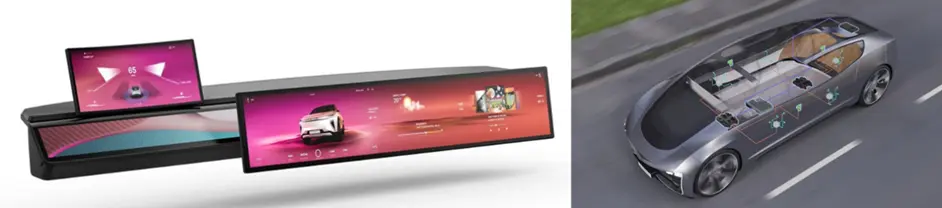
AUMOVIO (formerly the automotive group division of Continental) is looking to use its new independent identity to push harder on the three pillars of software-defined vehicles – UX, ADAS and scalable E/E architecture. On the HMI side, it previewed a “Personalized Cockpit” featuring multi-display customization, color ePaper, switchable privacy, and a camera integrated behind an OLED panel. On ADAS, Xelve spans L2-L4, with variants like Xelve Park, Xelve Drive, Xelve Pilot and the new Xelve Trailer (surround-view computer vision-based collision warning for trailer maneuvering). The deeper play is its Automotive Remote Control Network concept, framed as a standardized, scalable and cost-efficient vehicle architecture approach aimed at reducing wiring and hardware variants while shifting differentiation to software. For automakers, AUMOVIO’s CES tech is about cutting platform complexity so that vehicles can be differentiated and updated mainly through software, faster and at lower cost.
• Valeo unveils safety-enhancing advanced monitoring applications powered by Seeing Machines
Automotive tech company Valeo unveiled a suite of advanced monitoring and in-cabin safety applications developed in collaboration with Seeing Machines, a specialist in AI-driven vision and interior sensing. These systems combine Valeo’s full-stack vehicle integration capabilities with Seeing Machines’ interior perception software to create safety-enhancing technologies for automotives and two-wheelers. Seeing Machines will support Valeo by integrating its ICMS software, expanding classic driver-monitoring functions to include gaze tracking to determine whether the driver has identified a detected hazard, as well as helmet-wearing detection for two-wheelers. These capabilities will be deployed across three different SoCs, demonstrating multi-platform integration capabilities, which include Valeo Panovision heads-up display (featuring an adaptive warning system based on gaze tracking), Valeo Safe InSight (presenting a multi-layer approach to driver and interior monitoring) and SmartCluster helmet detection for two-wheelers (enabling the detection of helmet absence before the ride begins).

• Qualcomm, Google solidify partnership to power next-gen AI in SDVs
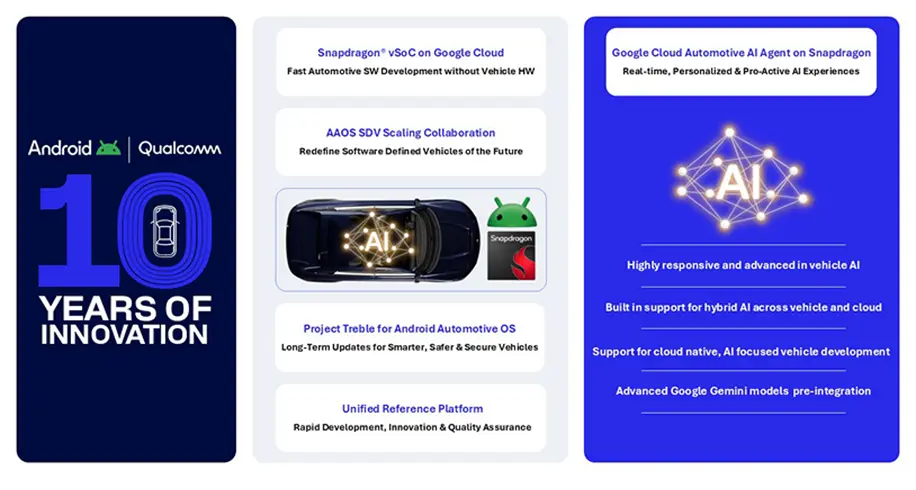
At CES 2026, Qualcomm and Google expanded their decade-long partnership to accelerate the development of SDVs by integrating the Snapdragon Digital Chassis with Google’s automotive software and Gemini AI models. A central feature of this collaboration is the shift toward “agentic AI”, which utilizes multimodal interfaces to create proactive in-car assistants capable of reasoning and executing complex tasks, such as adjusting vehicle settings based on driver gaze or managing multi-app workflows like restaurant bookings and navigation. To streamline manufacturing, the companies are establishing a unified reference platform (starting with Android 17) and introducing Snapdragon vSoC on Google Cloud, a virtual development environment that allows automakers to design and test software without physical hardware. Additionally, the partnership introduces Project Treble for Automotive, ensuring predictable software updates and a 10-year support window across multiple vehicle generations, with early adoption already seen in central computing systems from brands like Leapmotor.
• TomTom Orbis Maps to power CARIAD’s automated driving systems
At CES 2026, TomTom announced that Volkswagen Group’s software arm CARIAD will adopt TomTom Orbis Maps as a core component of its future automated driving systems across Volkswagen Group brands. The AI-native Orbis Maps for automated driving will act as a high-accuracy, real-time spatial layer that complements onboard sensors, enhancing safety-critical functions such as Intelligent Speed Assistance and hands-free driving with more human-like behaviour in complex traffic scenarios. TomTom’s real-time mapmaking platform combines vehicle sensor data, survey fleets and aerial sources to deliver detailed lane geometry and behavior data on a global, interoperable map standard, with minute-level updates and coverage in over 235 countries and territories. Executives from both companies emphasized that fresh, high-quality maps are foundational for safe, scalable automated driving (AD) and highlighted this deal as proof of TomTom’s technical strength and deep collaboration with CARIAD to meet Volkswagen Group’s evolving AD needs.

• Arbe combines market-leading radar solution with powerful NVIDIA AI computing, creating advanced platform for AI-based driving
Arbe Robotics is showcasing its automotive-grade ultra-high-definition radar system at CES 2026, marking its first major public demonstration of the platform integrated with full perception stacks. The advanced radar generates a raw point cloud with over 20,000 detections per frame from a 2,304-channel array, enabling rich data for AI-based perception that can support hands-off and eyes-off driving at highway speeds by detecting objects beyond 300 m. At the show, Arbe is demonstrating its radar in live demos, including an AI-based occupancy grid developed with Perciv AI, LiDAR-like performance use cases, and integration with NVIDIA’s DRIVE AGX Orin computing platform, highlighting consistent performance even in challenging weather and low-visibility conditions. The collaboration with NVIDIA aims to create a new benchmark for autonomous perception and accelerate the adoption of safer, cost-effective autonomous driving solutions for automakers worldwide.