Qualcomm Unveils Data Center Roadmap At Investor Day 2026
At its Investor Day earlier this week, Qualcomm provided an update of its Dragonfly-branded data center product roadmap. The Dragonfly brand covers data center CPUs, AI accelerators and custom silicon.
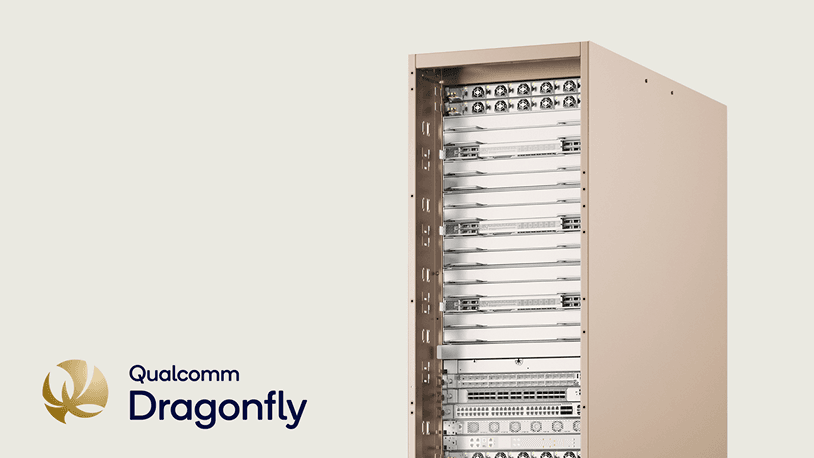
Dragonfly C1000 - a 250-core server CPU built on the Oryon architecture, operating at frequencies above 5GHz and with PCIe Gen 7, CXL support and full enterprise RAS capabilities. Expected to ship in H2 2028. The target workload is agentic AI orchestration: high-throughput sequential reasoning and context switching at scale, workloads that GPUs handle poorly and fast CPUs handle well.
Meta confirmed that it had signed a multi-generation agreement to deploy the C1000 in its server infrastructure.
Custom Silicon – will offer performance-optimized silicon, end-to-end design capabilities, advanced packaging solutions, a proven IP stack and full execution including design and high-volume production. Qualcomm confirmed contracts in excess of $1 billion apiece from two hyperscalers for its custom silicon products, with delivery expected to start in late 2026.
Modular Acquisition - by acquiring Modular, Qualcomm is buying an established, AI-native software ecosystem. Modular’s flagship products - the MAX inference engine and the Mojo programming language—allow developers to write AI inference code once and run it completely optimized across various hardware layers (CPUs, GPUs, NPUs, and ASICs) without having to rewrite a single line of code.
Qualcomm claims that using the Modular stack enables its Dragonfly hardware to achieve inference performance on par with NVIDIA’s CUDA, neutralizing the heavy switching costs that usually force cloud vendors to stick with NVIDIA.
Rackscale Systems – Qualcomm is entering the data center market in phases. It is shipping the AI200 in late 2026 to get a foot in the door and to demonstrate that its software works but the complete, proprietary, full-stack ecosystem will not ship in volume until 2028. Qualcomm provided brief updates of its AI200, AI250 and AI300 product range as follows:
- AI200 – is actively sampling and remains firmly on track for initial customer deployments in H2 2026. Major win with Saudi Arabia’s AI firm Humain, which has committed to building out a 200MW data center all powered by Qualcomm's AI infrastructure.
Qualcomm is heavily focused on inference efficiency (tokens-per dollar and token-per-Watt) rather than raw, brute force LLM training and the company highlighted that the AI200 is built to slash the TCO per million tokens compared to standard GPU-based inference stacks. It uses standard LPDDR5X memory, which does not require any new advanced manufacturing methods as the supply chain for LPDDR5X is mature and readily available. - AI250 - commercial sampling in mid-2027. The AI250 rack marks the debut of Qualcomm’s HBC Gen 1 technology. While it maintains the same 43 TB capacity as the AI200, the 3D-stacked near-memory architecture boosts effective memory bandwidth by 18x per card over the AI200. This translates to a massive 7.4 PB/s of effective memory bandwidth per rack. It also offers a 5x improvement in bandwidth-per-watt.
- AI300 - officially launched at the event, with commercial sampling expected in 2028. This is the flagship third-generation platform with 3D-stacked HBC Gen 2 memory technology integrated with the Dragonfly C1000 CPU. The AI300 is designed to deliver a staggering 54x increase in effective memory bandwidth compared to the baseline AI200. Qualcomm notes that the AI300 system is expected to deliver 4-8x better performance-per-watt on memory bandwidth than current GPU-based data center architectures. For the AI300 generation, Qualcomm is adopting scale-up protocols UALink and E-SUN alongside advanced 1.6T and 3.2T optical/copper networking to allow seamless cross-rack scaling.
Analyst Viewpoint
Following a number of high-profile acquisitions over the past few months, Qualcomm has proved that is has the IP to build incredible, efficient silicon. However, its roadmap requires the company to execute perfectly over the next few years if it is to reach the $15 billion target in data center revenues by FY2029, up from $5 billion in 2027 and just $300 million in 2026.
While it has pre-booked revenues on the back of its custom silicon design wins, immediate rollouts of AI200 rackscale systems and its deep partnerships with Meta and Microsoft, reaching the full $15 billion revenue target requires perfect execution of its plans for Modular and successful manufacture of its 3D stacked LPDDR-based HBC technology at extreme scale.
Counterpoint Research believes that Qualcomm is banking heavily on China to achieve its revenue targets. As Qualcomm already has deep, localized supply chain trust with Chinese OEMs for mobile, it can navigate the geopolitical friction far better than data center pure-plays such as NVIDIA. In fact, Qualcomm is introducing all four Dragonfly product lines - the C1000 CPUs, the AI rackscale systems (AI200/250/300), the High Bandwidth Compute (HBC) memory tech and connectivity products to China via versions engineered from day one to stay strictly beneath the US government's performance-density thresholds.
Post event, Qualcomm announced that ByteDance will be purchasing large volumes of Qualcomm's off-the-shelf, export-compliant Dragonfly ASICs for its generative AI workloads. ByteDance has also hired Qualcomm’s custom silicon division to help co-design and bring ByteDance’s own proprietary, internally designed data center chip to volume production.
Cloud AI Server Analysis Service
The above 2-page report is part of Counterpoint Research’s Cloud AI Server Analysis Service, which tracks, forecasts and analyses key components of AI servers and racks as follows:
- ASIC & Custom Silicon Tracker – tracks the shift away from standard merchant GPUs (like Nvidia's) towards custom cloud chips. Includes shipments of Google’s TPUs, Amazon’s Trainium/Inferentia, Meta’s MTIA and Microsoft’s Maia chips.
- High Bandwidth Memory (HBM) Forecasts - tracks memory density and generational transitions, such as the shift to HBM3E and HBM4.
- Networking Components – provides qualitative and quantitative information, including forecasts, of key networking components such as switches, pluggable transceivers, CPO, NPO LPO, etc. and other data center networking components.
- Hyperscaler & ODM Dynamics - market share by CSPs such as AWS, Microsoft, Google, Meta and ODMs such as Foxconn, Quanta and Wistron building direct-to-cloud servers.
- Foundry and Node Tracking - maps out which chips built on advanced nodes (e.g., TSMC's 3nm/5nm) and tracks packaging constraints like CoWoS (Chip-on-Wafer-on-Substrate).
Category
Industry
AI, Semiconductors
Service
Standard
Report Type
Report
Time Period
Other
Receive our insightful weekly newsletter and stay ahead of the competition.
Author
Gareth Owen
Gareth has been a technology analyst for over 20 years and has compiled research reports and market share/forecast studies on a range of topics, including wireless technologies, AI & computing, automotive, smartphone hardware, sensors and semiconductors, digital broadcasting and satellite communications.